
TI Museum
TI-2500 V0 (white) datamath
Audio Guide

|
|

|
|
.jpg) Model: TI-2500 V0 (white) datamath
Model: TI-2500 V0 (white) datamath
Battery: 6 x AA ni-cd internal
Adapter: AC9100
Year: 1972 S/N: D0000 - 00599
Chip: TMS0110
Info: The famous TI-2500 Datamath calculator was first announced in April 1972 with a suggested retail price (SRP) of $149.95. Beginning June 1972 first customers received in the Neiman-Marcus and Sanger-Harris department stores in Dallas, TX their calculators before the formally introduction on September 21, 1972.
.jpg)
.jpg)
.jpg)
Special thanks to Alexandru Balasa for the donation
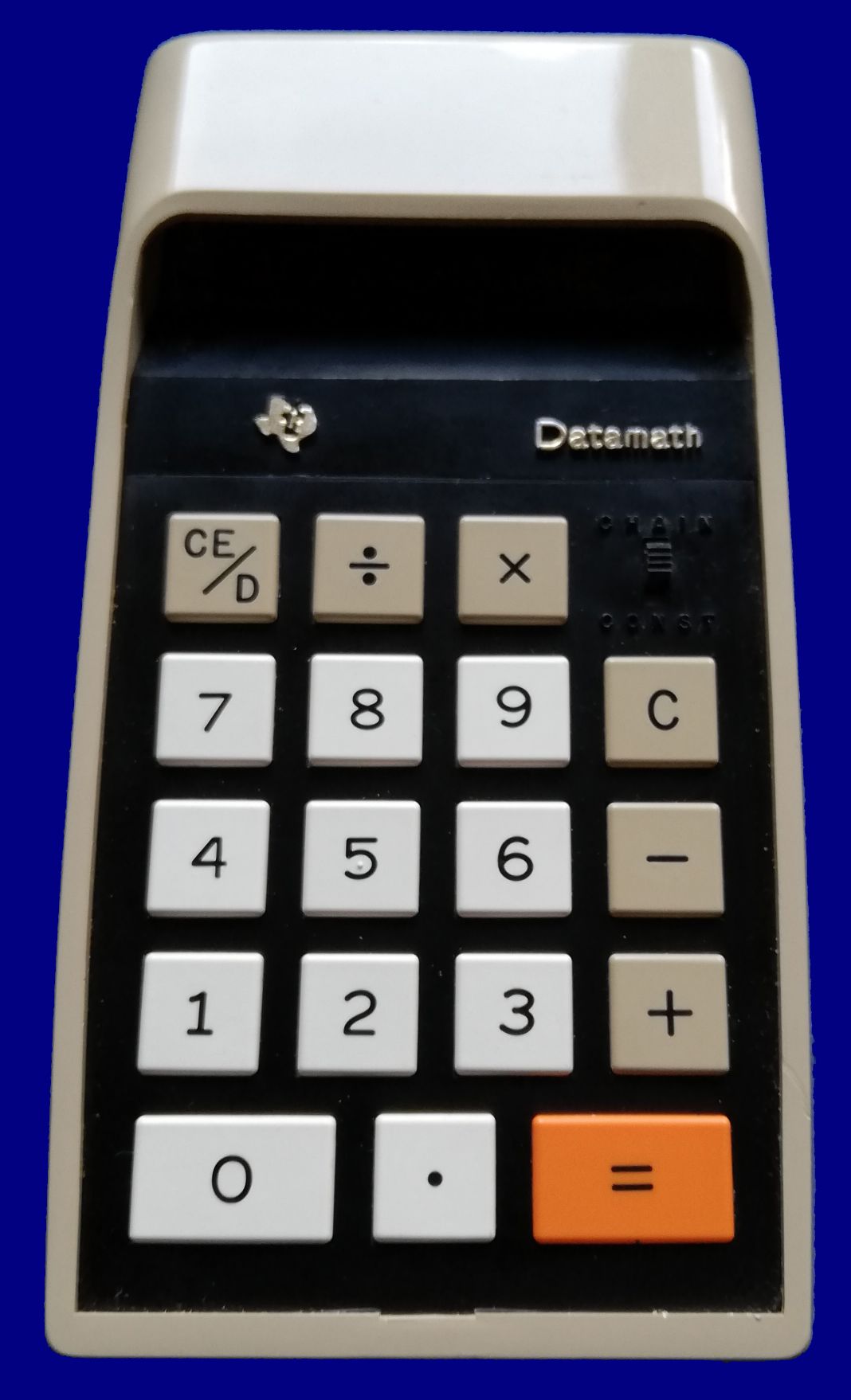 Model: TI-2500 datamath
Battery: 6 x AA ni-cd internal
Adapter: AC9100
Year: 1972
Chip: TMS0119
Info: 1 version
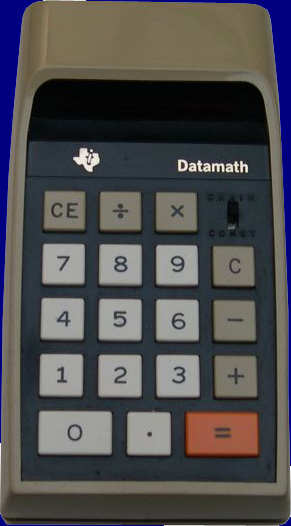 Model: TI-2500
Battery: 6 x AA ni-cd internal
Adapter: AC9100
Year: 1972
Chip: TMS0119
Info: 2 version
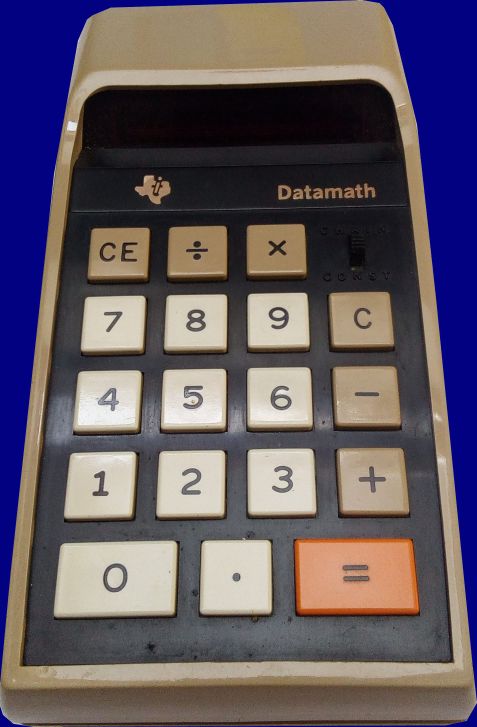 Model: TI-2500 B
Battery: 6 x AA ni-cd internal
Adapter: AC9100
Year: 1972
Chip: TMS083
Info:
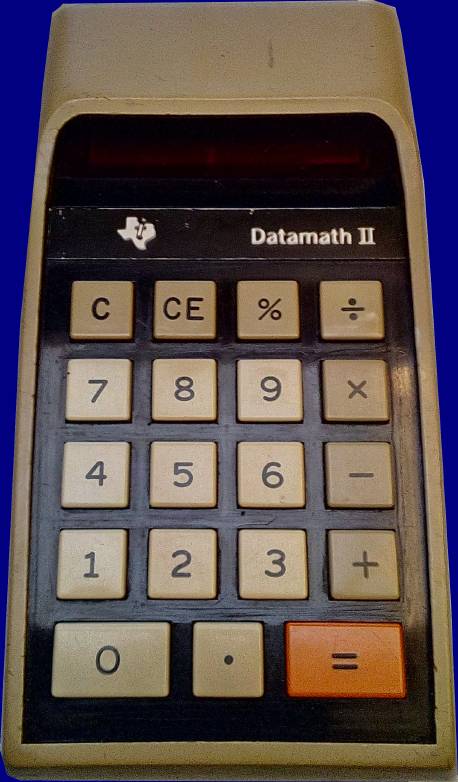 Model: TI-2500 II
Battery: 6 x AA ni-cd internal
Adapter: AC9100
Year: 1972
Chip: TMS083
Info:
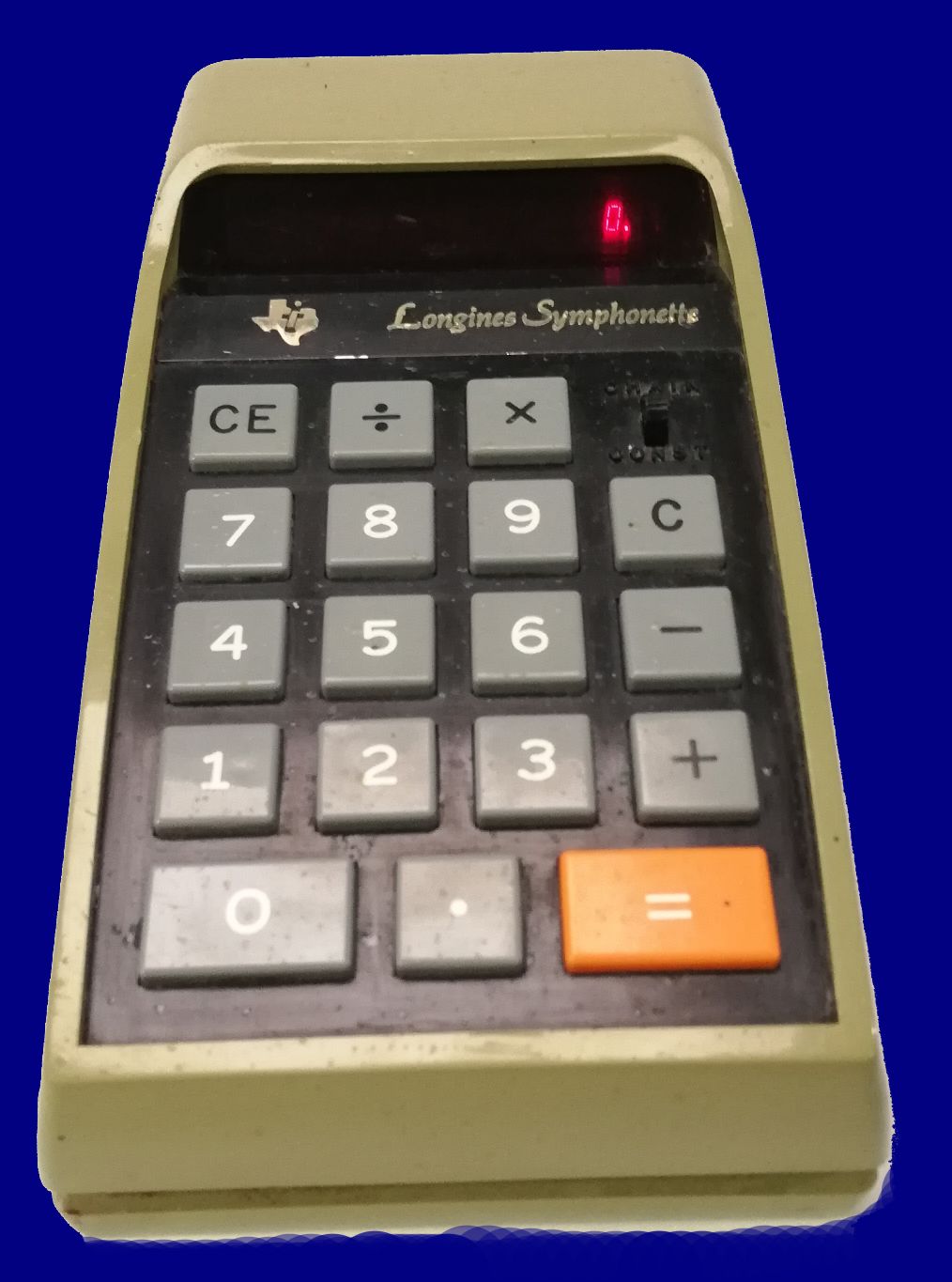 Model: TI-2500 Longines Symphonette
Battery: 6 x AA ni-cd internal
Adapter: AC9100
Year: 1972
Chip: TMS0119
Info: This calculator sold by Longines Symphonette could be easily recognized as a Texas Instruments Datamath calculator. It followed the Electronic Calculator introduced few month earlier. The main differences between the original and the badged calculators are the olive-green colour of the housing, the grey keys and the Longines Symphonette label.
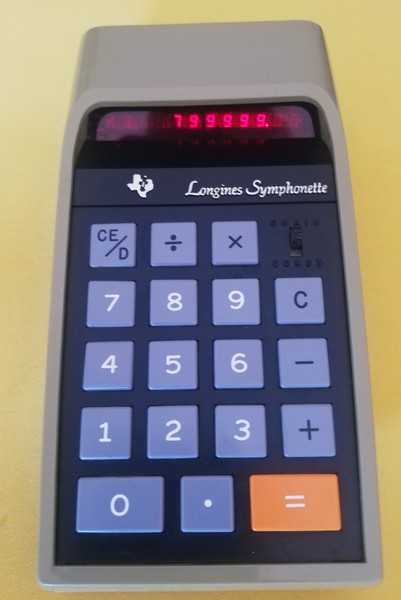 Model: TI-2500 Longines Symphonette 1 version
Battery: 6 x AA ni-cd internal
Adapter: AC9100
Year: 1972
Chip: TMS0119
Info: This calculator sold by Longines Symphonette could be easily recognized as a Texas Instruments Datamath calculator. It followed the Electronic Calculator ioduced few month earlier. The main differences between the original and the badged calculators are the olive-green color of the housing, the grey keys and the Longines Symphonette.
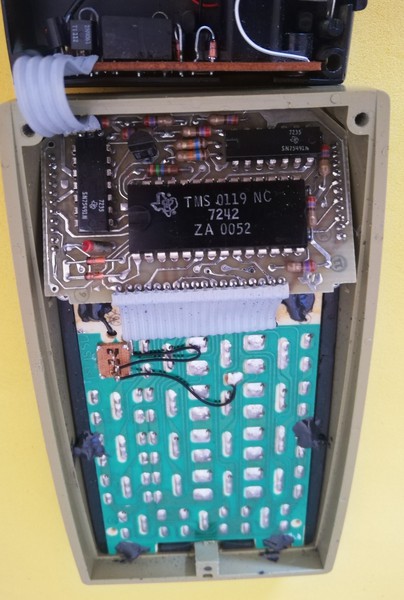
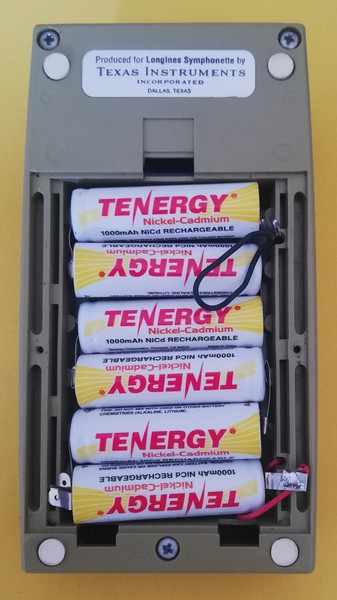
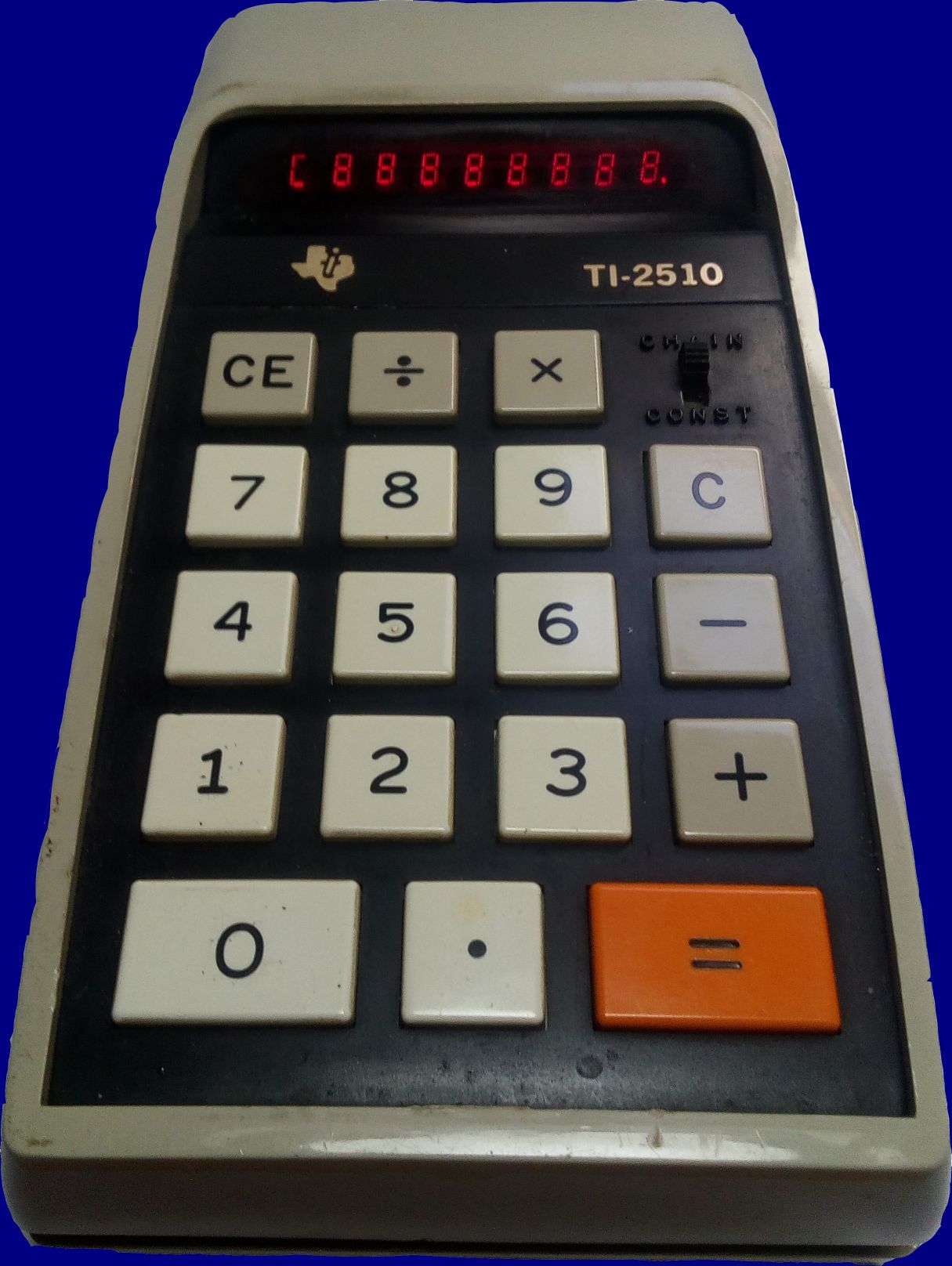 Model: TI-2510
Battery: 4 x AA ni-cd internal
Adapter: AC9120
Year: 1975
Chip: TMS0119
Info:
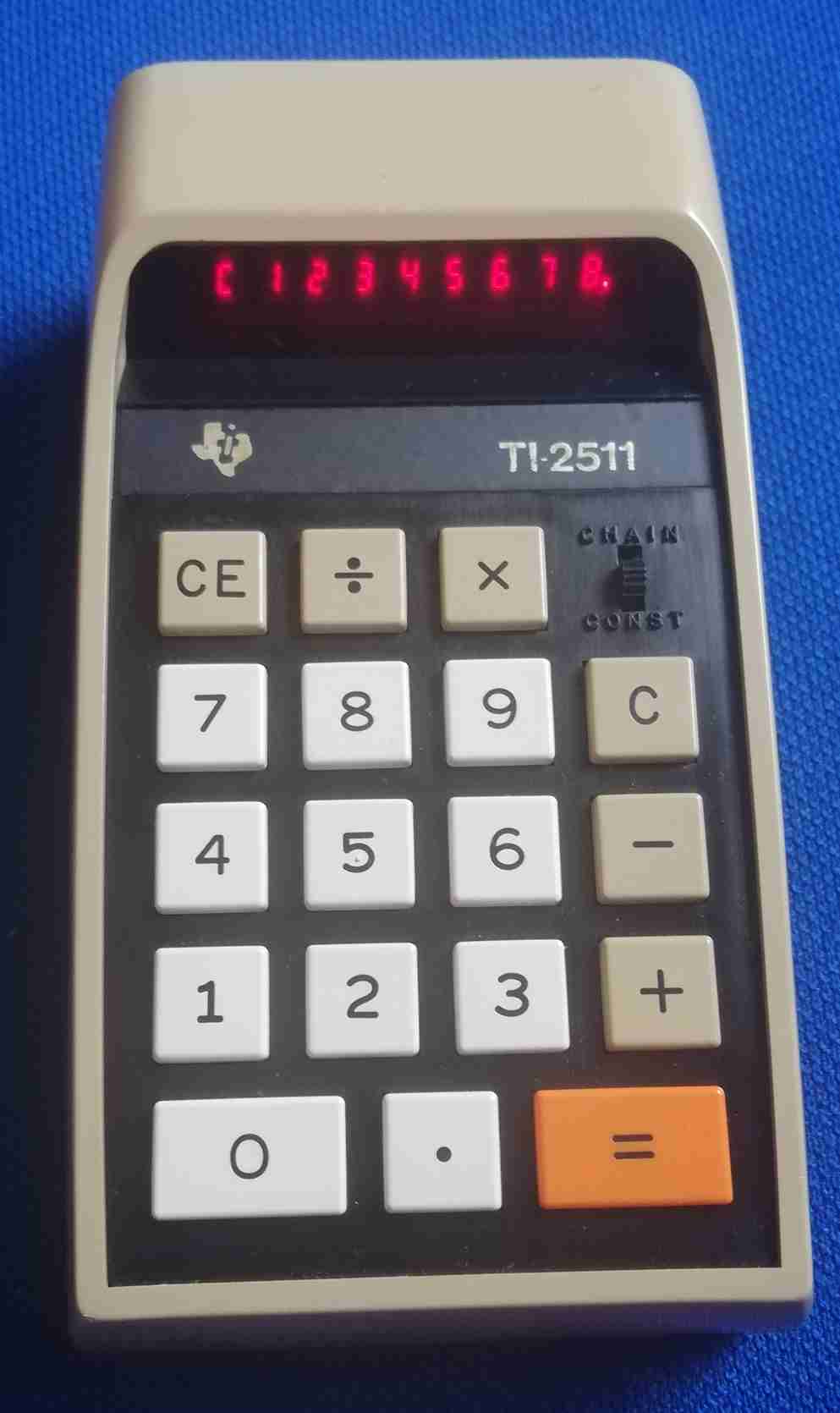 Model: TI-2511
Battery: 4 x AA alkaline
Adapter: AC9900/e
Year: 1974
Chip: TMS0119
Info: 1 version
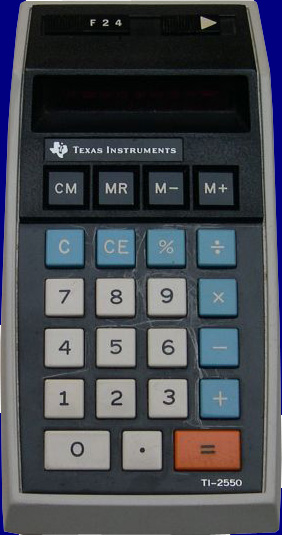 Model: TI-2550
Battery: 3*AA NiCd or 4*AA Alkaline
Adapter: AC9130 or AC9120
Year: 1974
Chip: TMS0601
Info: Released one year after the legendary TI-2500, the first with a lens display (like bubbles)
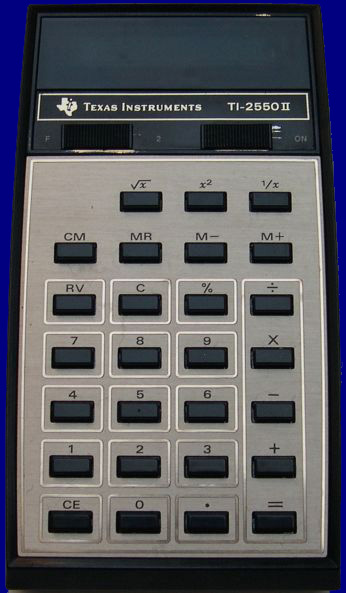 Model: TI-2550 II
Battery: 2 AA or BP2
Adapter:
Year: 1976
Chip: TMS1071
Info:
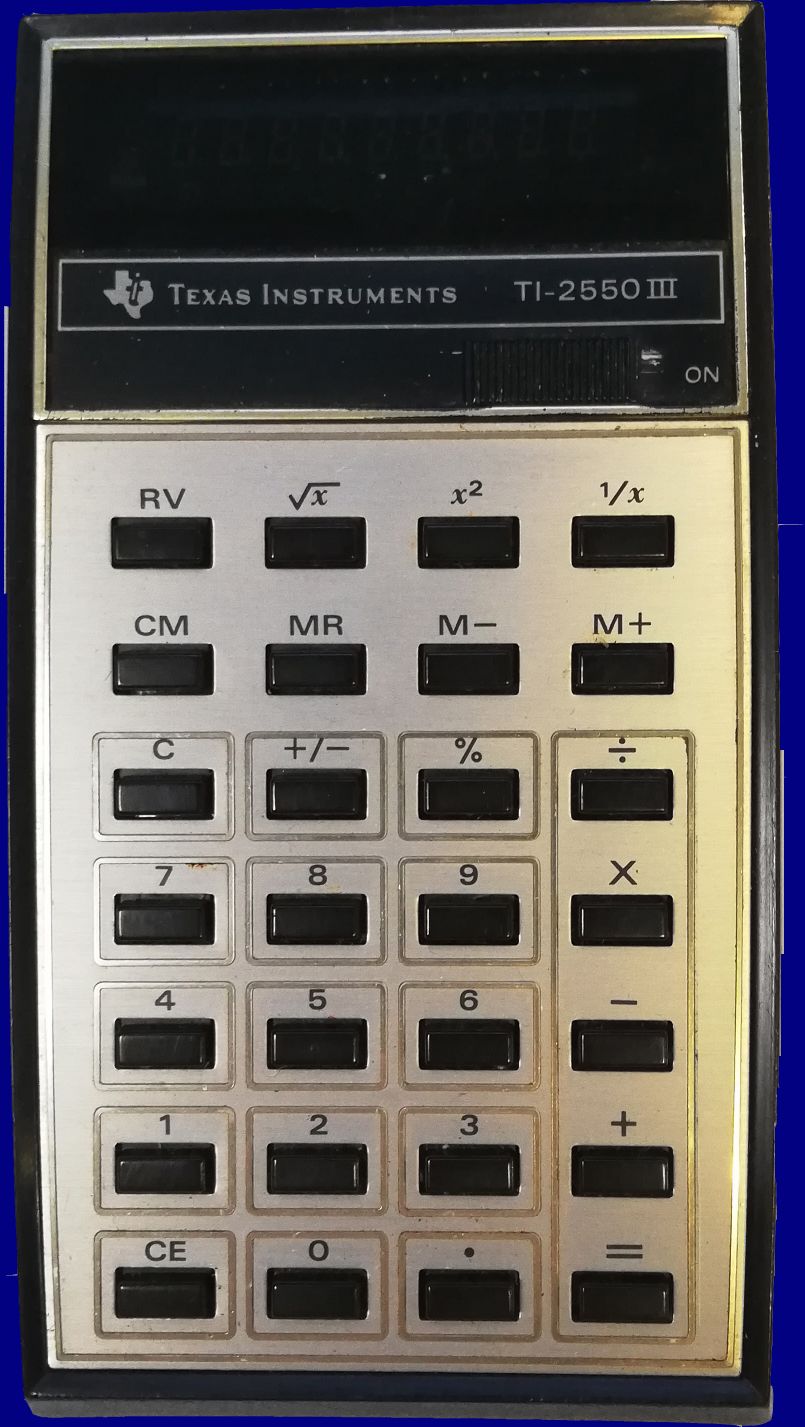 Model: TI-2550 III
Battery: BP3
Adapter: AC9130A
Year: 1976
Chip: TMS1043
Info:
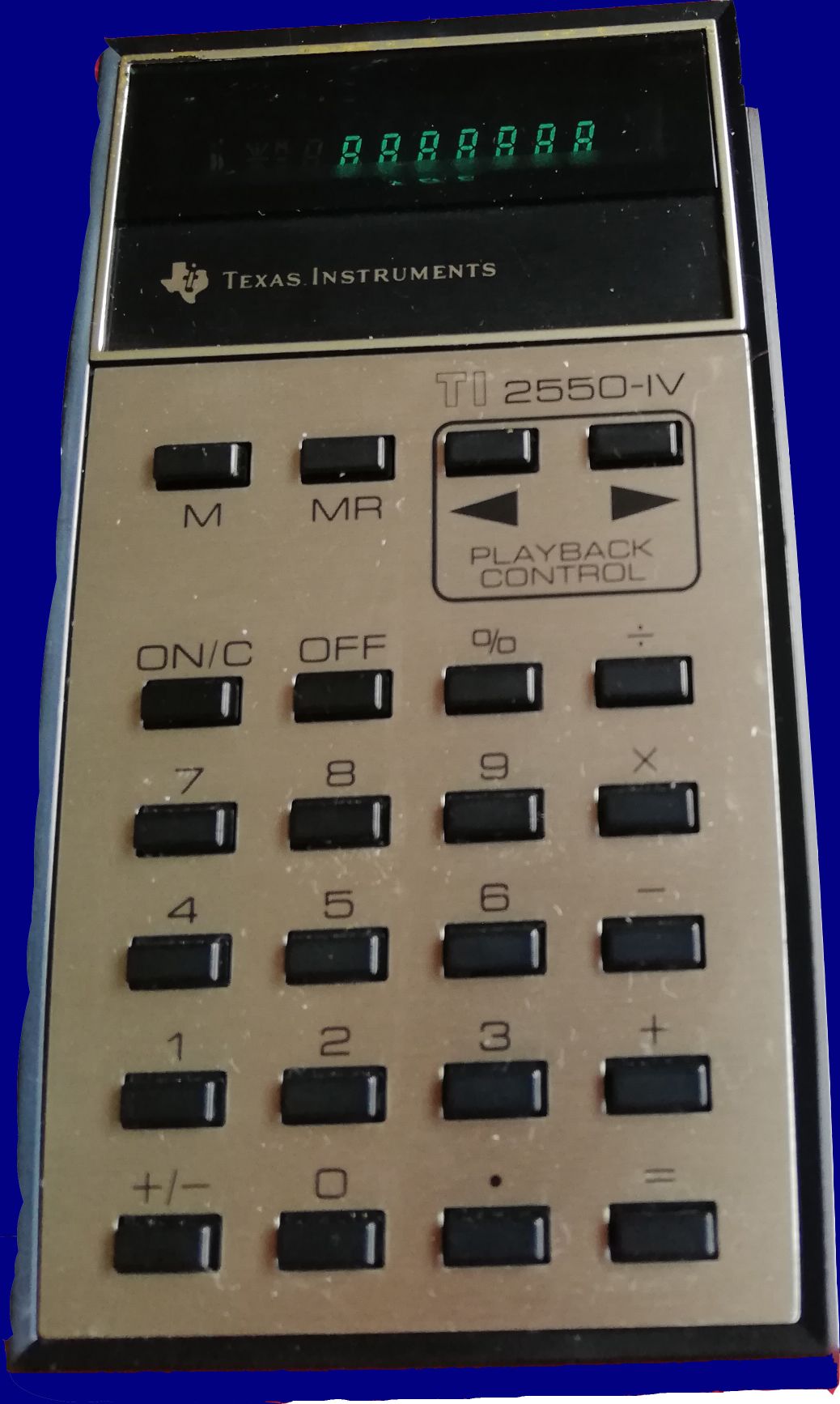 Model: TI-2550 IV
Battery: BP4
Adapter: AC9900/H
Year: 1979
Chip: TMC1981,TMC0999
Info:
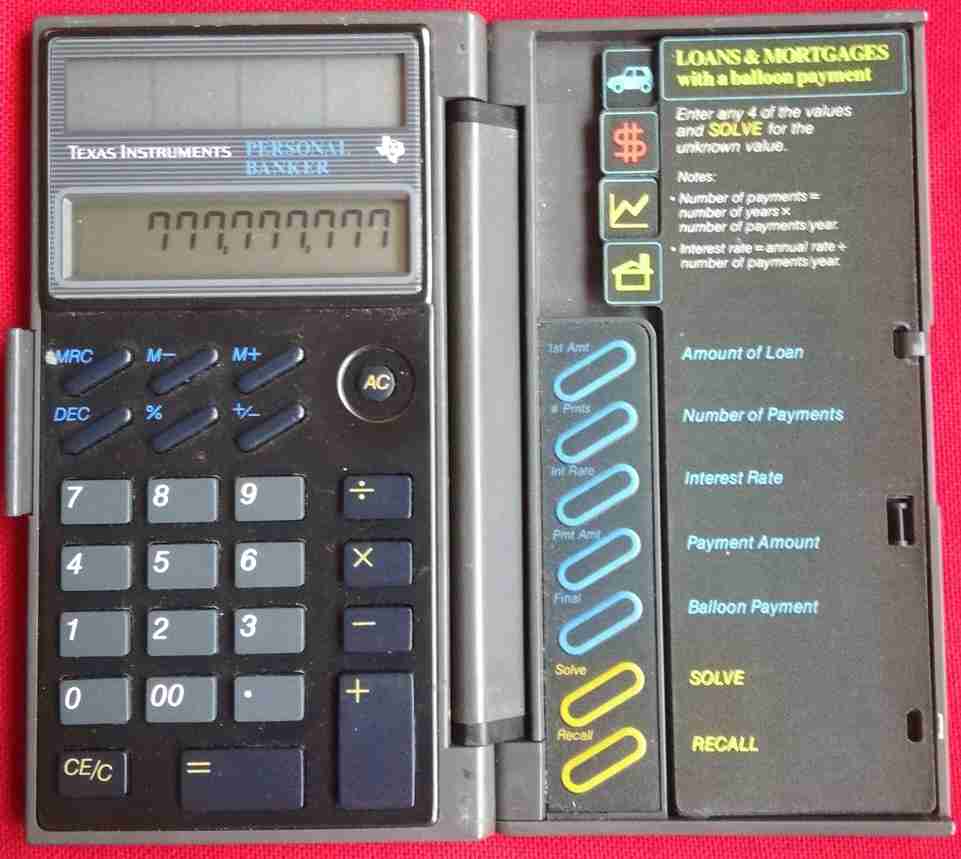 Model: TI-2600 personal banker
Battery: solar
Adapter:
Year: 1987
Chip: Toshiba
Info:
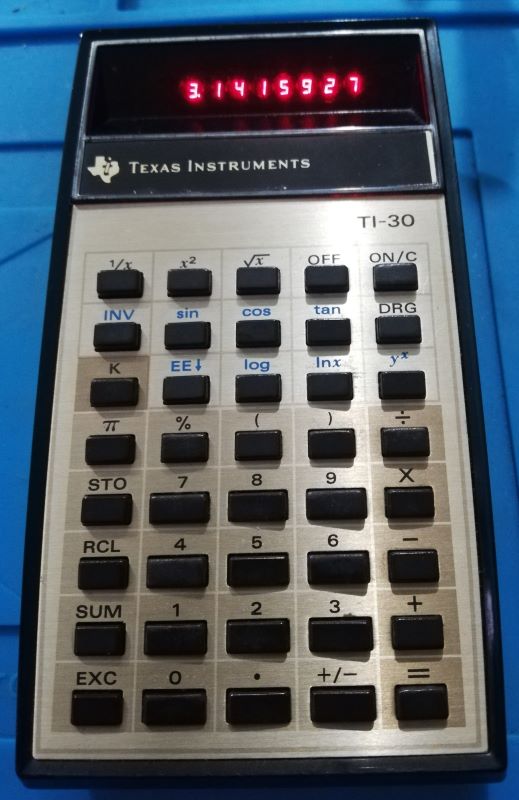
Model: TI-30 LED
Battery: 9 volt or RK2
Adapter: AC9132 or AC9182
Year: 1976 Price: Lire 19.000 + 14 % iva
Chip: TMC0981
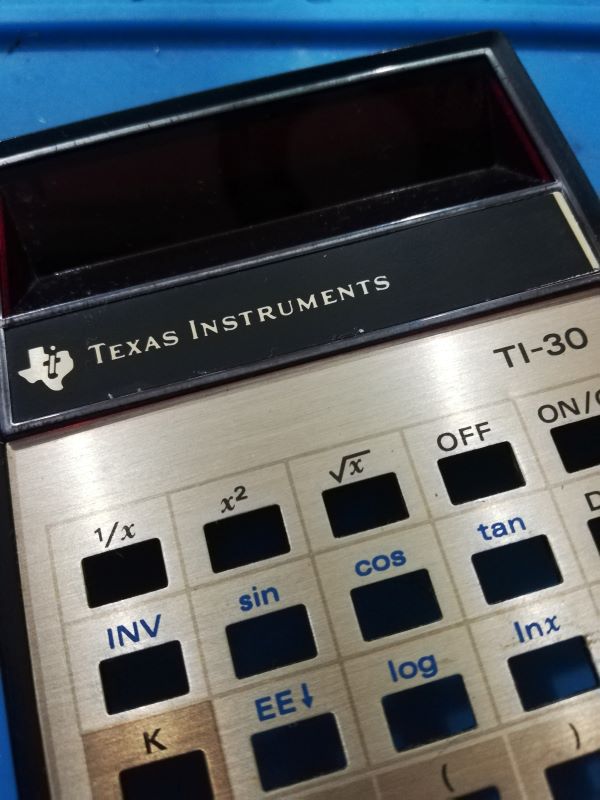
Info:This Italian-made TI-30 (4376 RCI, November 1976) looks different from the original TI-30. Instead of the usually printed TI logo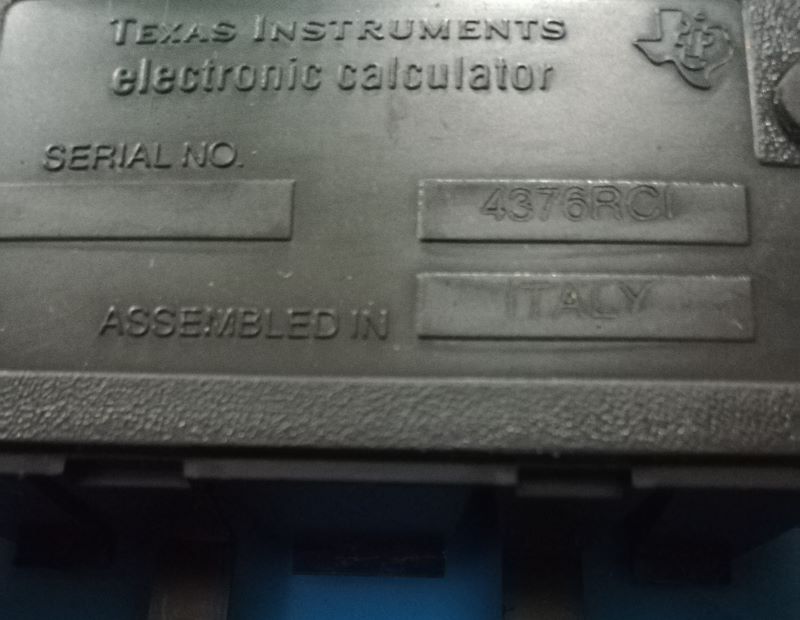 and the TEXAS INSTRUMENTS nameplate, this one uses only a sticker, a metal plate with a black background and gold-colored writing, like other calculators made in Europe, TI-45, TI-57, Privileg SR-35NC, but also a calculator sold by Radio Shack in the United States, the Radio Shack EC-4000. Later, during production, the metal plate was replaced to adapt it to the US design. We are particularly fond of this one, as we have been looking for one for many years and finally found two in one week (2023).
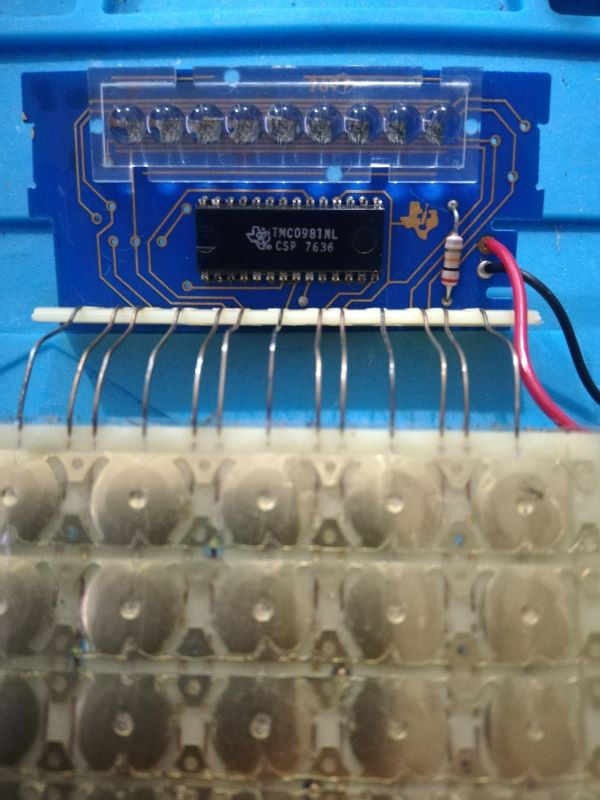
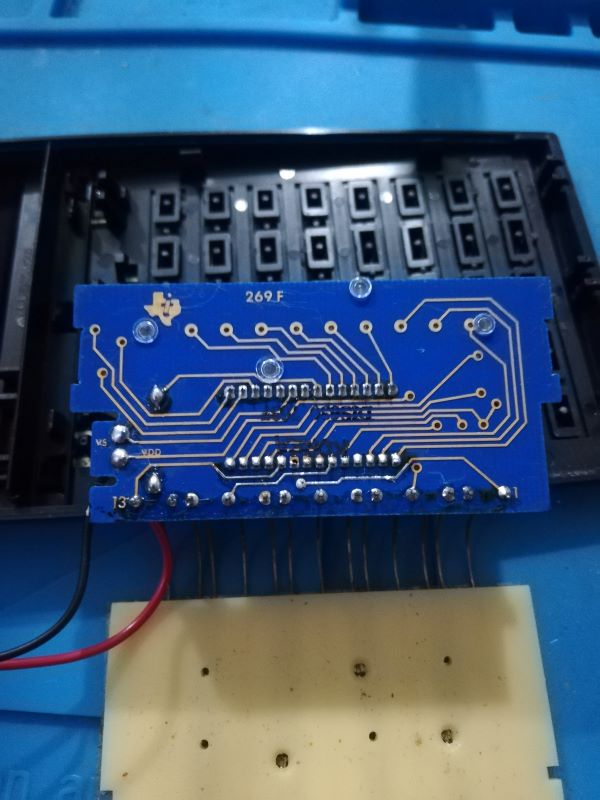
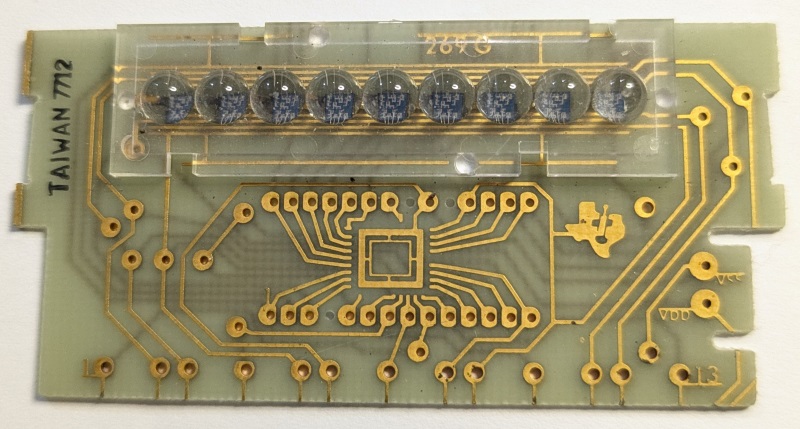 Here's a nice display for the famous TI-30 LED. They could have inserted a small wafer into this PCB and then covered it with resin or soldered the integrated circuit, the TMC0981.

 Model: TI-30 clear case
Battery: 2 x LR44
Adapter: no
Year: 1986
Chip: TP0456/CD4565
Info:In particular, the writing is in orange, as are the keys and the battery cover of the same color, made in Italy (Rieti).
I have to thank Gaetano Perrella, former employee of Texas Instruments in Rieti for the donation!
Why were transparent shells made? Transparent shells helped visually where the CAD of the time was not enough, in this way further mechanical modifications could be made! (info Domenico Calì , former Texas Instruments employee).The transparent shells helped visually where the CAD of the time was not sufficient, in this way further mechanical modifications could be made! info Domenico Calì (ex Texas Instruments employee)
Another particular reason for the transparent case was to follow the behavior of the flexible PCB combined with the rubber keyboard, elements introduced for the first time at TI by us in Rieti. Info Gaetano Perrella (ex Texas Instruments employee)
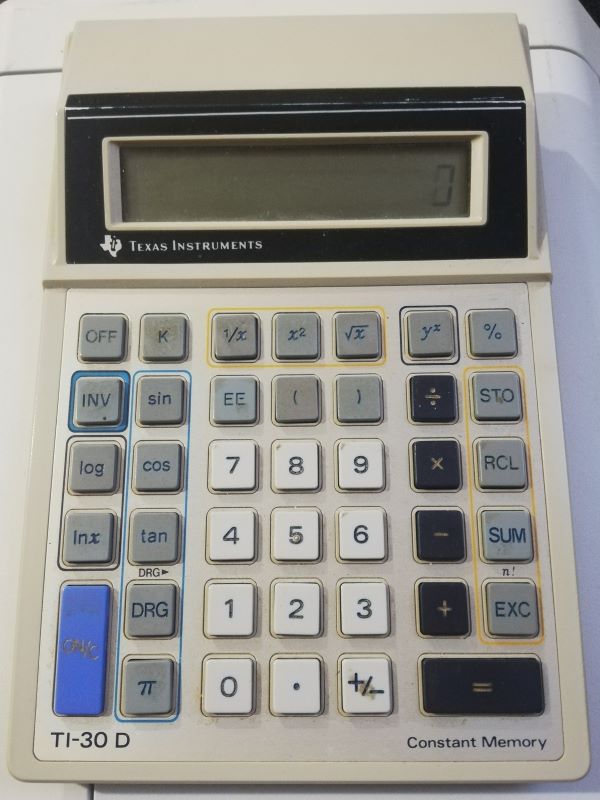 Model: TI-30 D
Battery: 2 x AA
Adapter:
Year: 1982
Chip: TP0456 (CD4565)
Info: I must thank the family of Massimo Di Pietro, former Texas Instruments employee of the Cittaducale (Rieti) office, in particular his daughter Francesca and her husband Antonio who donated many databooks, calculators and personal paper material of their father Massimo to our ODV. A thousand thanks
 Model: TI-30 galaxy
Battery: LR44
Adapter:
Year: 1985
Chip: Toshiba T6975S
Info: Thanks to my friend Paolo Maistrello who sent me this calculator donated by Giovanni Flammini.
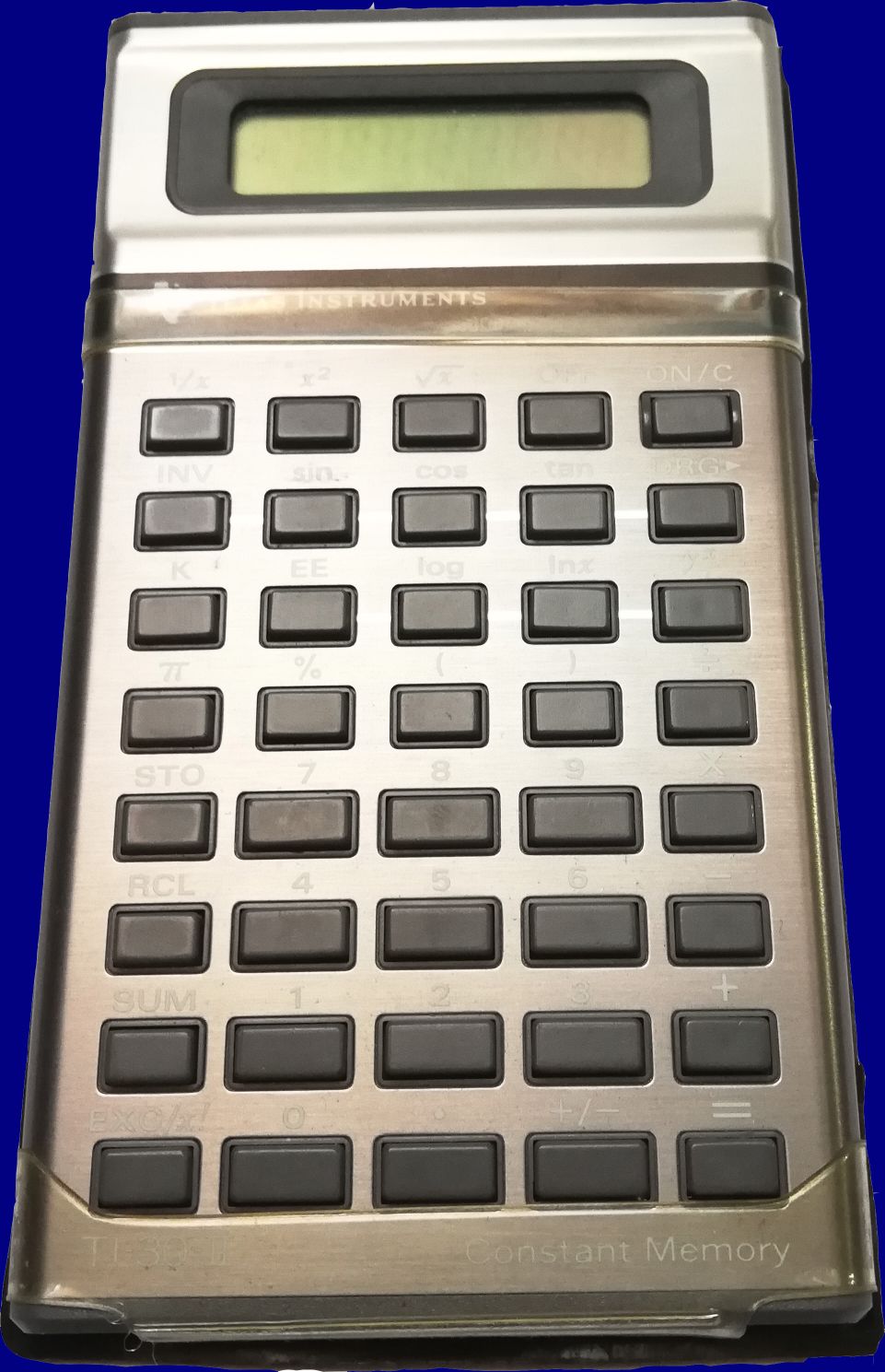 Model: TI-30 II
Battery: 2 x LR44
Adapter:
Year: 1983
Chip: CD4565
Info: first LCD and slimline LCD
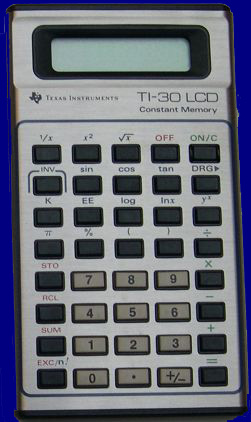 Model: TI-30 lcd
Battery: 2 x AA
Adapter:
Year: 1980
Chip: TP0320-4 or CD3202
Info: first LCD and slimline LCD
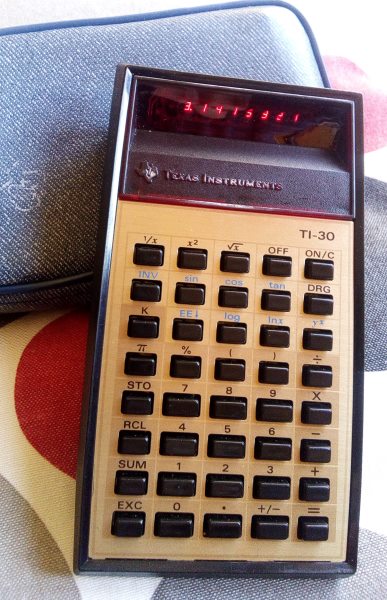 Model: TI-30 LED
Battery: 9 volt or RK2
Adapter: AC9132 or AC9182
Year: 1976 Price: Lire 19.000 + 14 % iva
Chip: TMC0981
Info: In the photo below, the test calculator used in the Rieti plant to test the TMC0981 chips. From an advertisement of the time! The most Famous. The TI-30 scientific calculator is more famous because it is the best-selling in the world (10 million units). In fact, no other calculator, at the same price, can give you the same performance at the same quality level. With the TI-30 you have the 8-digit display. The AOS (algebraic operating system) to set the expressions in the same sequence in which you write them, 15 levels of parentheses, memory, trigonometric functions, plus with the security of TI assistance even after a one year warranty!
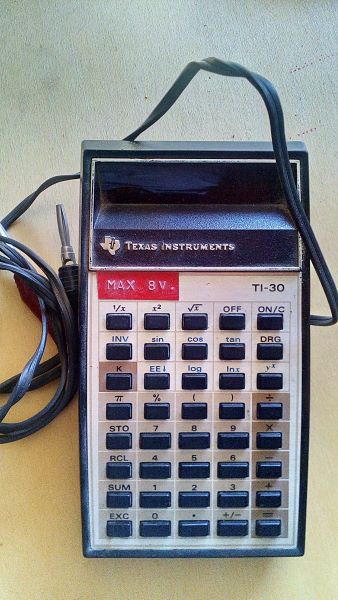
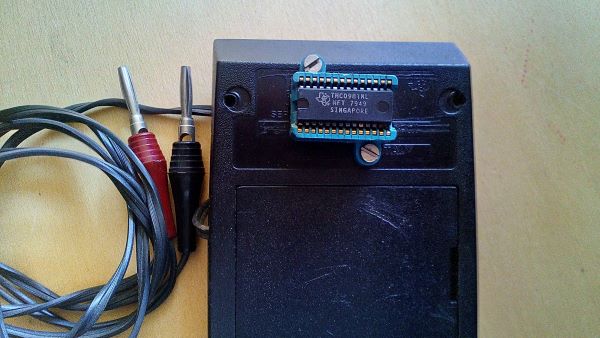 Here's a nice display for the famous TI-30 LED. They could have inserted a small wafer into this PCB and then covered it with resin or soldered the integrated circuit, the TMC0981.
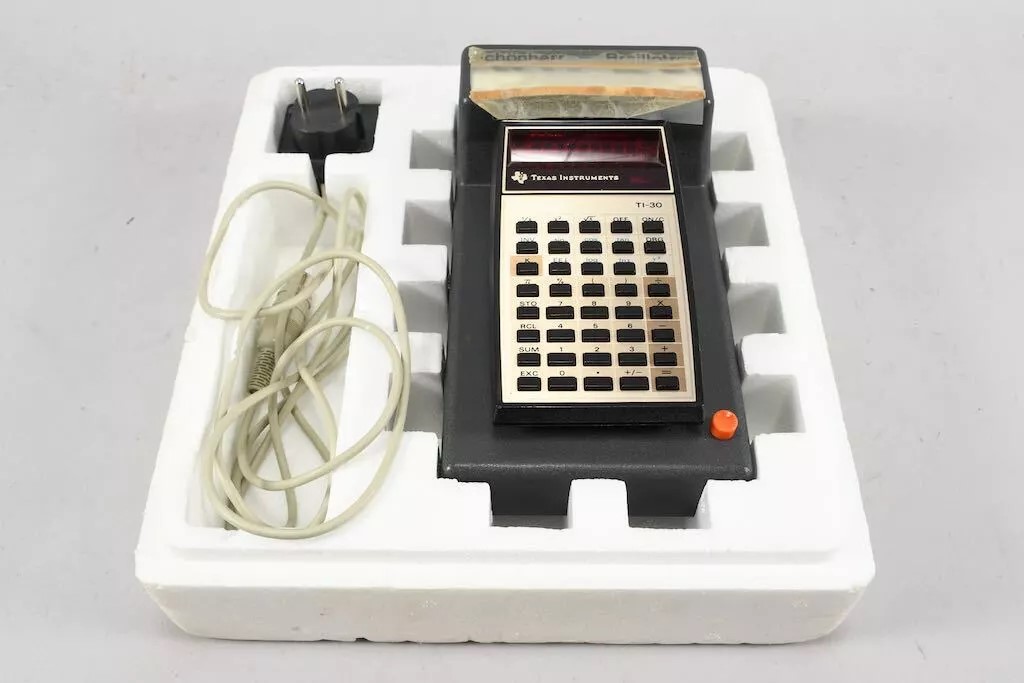 Model: TI-30 Braillotron
Battery: ni-cd
Adapter: yes
Year: 1980
Chip: TMC0981
Info:The TI-30 was introduced mid of 1976 and found soon its way to the vision impaired people. The German company Schoenherr developed already in 1975 a refreshable Braille display and introduced in 1978 this Braillotron. Since 1994 the company Schoenherr GmbH refirmed as EHG Handy Tech Elektronik GmbH and introduced in 1985 with the Galixa Speech a scientific calculator with natural voice speech output and later the Galixa Braille a scientific calculator with speech output and a 10-cell braille display. This Schoenherr Braillotron was manufactured till 1985. Another approach to solve the communication with vison impaired people could be found in talking calculators like the TSI speech+ and the Orbit TI-34.


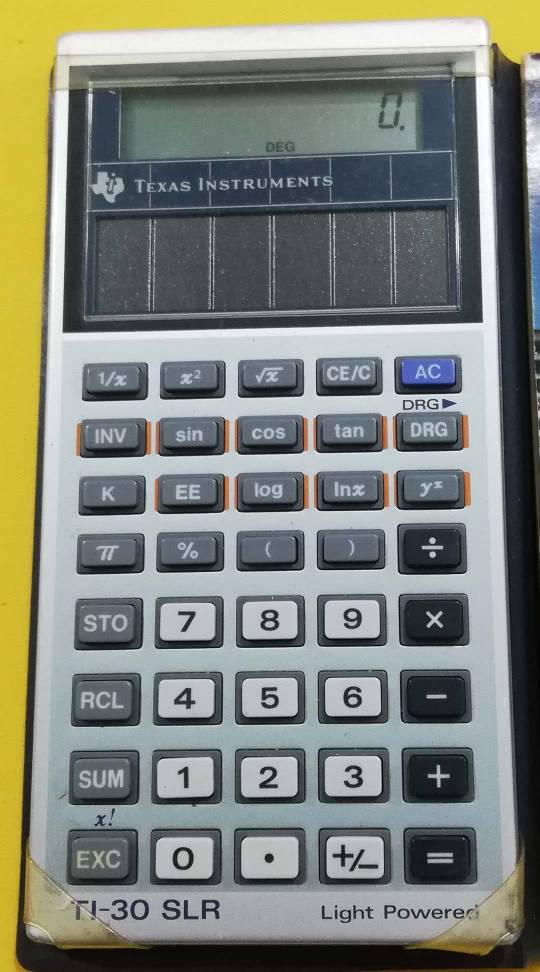 Model: TI-30 slr
Battery: solar
Adapter:
Year: 1984
Chip: Toshiba T6974S
Info:
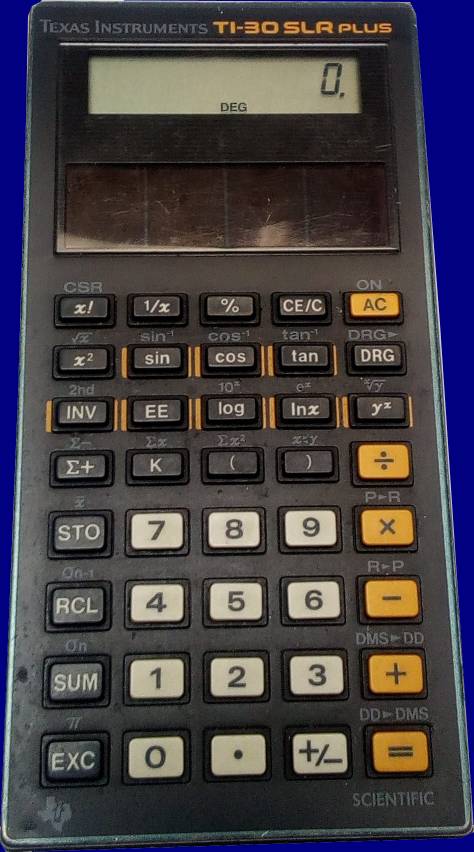 Model: TI-30 solar plus
Battery: solar
Adapter:
Year: 1987
Chip: T6974s Toshiba
Info: modern LCD 1982 - 1987
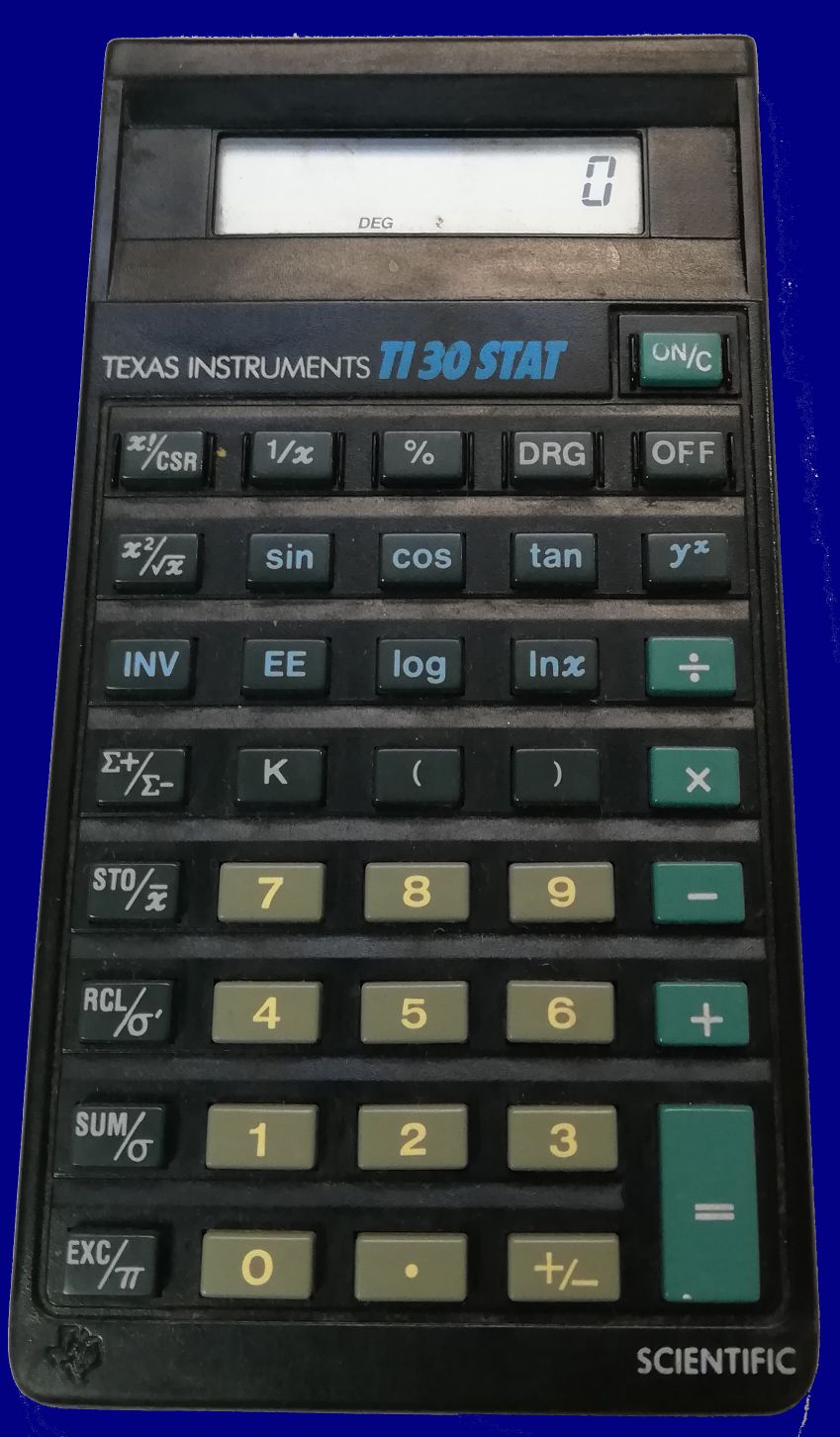 Model: TI-30 stat
Battery: 3 x LR44
Adapter:
Year: 1985
Chip: CD4557A
Info: modern LCD 1982 - 1987
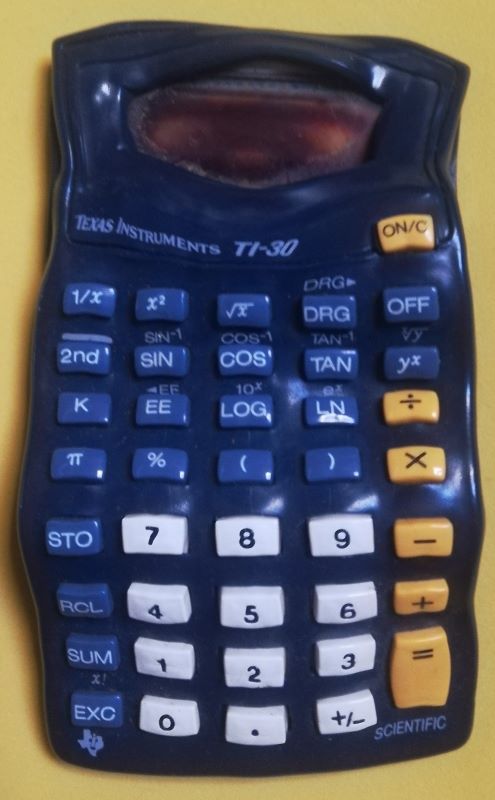
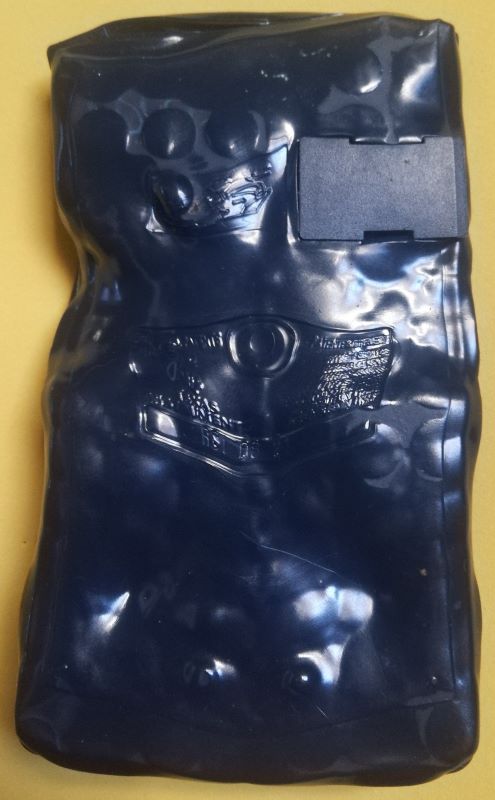 Model: TI-30 test
Battery: 2 x LR44
Adapter:
Year: 1985
Chip: CPU: Toshiba T9948A
Info: Calculator donated by Massa Gennaro in 2023 during the 2nd edition "the story with Texas Instruments" in Rieti, (World Chili Pepper Fair). This rare calculator is a proof test for plastic material.
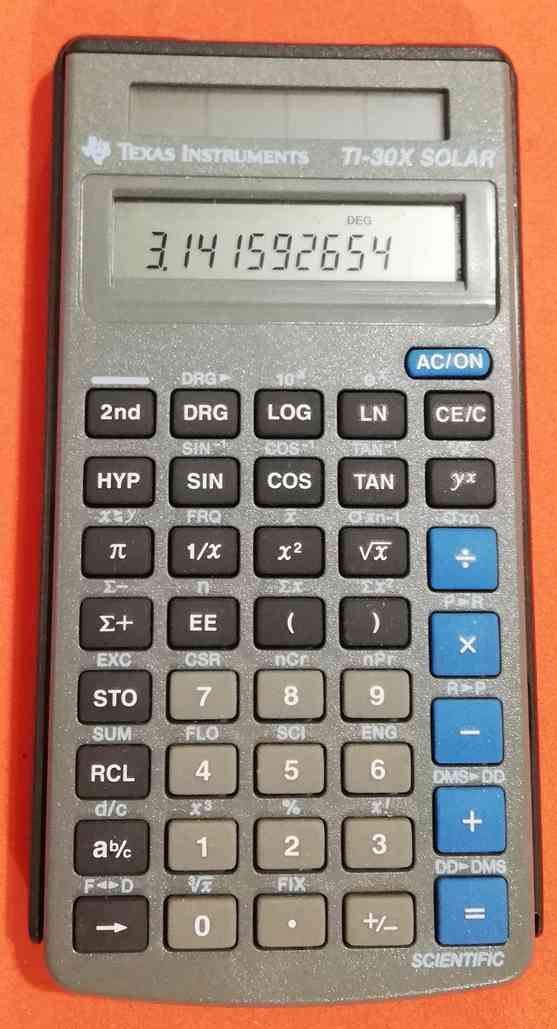 Model: TI-30X
Battery: solar
Adapter:
Year: 1994
Chip: Toshiba T6M38
Info:
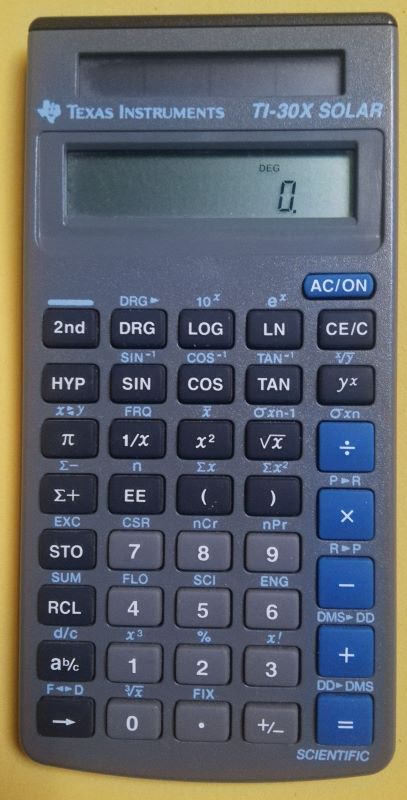 Model: TI-30 X
Battery: solar
Adapter:
Year: 1985 ( RCI 09 02 85 )
Chip: Toshiba T6M38
Info: Calculator donated by Angelucci Adalgisa in 2023 during the 2nd edition "the story with Texas Instruments" in Rieti, (World Chili Pepper Fair)
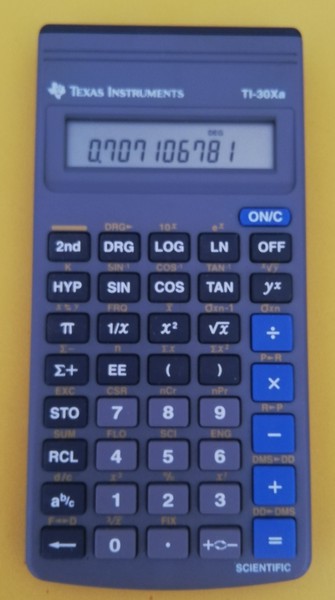 Model: TI-30 xa
Battery: 2 x LR44
Adapter:
Year: 1996
Chip: T6m80 Toshiba
Info:
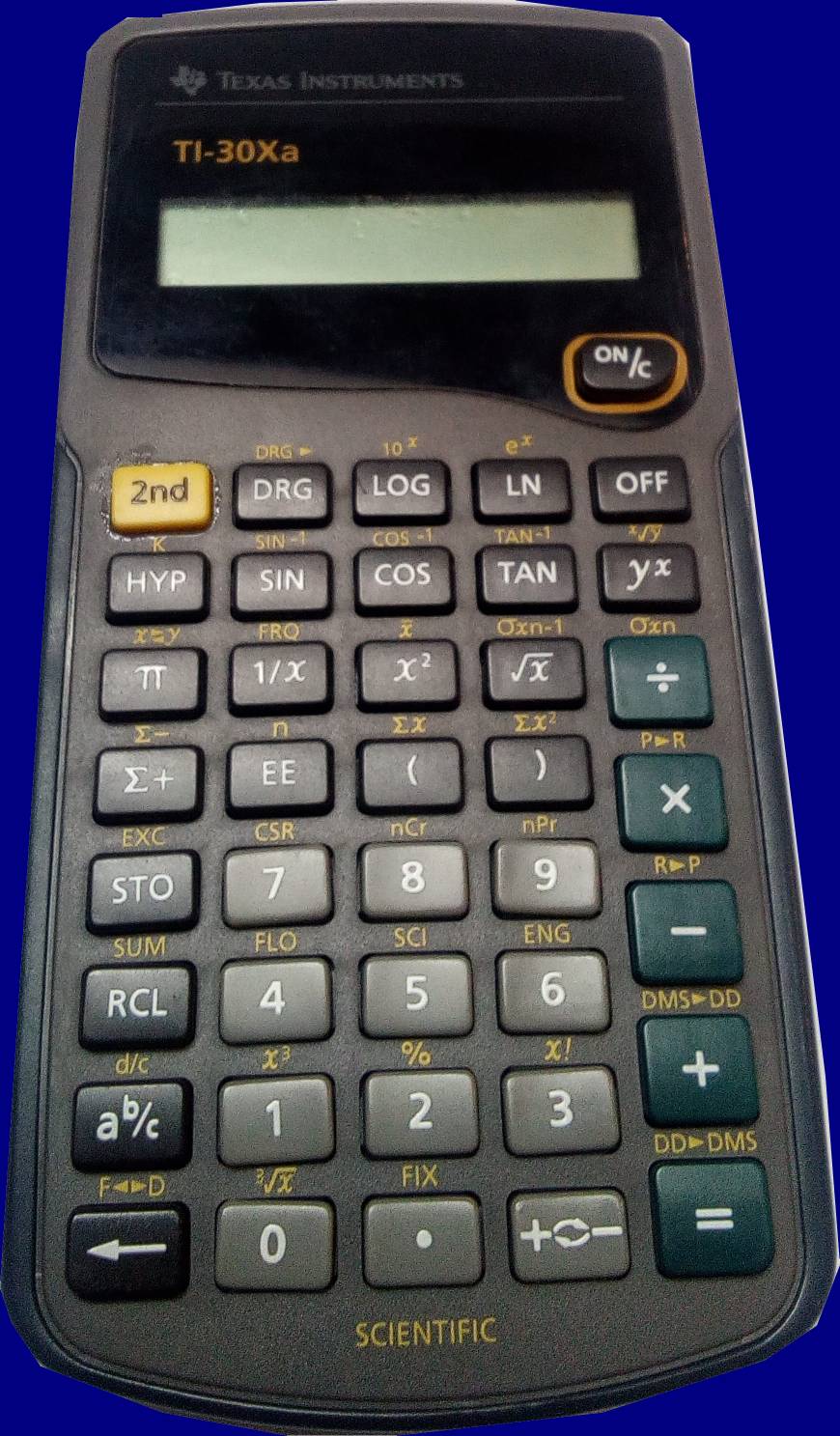 Model: TI-30 xa
Battery: 2 x LR44
Adapter:
Year: 1997
Chip: T6m79 Toshiba
Info: modern LCD 1991 - 1999
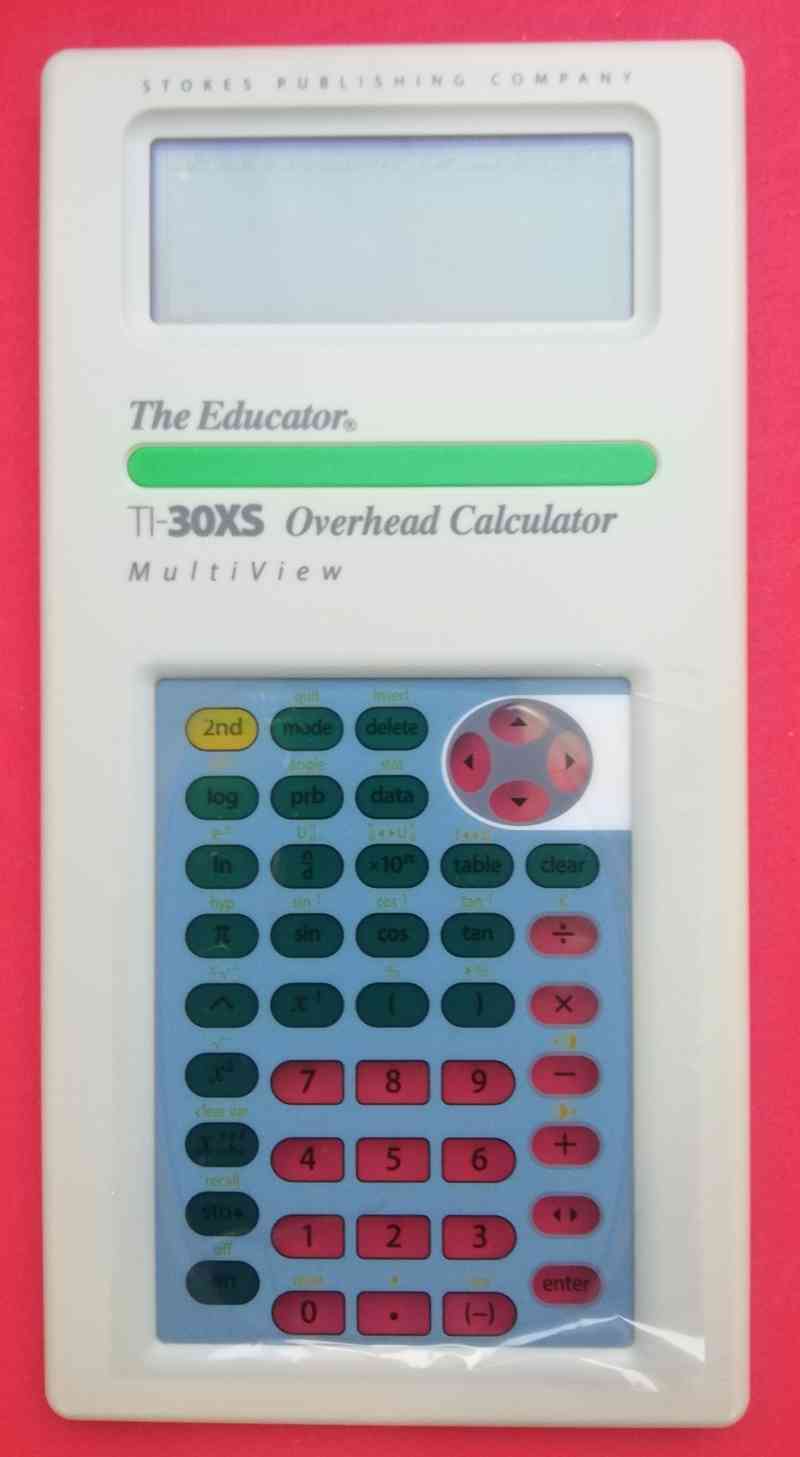 Model: TI-30 XS overhead
Battery:
Adapter:
Year: 2007
Chip: made in China
Info: The California based company Stokes Publishing Company, Inc. distributes under the label "The Educator®"
calculators optimized for teaching purposes. William T. Stokes filed already July 30, 1991 the US Patent Application U.S. Pat. No. 5,035,502
with the title "Transparent calculator for overhead projection".
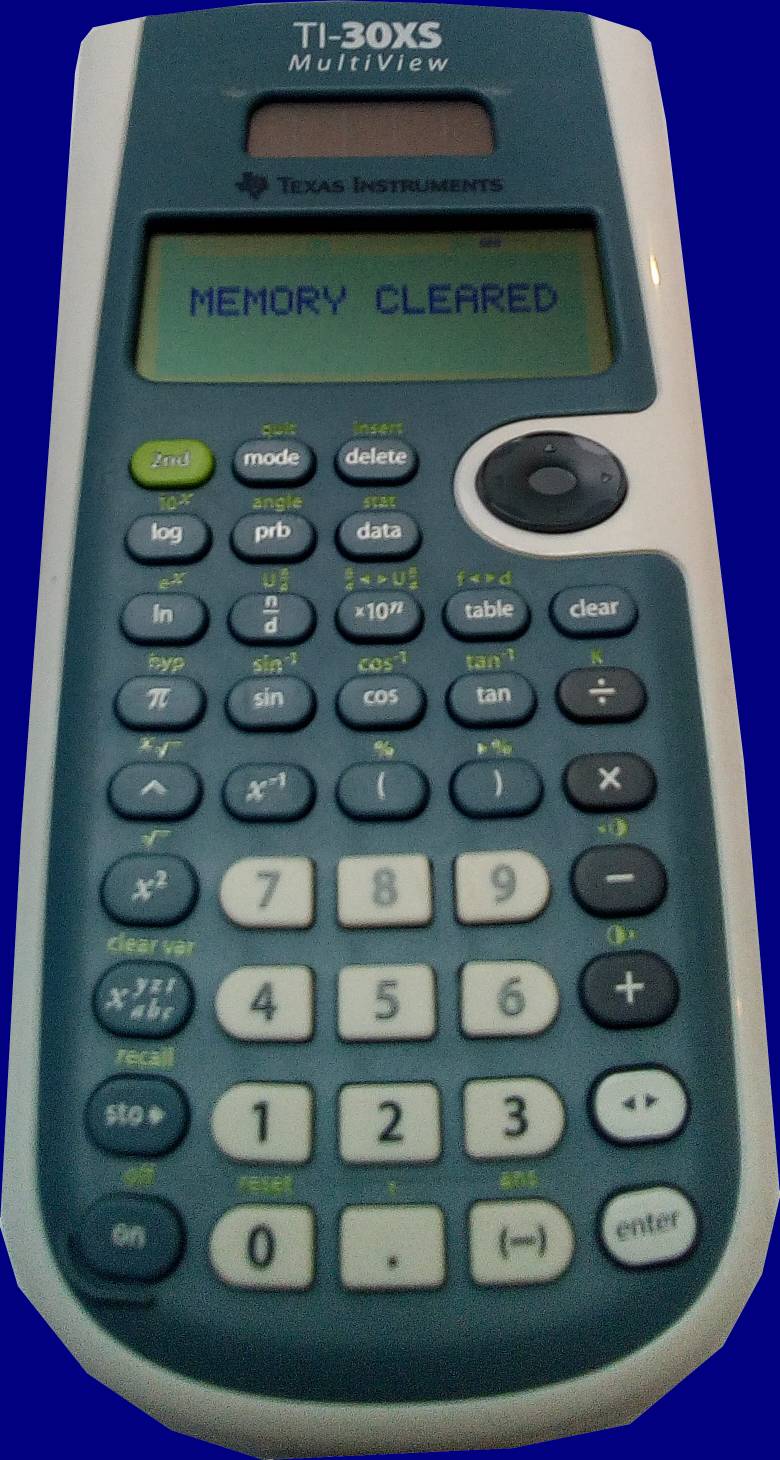 Model: TI-30 xs
Battery: solar , CR2032
Adapter:
Year: 2007
Chip:
Info: modern LCD 2000 - 2017
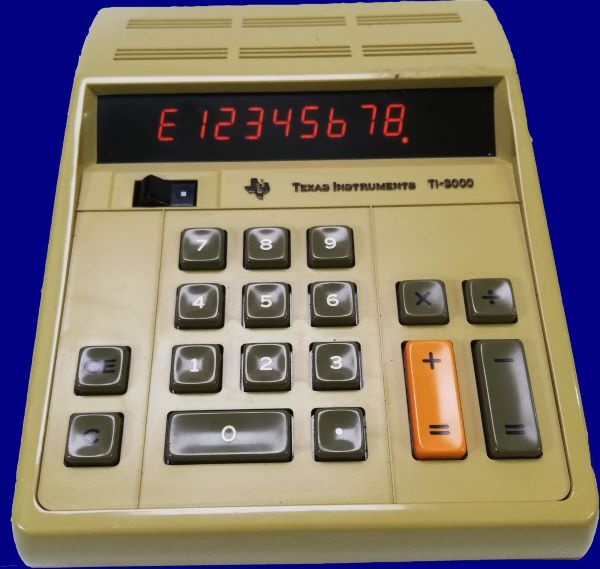 Model: TI-3000
Battery:
Adapter: 110 volt
Year: 1972
Chip: TMS0109
Info: DESKTOP line
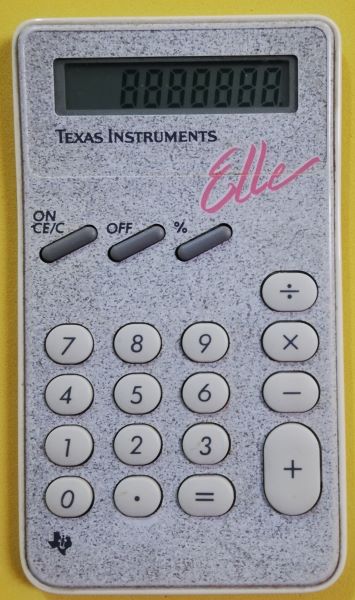 Model: TI-308 elle
Battery: LR1130
Adapter:
Year: 1988
Chip:
Info:
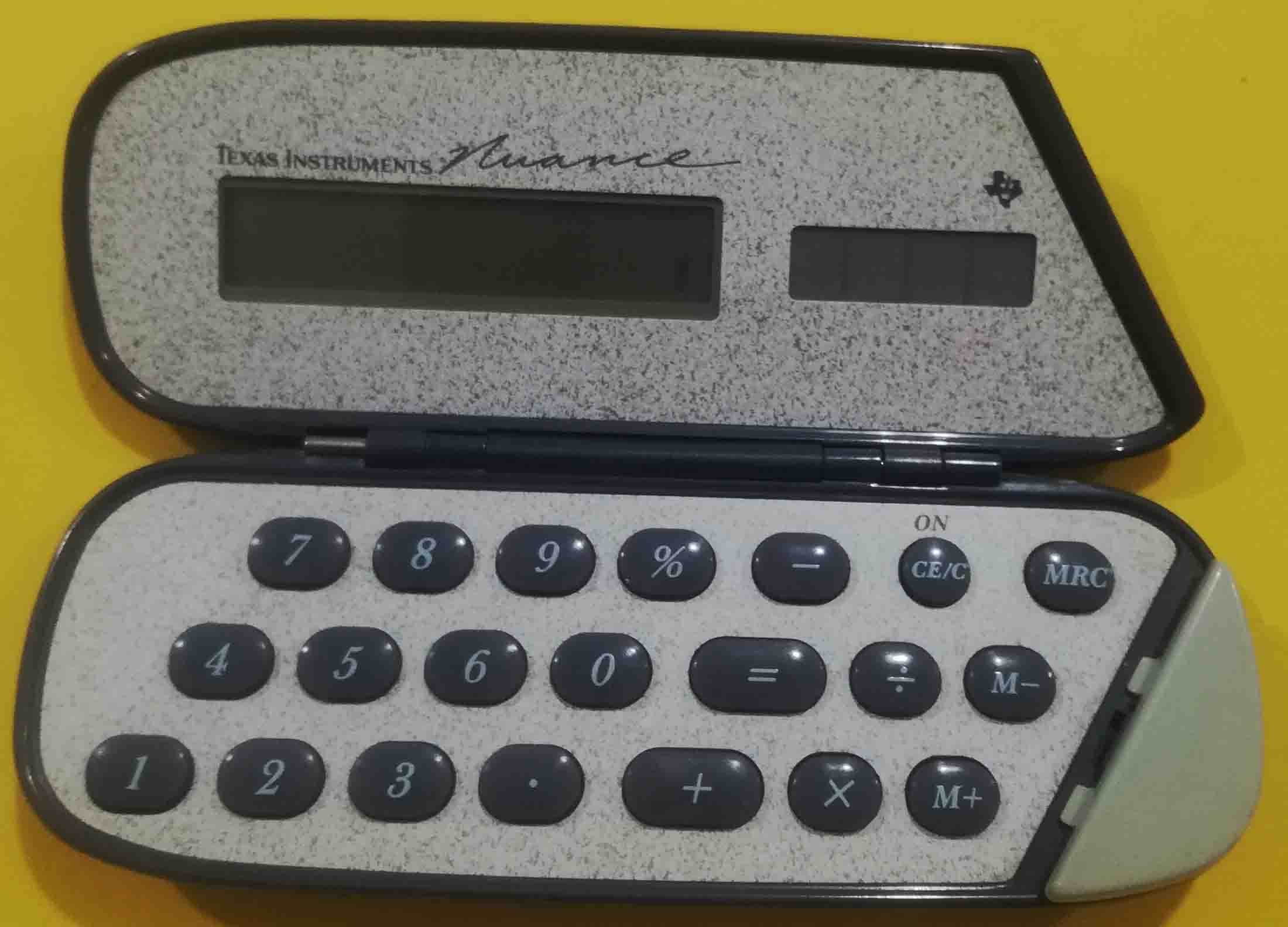 Model: TI-309 Nuance
Battery: Solar
Adapter:
Year: 1989
Chip:
Info: The box states: An elegant hinged case calculator designed for women. A foldable compact protective case which fits easily into the purse or handbag.
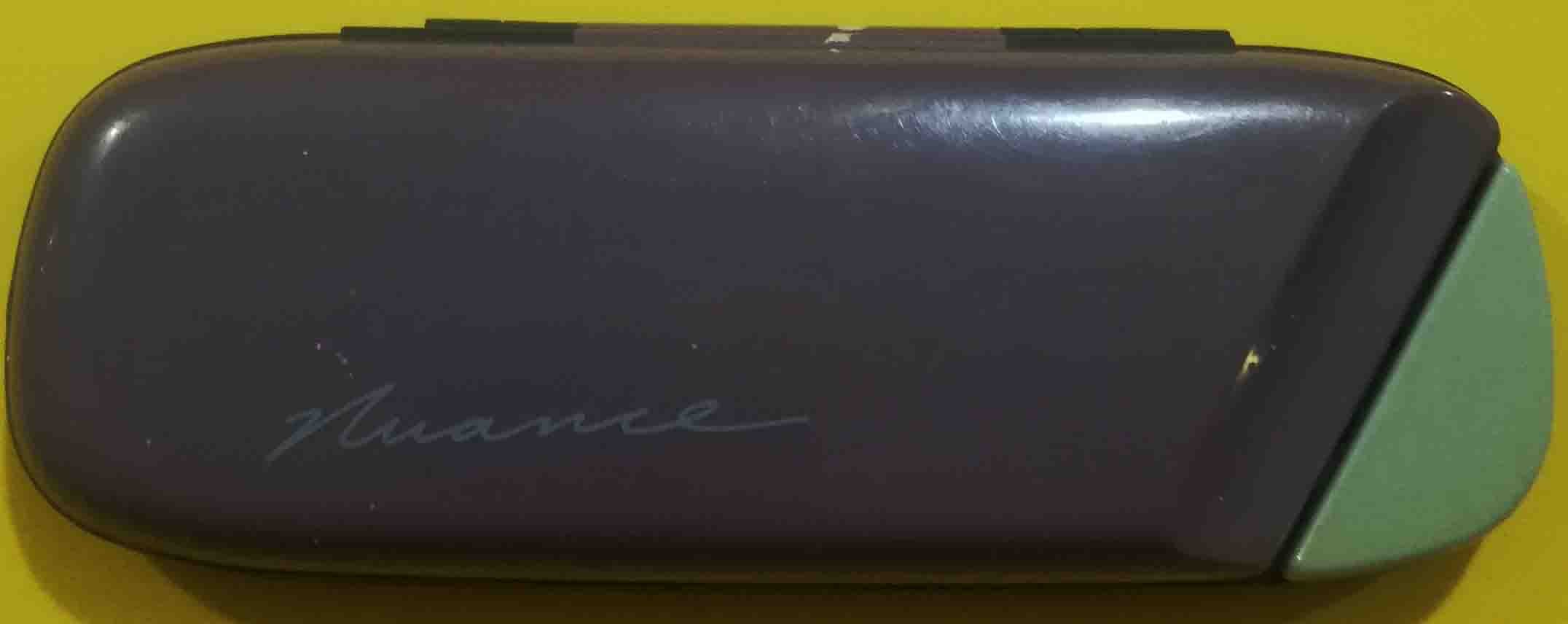 The TI-309 Nuance was available in two colors, soft beige and purple.
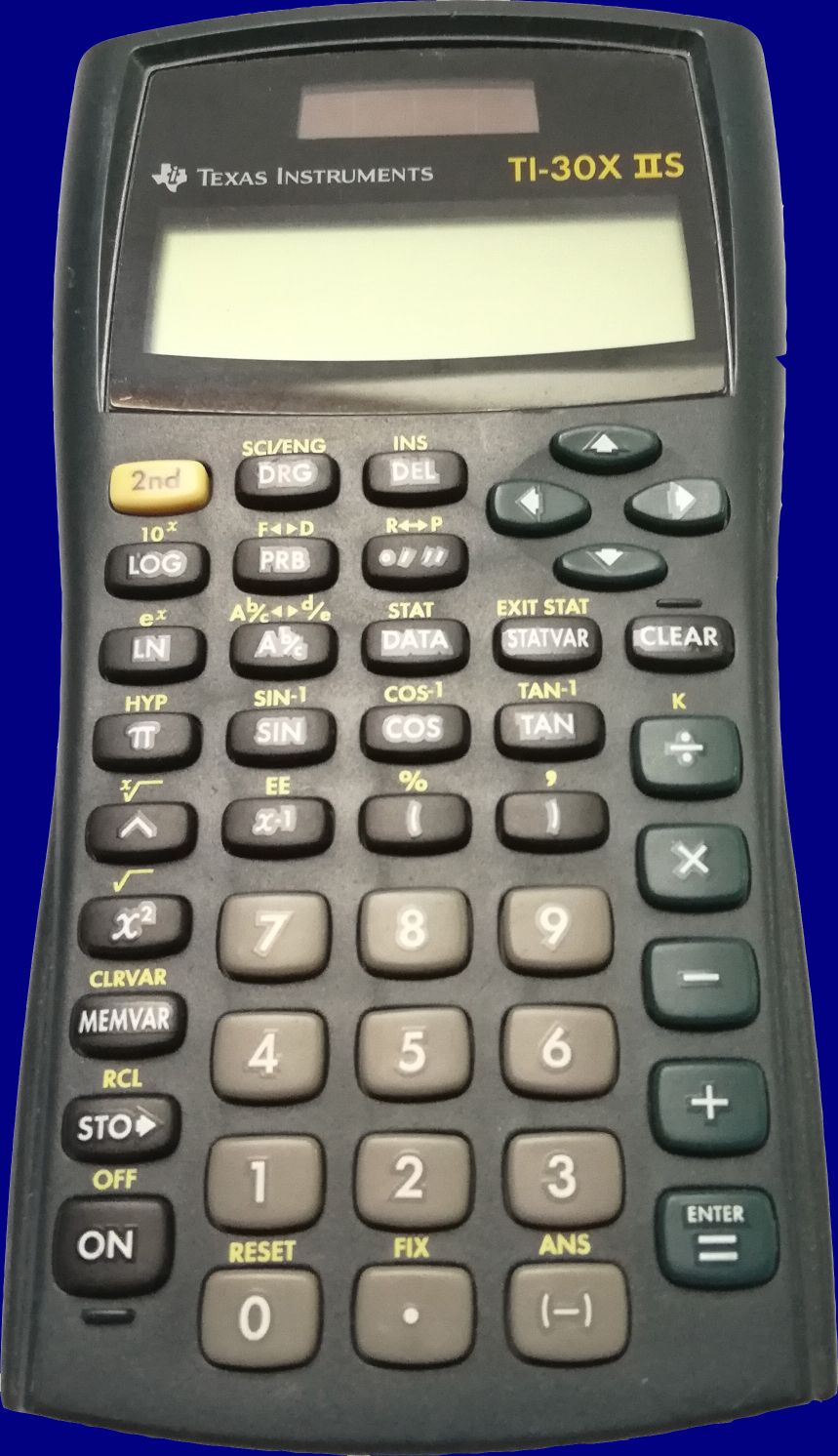 Model: TI-30X IIs
Battery: solar , CR2025
Adapter:
Year: 1999
Chip:
Info: modern LCD 1991 - 1999 made in China
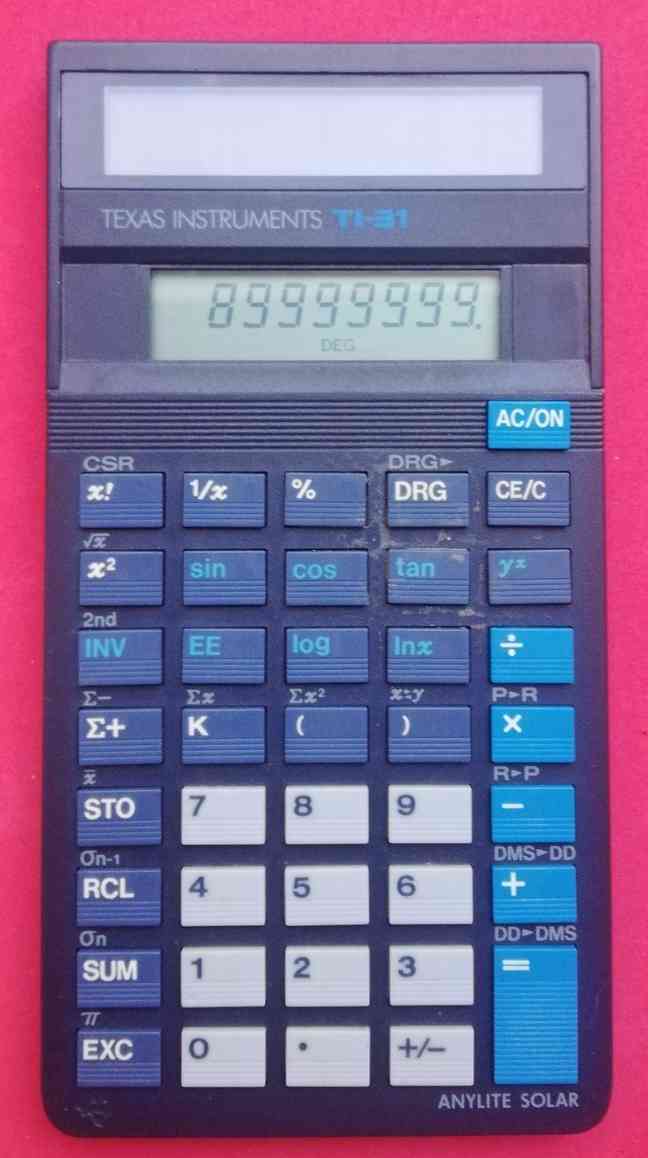 Model: TI-31 lcd
Battery: solar
Adapter:
Year: 1987
Chip: Toshiba T6974S
Info: At first glance the TI-31 added just a few conversions and statistical functions to the TI-30 Challenger.
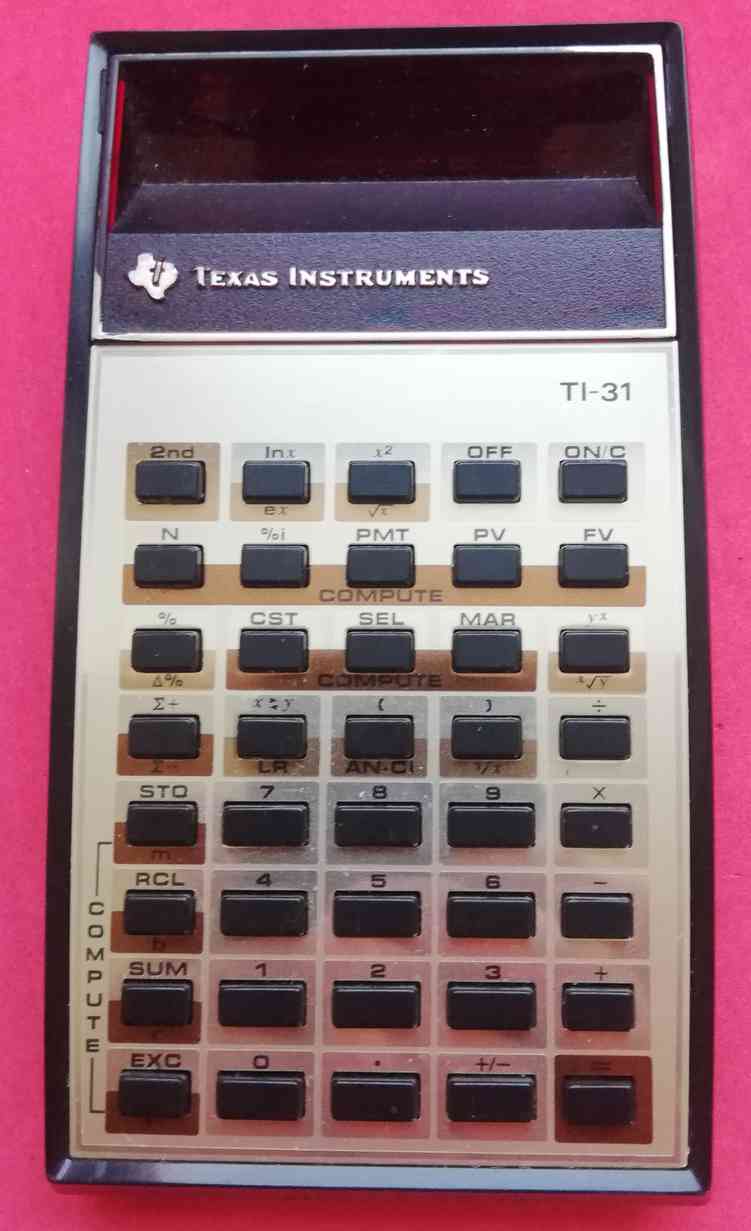 Model: TI-31 led
Battery: 9 volt
Adapter:
Year: 1978
Chip: TMC0982
Info: EURO line
 Model: TI-31 solar
Battery: solar
Adapter:
Year: 1991 ( RCI 01 18 91 )
Chip: Toshiba T6974S
Info: Thanks to my friend Paolo Maistrello who sent me this calculator donated by Giovanni Flammini.
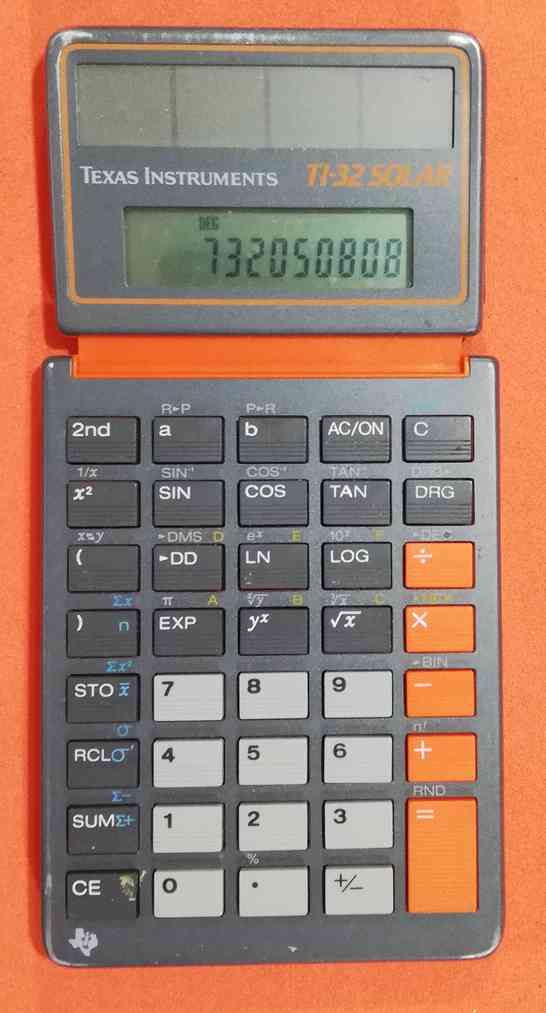 Model: TI-32
Battery: solar
Adapter:
Year: 1988
Chip:
Info: Made in Taiwan
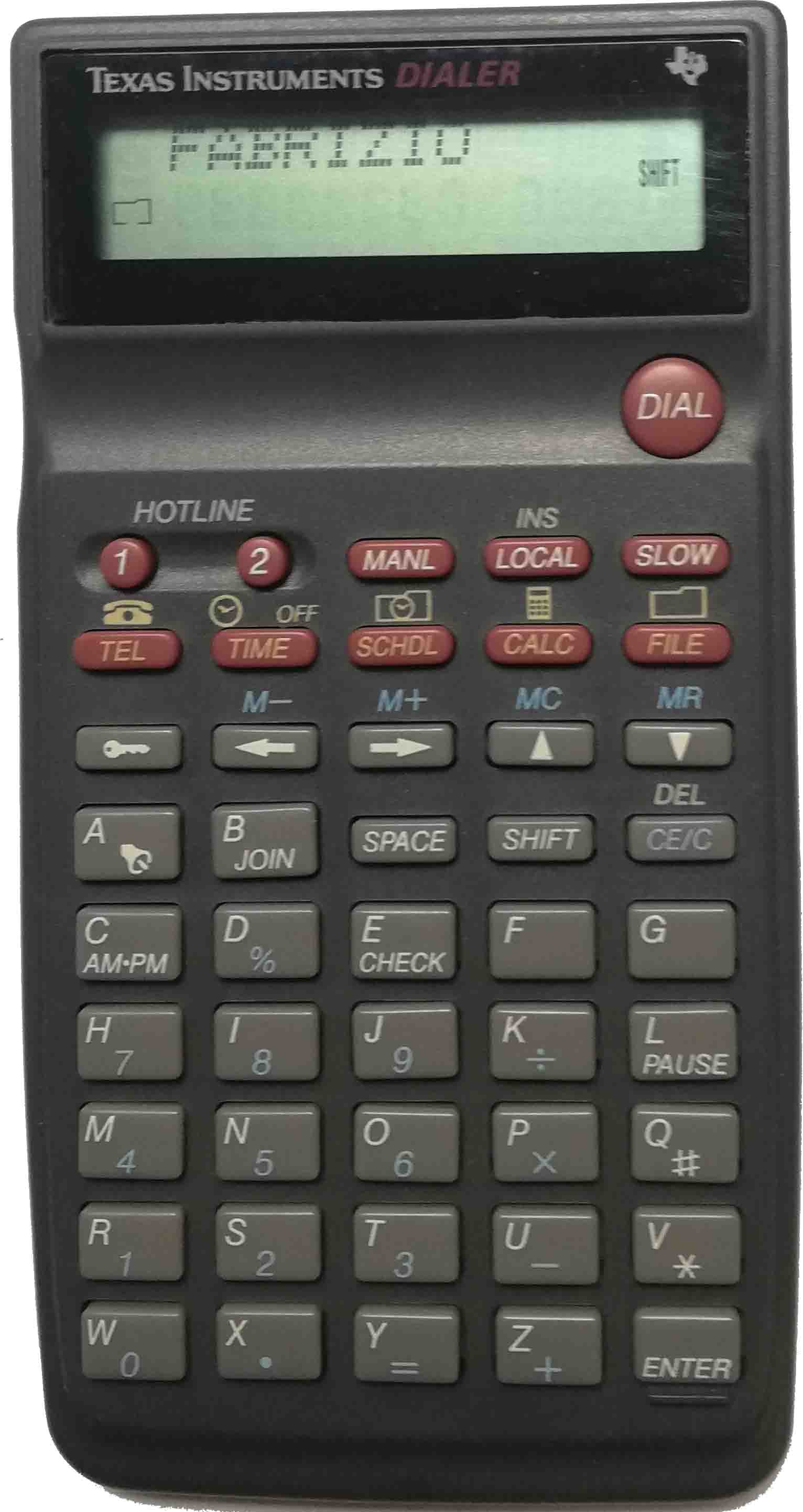 Model: TI-3200 dialer
Battery: 2 x CR2025
Adapter:
Year: 1991
Chip: CPU: Toshiba T7915-0108
RAM: Sharp LH5160
Info:
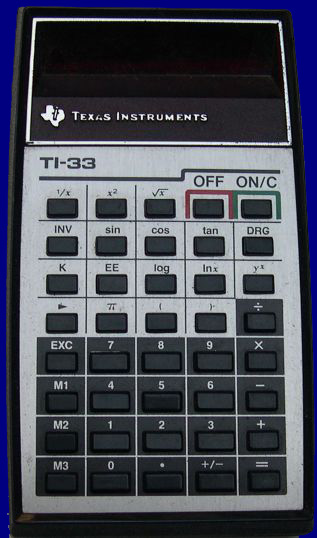 Model: TI-33
Battery: 9 volt
Adapter:
Year: 1977
Chip: TMC0984
Info: EURO line
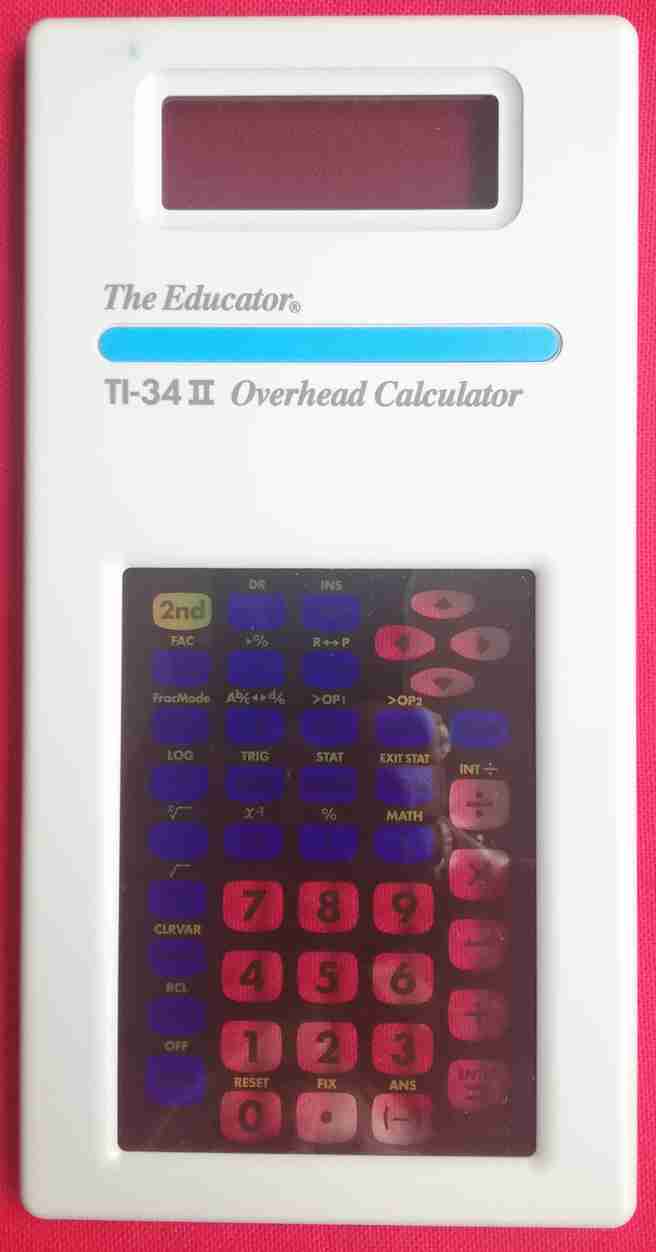 Model: TI-34 II overhead
Battery:
Adapter:
Year:
Chip: made in China
Info: The California based company Stokes Publishing Company, Inc. distributes under the label "The Educator®"
calculators optimized for teaching purposes. William T. Stokes filed already July 30, 1991 the US Patent Application U.S. Pat. No. 5,035,502
with the title "Transparent calculator for overhead projection".
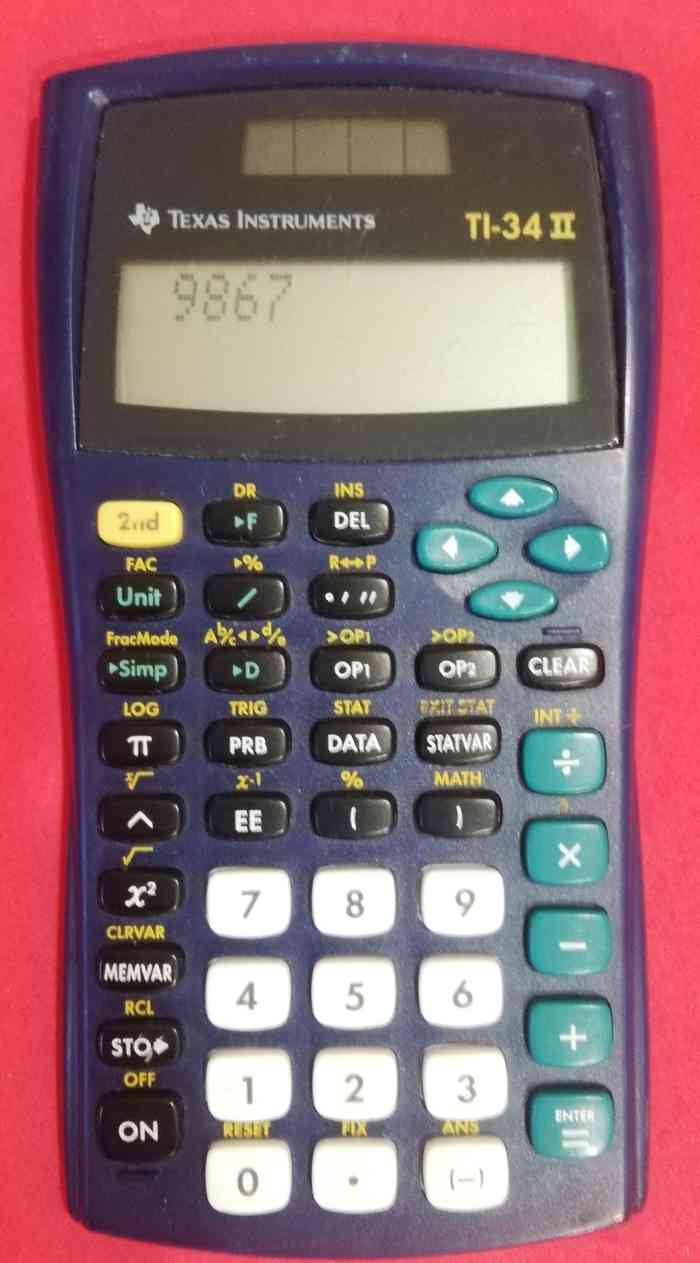 Model: TI-34 II
Battery: solar
Adapter:
Year: 2000
Chip:
Info: In 1999 the TI-30 line of calculators received a great feature - a 2-line display. The upper entry line displays up to 11 characters and can be scrolled left and right up to 88 characters. The lower result line displays 10 digits of mantissa and 2 digits for the exponent.Compared with the traditional TI-34 the upper line permits to recall the last entry and to correct instantly.
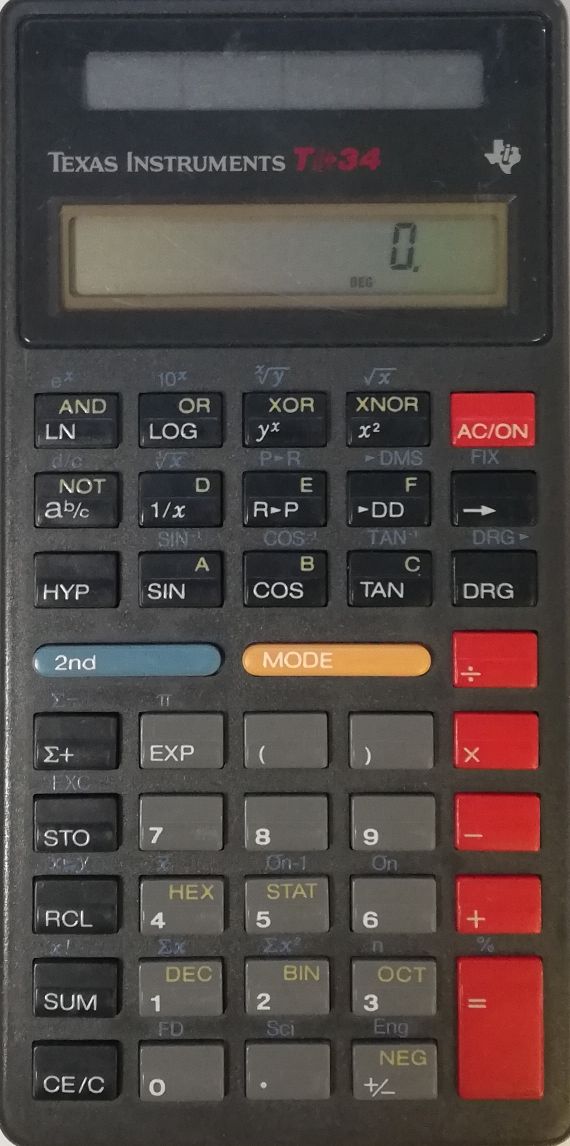 Model: TI-34
Battery: solar
Adapter:
Year: 1987
Chip: Thoshiba T7988
Info: modern LCD 1982 - 1987
Donated by Onofri Rodolfo (Rudy)
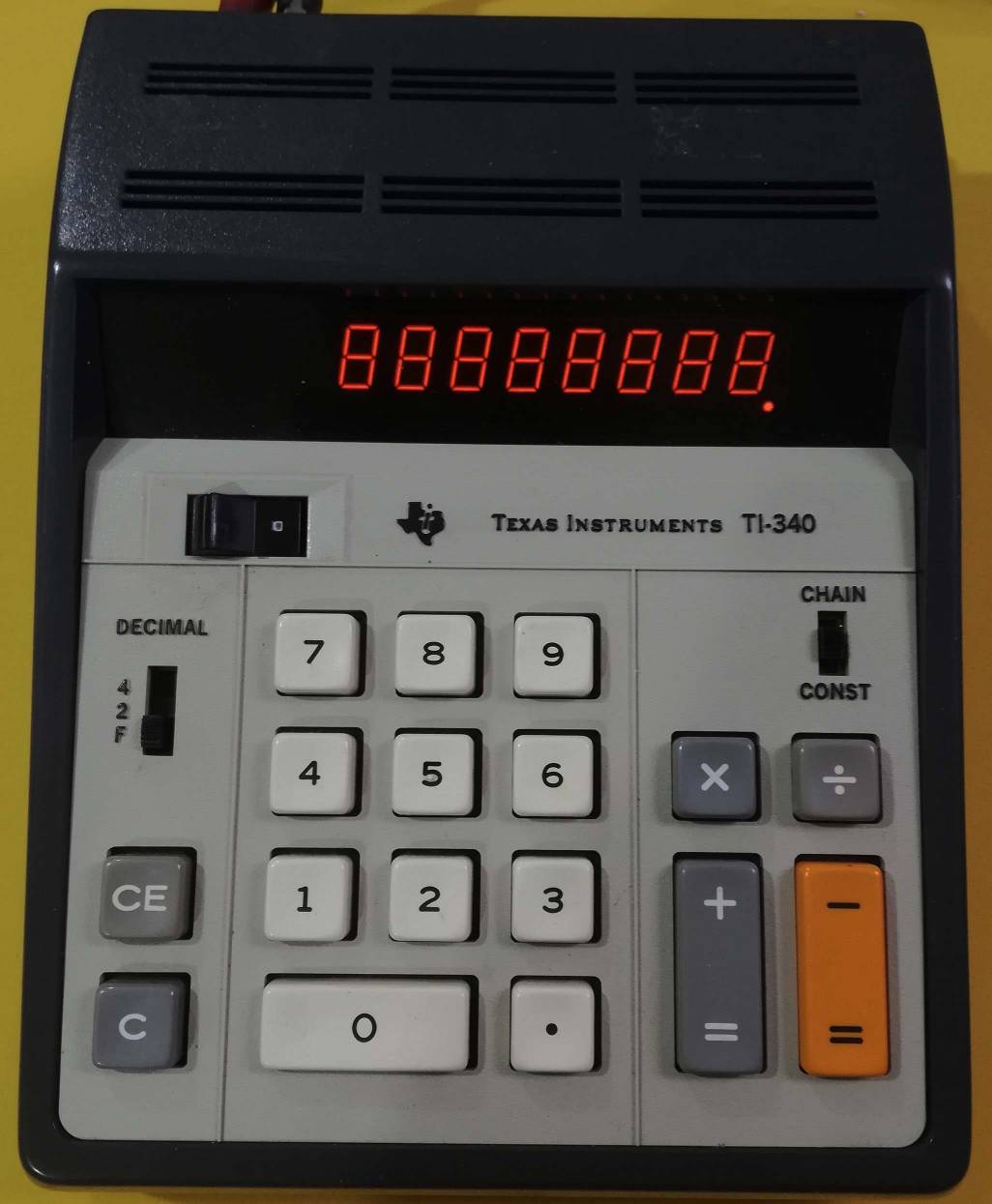 Model: TI-340
Battery:
Adapter: 120 volt
Year: 1975
Chip: TMS0106
Info:
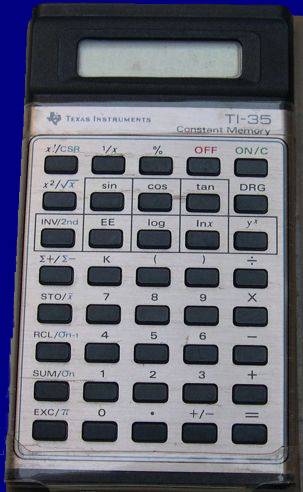 Model: TI-35 black
Battery: 2 x LR44
Adapter:
Year: 1981 Price: L. 35.00 + iva 14%
Chip: TPO324
Info:From an advertisement of the time! The most ready. The TI-35 scientific calculator is more responsive because it has "constant" memory. To keep the contents unchanged, even when the calculator is turned off, restart the calculations in due course. AOS (algebraic operating system): 54 functions, algebraic, logarithmic, trigonometric and statistical, ultra-flat with very long life batteries, energy saving device!
 Model: TI-35 Galaxy Solar
Battery: solar
Adapter:
Year: 1985 Price: L. ? + iva 14%
Chip: Toshiba T6975AS
Info:
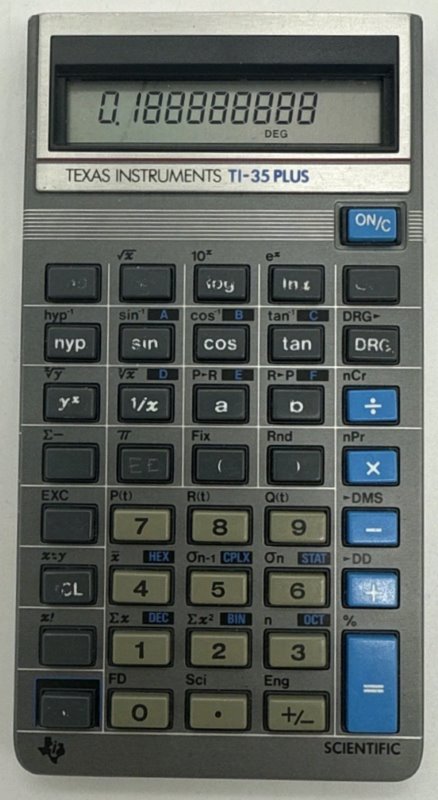 Model: TI-35 plus
Battery: 2 x LR44
Adapter:
Year: 1981 Price: L. 35.00 + iva 14%
Chip: TPO324
Info:From an advertisement of the time! The most ready. The TI-35 scientific calculator is more responsive because it has "constant" memory. To keep the contents unchanged, even when the calculator is turned off, restart the calculations in due course. AOS (algebraic operating system): 54 functions, algebraic, logarithmic, trigonometric and statistical, ultra-flat with very long life batteries, energy saving device!
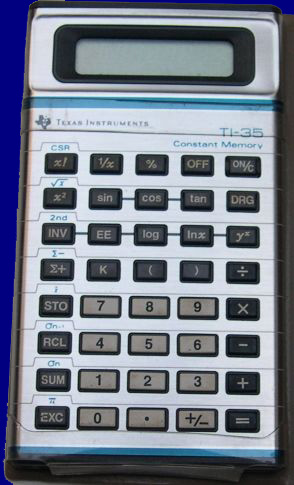 Model: TI-35 silver
Battery: 2 x LR44
Adapter:
Year: 1981
Chip: TPO324
Info: silver frame
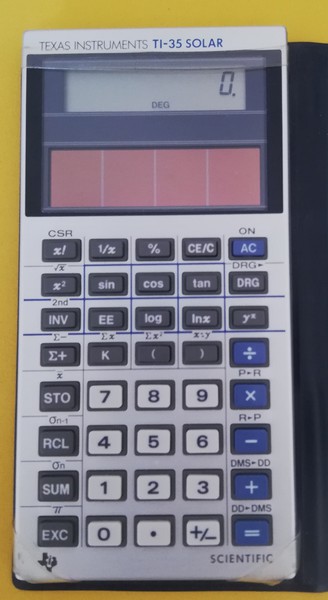 Model: TI-35 solar
Battery: solar
Adapter:
Year: 1984
Chip: T6974S Toshiba
Info:
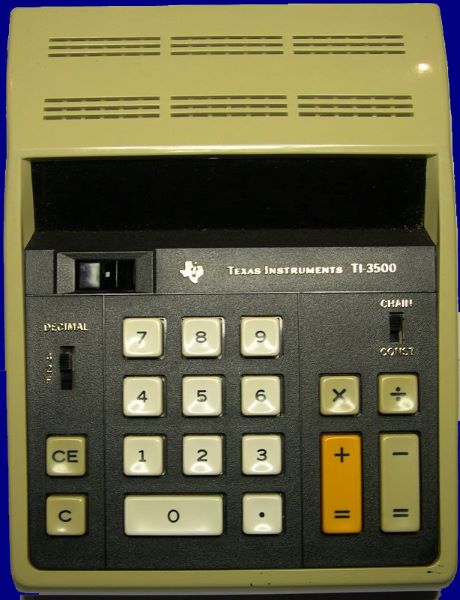 Model: TI-3500
Battery:
Adapter: 110 volt
Year: 1973
Chip: TMS0106
Info: DESKTOP line
 Model: TI-3510
Battery:
Adapter: 110 volt
Year: 1974
Chip: TMS0106, MM5314 national semiconductor
Info: DESKTOP line with clock

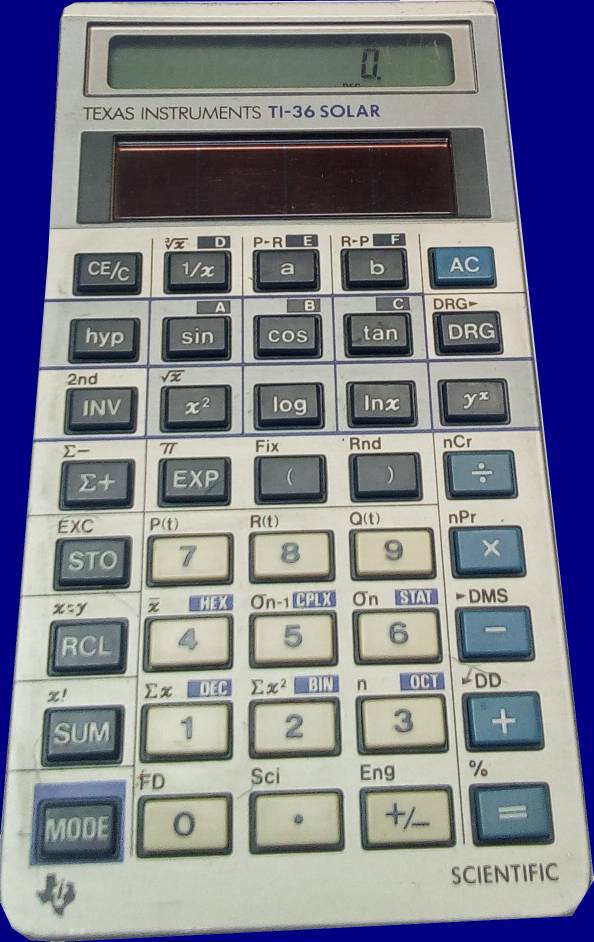 Model: TI-36
Battery: solar
Adapter:
Year: 1986
Chip: Thoshiba T7768
Info: modern LCD 1982 - 1987
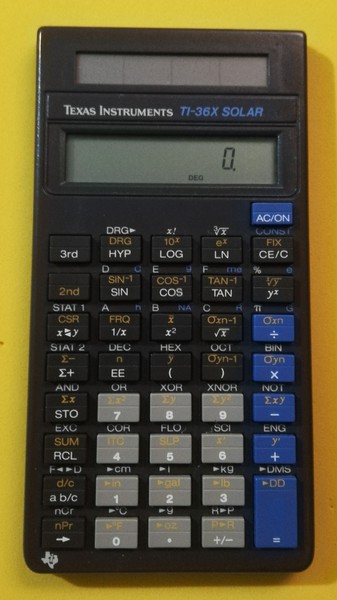 Model: TI-36 x
Battery: solar
Adapter:
Year: 1996
Chip:
Info:
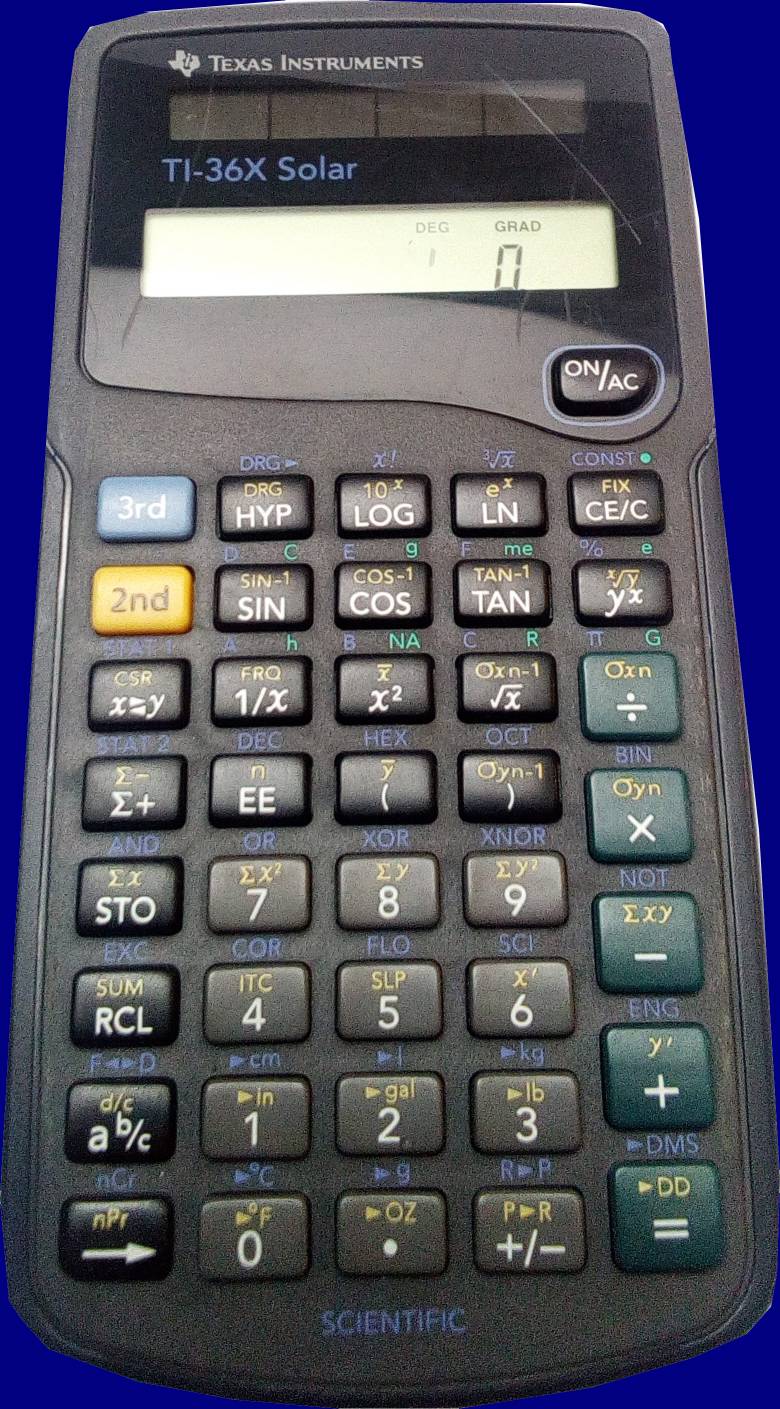
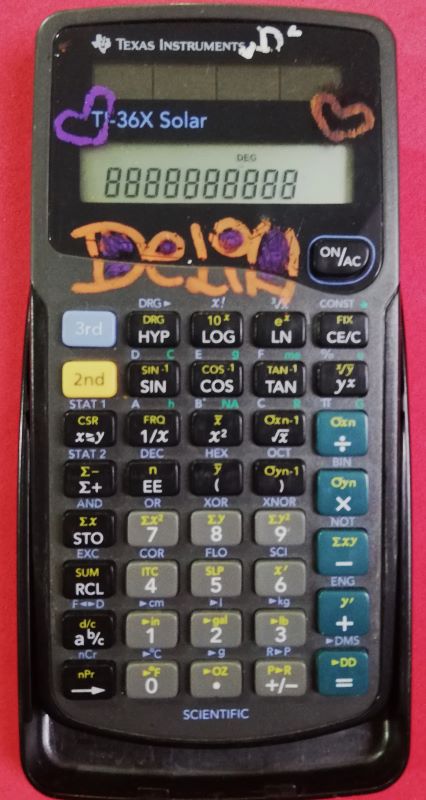 Model: TI-36 x
Battery: solar
Adapter:
Year: 2000
Chip:
Info: This TI-36 with the "Delia" inscription has a special meaning, because it was donated to our association by Mrs. Stefania Cervelli, a former Texas Instruments employee at the Cittaducale (Rieti) plant. Delia is Mrs. Stefania's daughter !
Questa calcolatrice TI-36 con la scritta "Delia" ha un significato speciale, perché è stata donata alla nostra associazione dalla Signora Stefania Cervelli, ex dipendente della Texas Instruments dello stabilimento di Cittaducale (Rieti). Delia è la figlia della Signora Stefania!
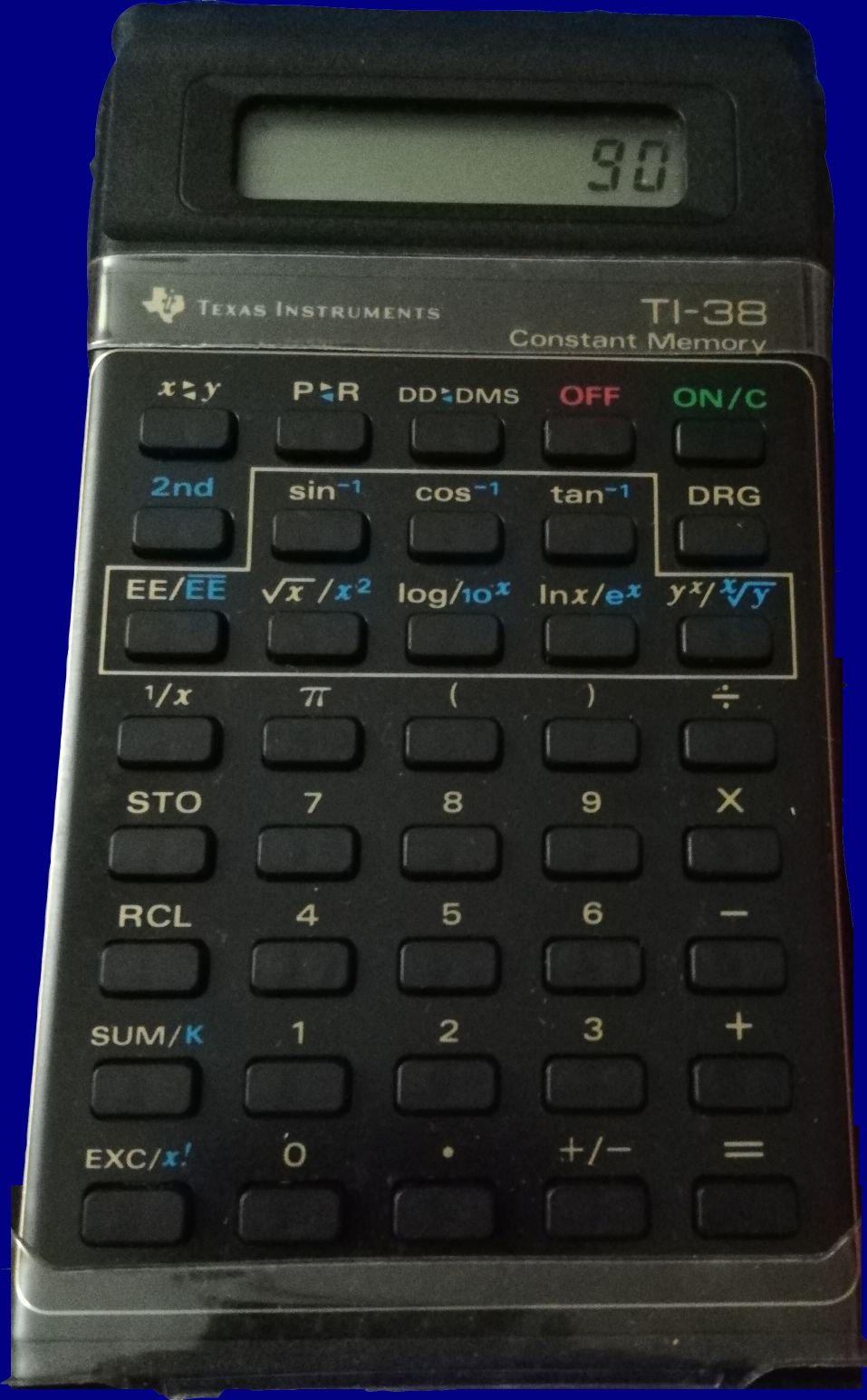 Model: TI-38
Battery: 2 x LR44
Adapter:
Year: 1981
Chip: TPO326
Info: first LCD and slimline LCD
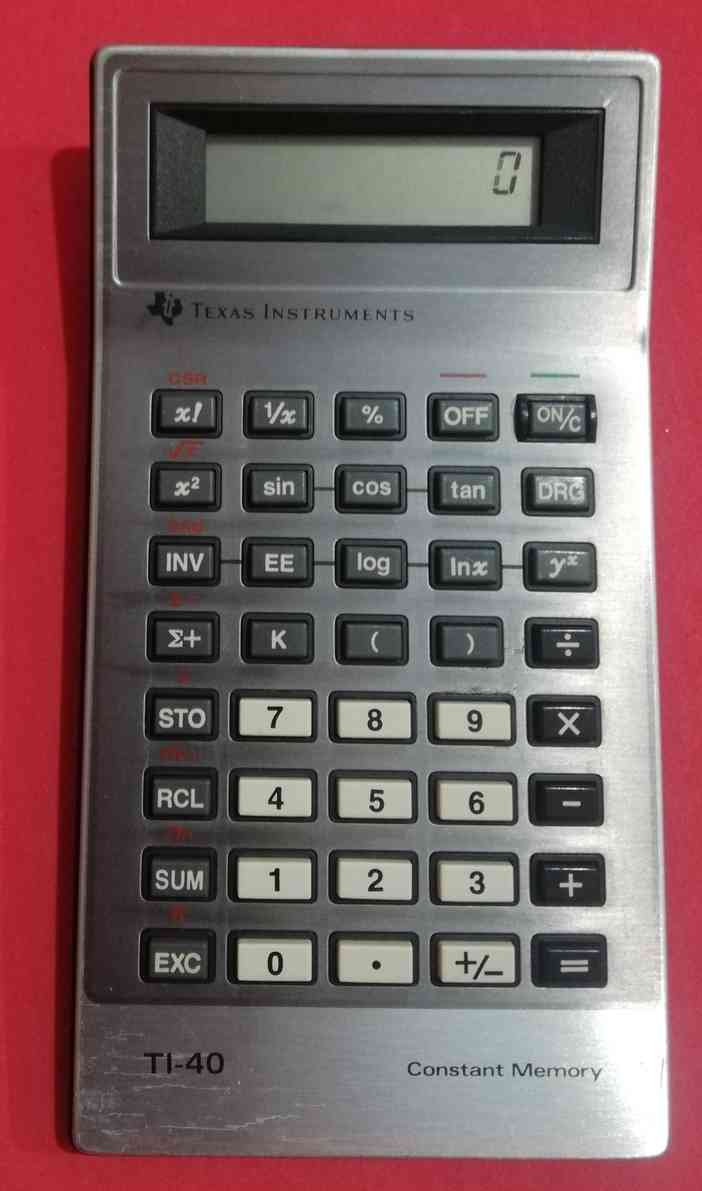 Model: TI-40
Battery: 2 x LR44
Adapter:
Year: 1983
Chip: CD4507
Info: slanted LCD generation
 Model: TI-4000
Battery:
Adapter: 110 volt
Year: 1974
Chip: TMS0201,TMS0301
Info: DESKTOP line
 Model: TI-40x galaxy
Battery: CR2032
Adapter:
Year: 1993 ( RCI 15 93 )
Chip: Toshiba T6A59
Info: Thanks to my friend Paolo Maistrello who sent me this calculator donated by Giovanni Flammini.
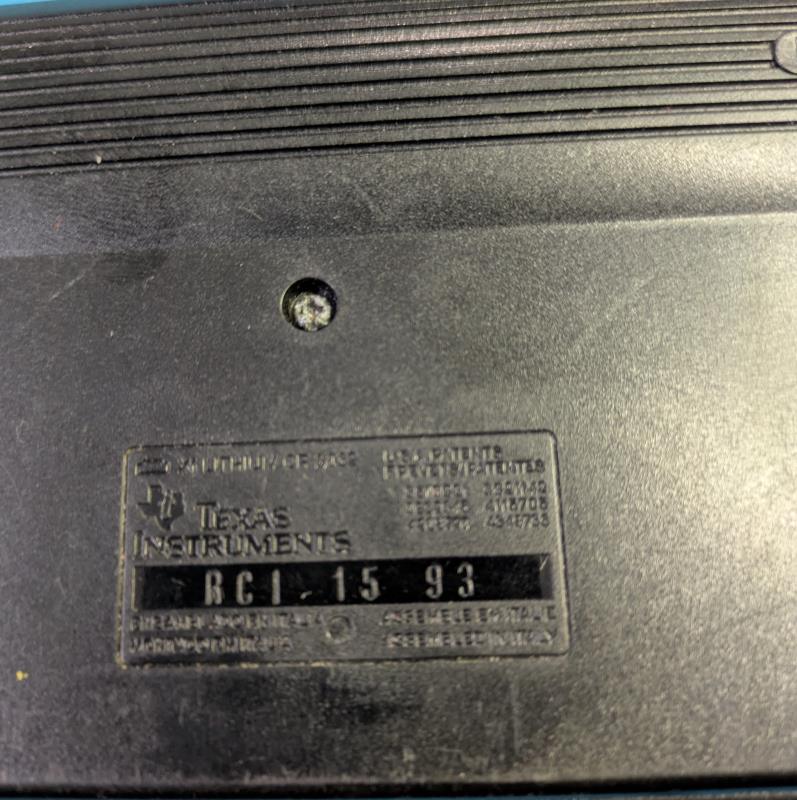
( RCI 15 93 ) built in the Rieti plant, 15th week of 1993.
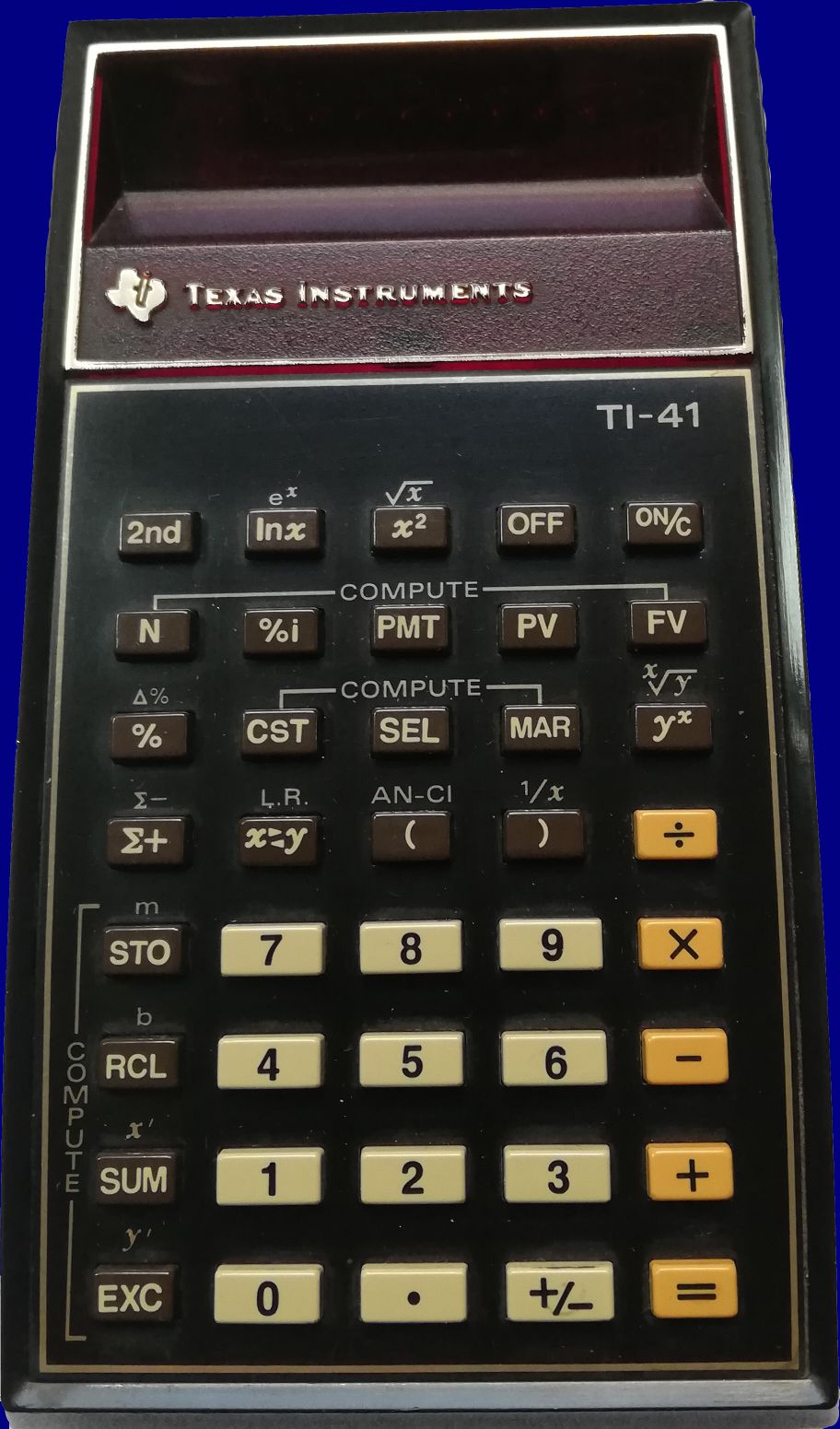 Model: TI-41
Battery: 9 volt
Adapter:
Year: 1977
Chip: TMC0982
Info: EURO line
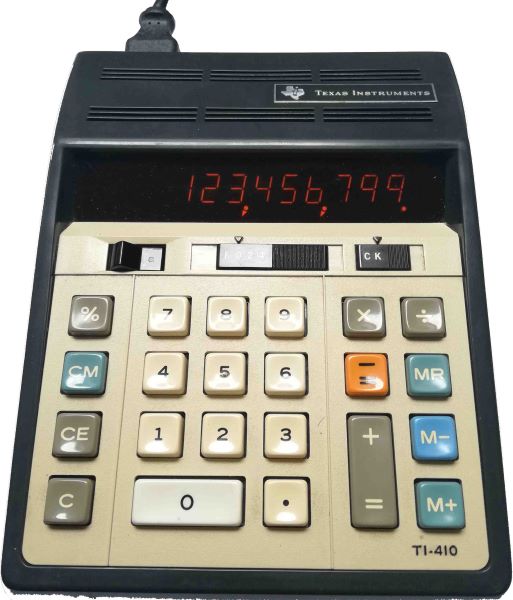 Model: TI-410
Battery:
Adapter: 120 volt
Year: 1974
Chip: TMS0201 and TMSxxxx
Info:
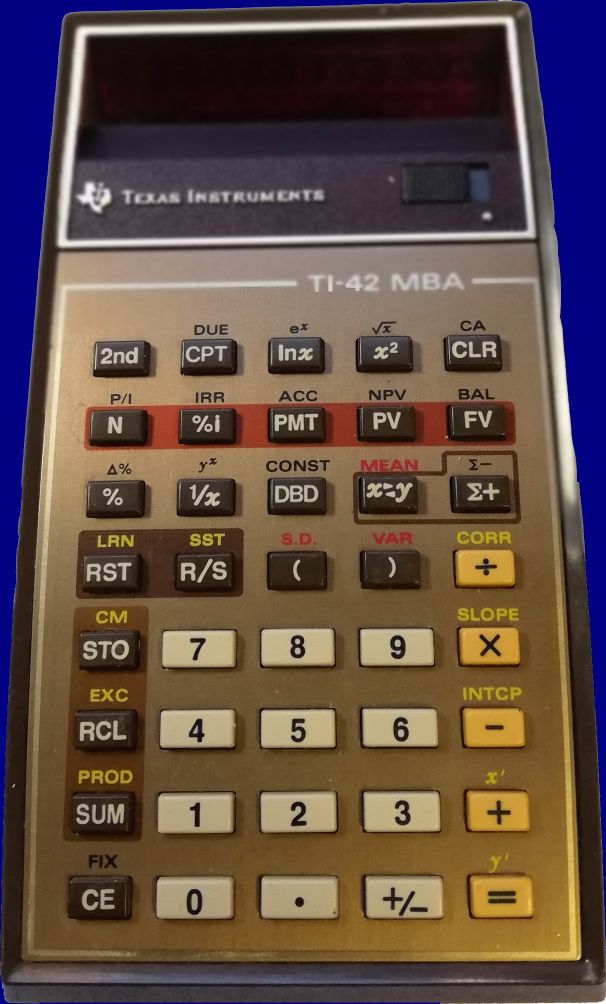 Model: TI-42 mba
Battery: BP7
Adapter: AC9900
Year: 1979
Chip: TMC1502
Info: EURO line Made in Iatly
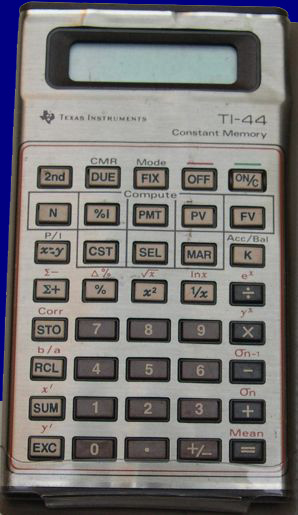 Model: TI-44
Battery: 2 x LR44
Adapter:
Year: 1983
Chip: TPO322
Info: first LCD and slimline LCD
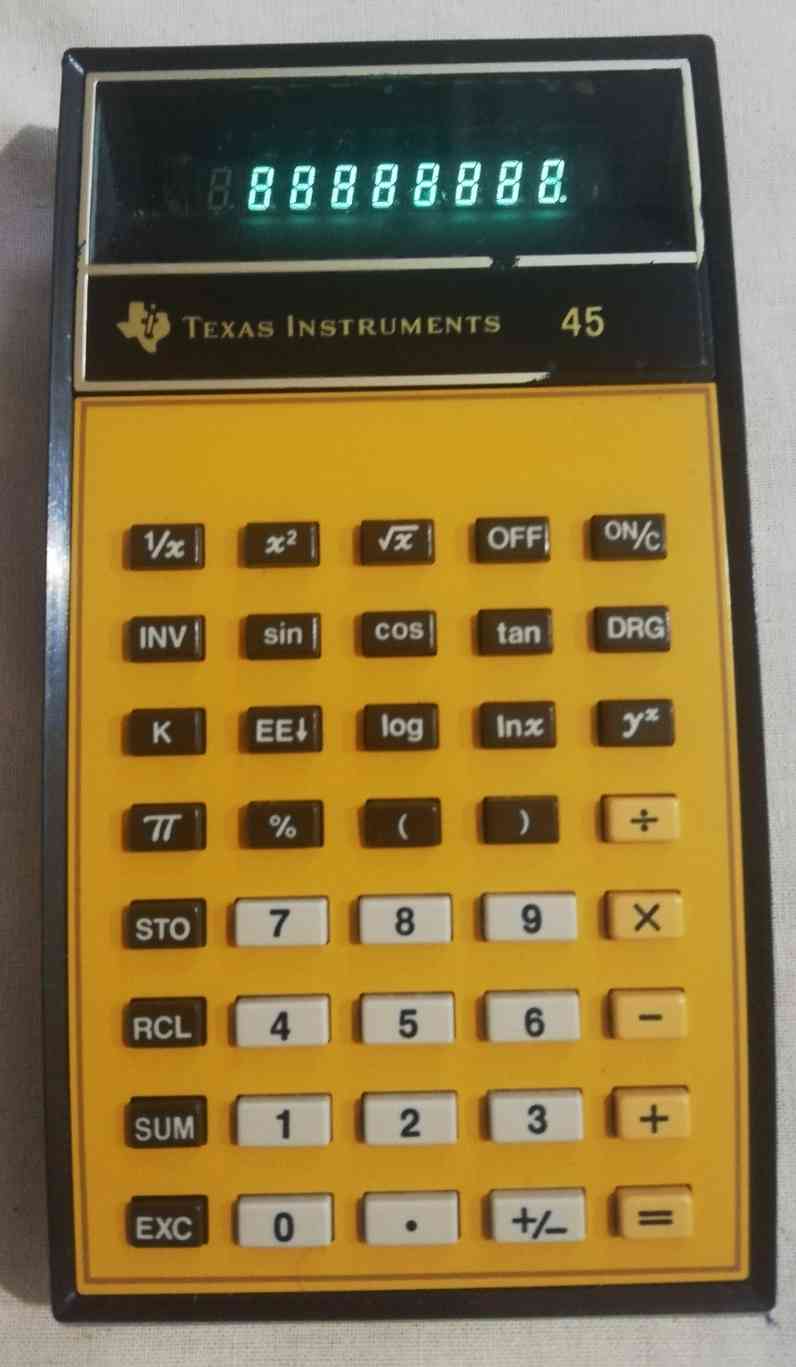
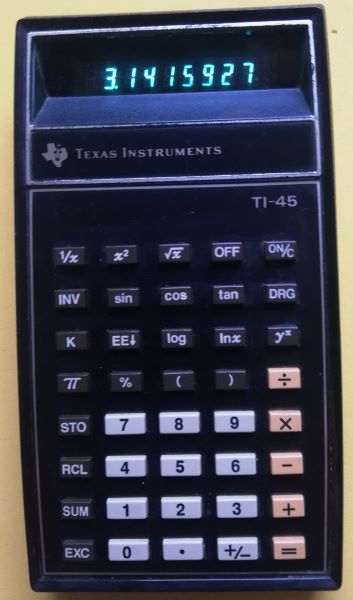 Model: TI-45 1 version
Battery: BP8 or BP9
Adapter: AC9900
Year: 1977
Chip: TMC1983
Info:At first glance is the European TI-45 identical to the SR-40. Surprisingly the TI-45 features a green vacuum fluorescent display (VFD), a major exception in the Majestic-line. Dismantling this TI-45 manufactured in September 1978 by Texas Instruments in their Rieti, Italy facility reveals a slightly more complex design than the SR-40 sporting a red LED display. Main reason is the higher operating voltage of the VF-Display, engineers at Texas Instruments are using a very effective way to generate -22 Volts out o the 9V battery with a simple voltage multiplier using just four diodes and four capacitors and an charge-pump oscillator integrated on the TMC1980 single-chip calculator circuit. Two variations of the TI-45 were reported, they differ in the mask over the display. View the later model with a molded TI-logo and TEXAS INSTRUMENTS nameplate.
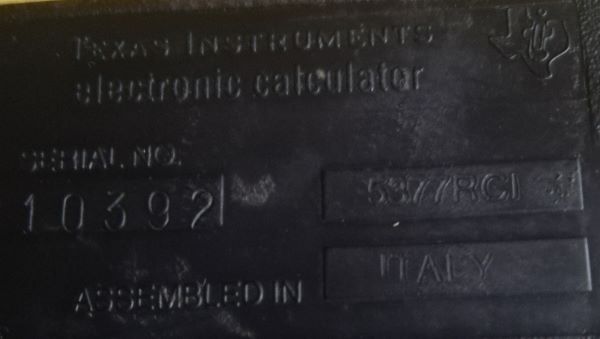 On the side you can see the serial, the date of construction 53 week of 1977 and the nation of manufacture Italy.
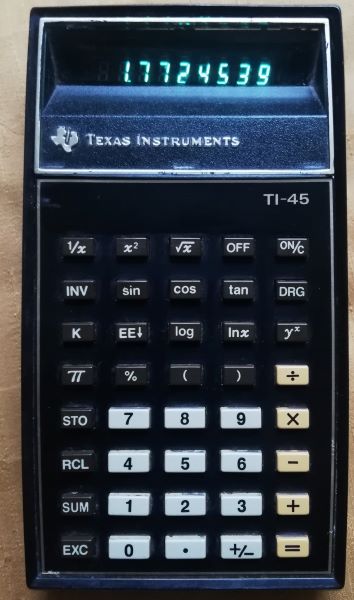 Model: TI-45 2v
Battery: BP8 or BP9
Adapter: AC9900
Year: 1978
Chip: TMC1983
Info: The TI-45 uses the exact same 4 ceramic capacitors plus 4 diodes to boost the 30 V anode voltage. No other components beside the TMC chip
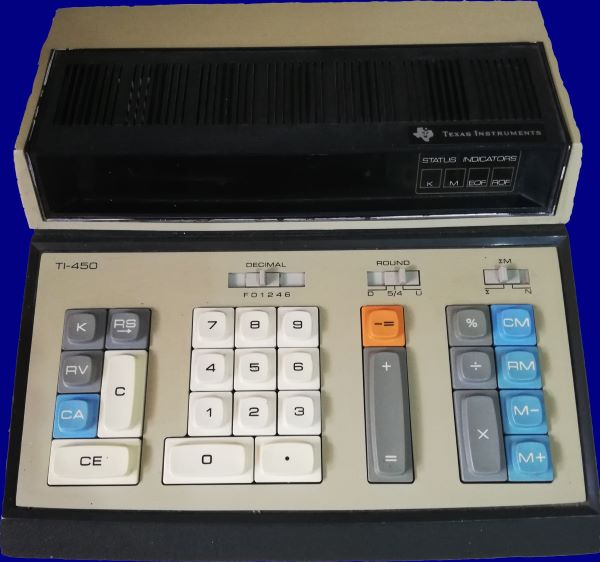 Model: TI-450
Battery:
Adapter: 120 vac
Year: 1974
Chip: TMS0203, TMC0322
Info:
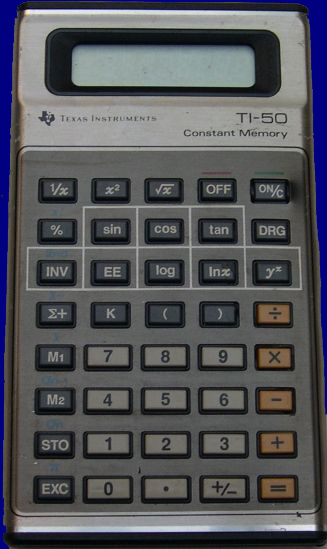 Model: TI-50
Battery: 2 x LR44
Adapter:
Year: 1979
Chip: TPO321
Info: first LCD and slimline LCD
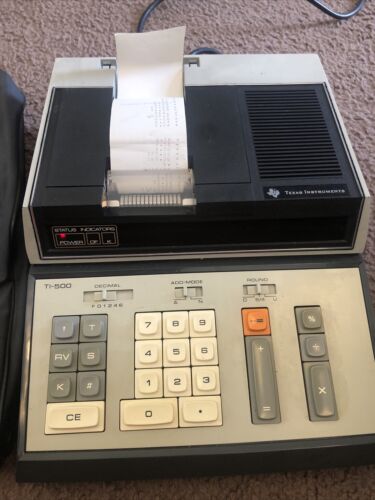 Model: TI-500
Battery:
Adapter: 120 vac
Year: 1974
Chip:TMS0203, TMS0221, TMC0305
Info: This rare TI-500 was introduced in the year 1974 and seems to be a sibling of the TI-450 and TI-620.The TI-500 is based on the TMS0200 Chipset for 12-digit desktop calculators but misses the usual 12-digit display.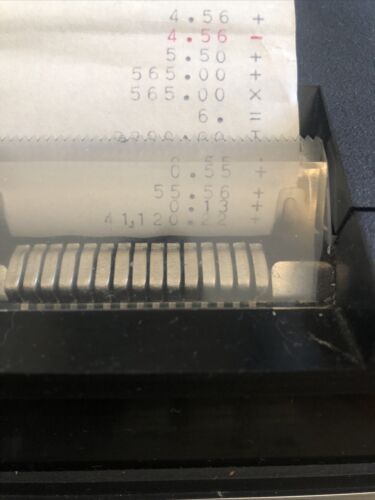 Related calculators using this chip set are the SR-20 and SR-22. The first usage of the TMS0200 Building Blocks were the TI-4000 and the Canon 121F. The architecture found in this TI-500 differs greatly from these calculators, it uses the Data Chip TMS0203, ROM Chip TMC0305, adding the Printer Chip TMS0221 to control the drum printer.
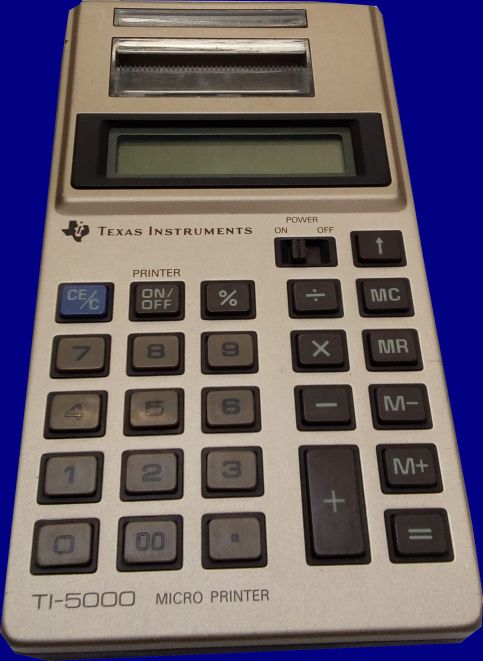 Model: TI-5000 microprinter
Battery: 4 x AAA
Adapter: AC9175
Year: 1982
Chip: Toshiba T676
Info: later HANDHELD printing
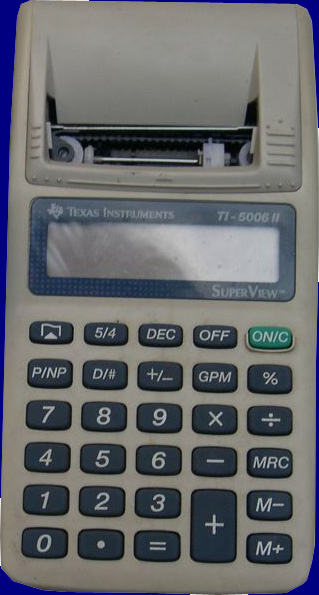 Model: TI-5006 II
Battery: 4 x AA
Adapter:
Year: 1994
Chip: Toshiba T7916S
Info: later HANDHELD printing
.jpg)
.jpg) Model: TI-5008 microprinter
Model: TI-5008 microprinter
Battery: 3 x AAA
Adapter: AC9175
Year: 1982
Chip: Toshiba T676
Info: Thermal paper TP-25000
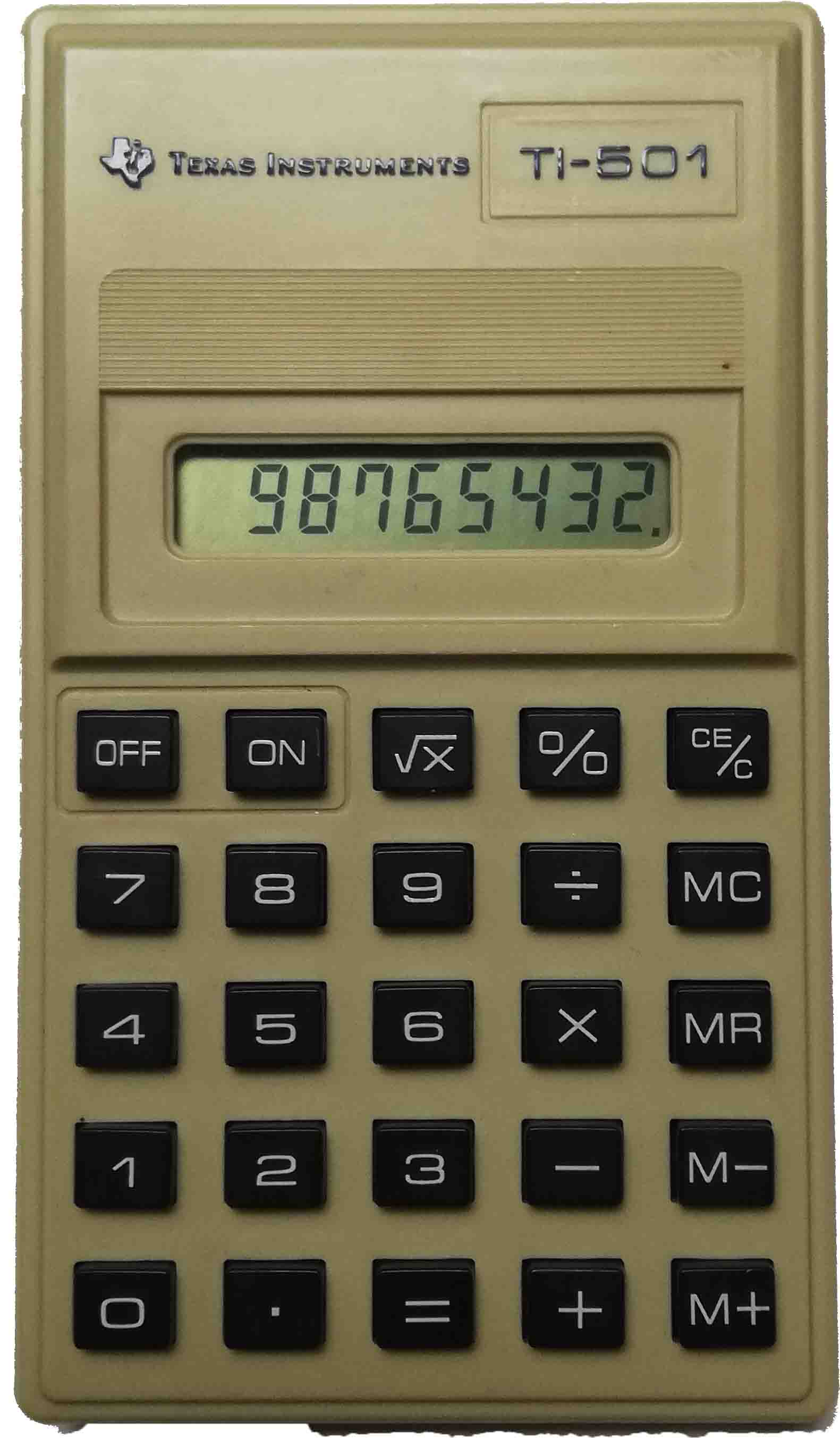 Model: TI-501
Battery: 2 x AA
Adapter:
Year: 1982
Chip: Toshiba
Info:
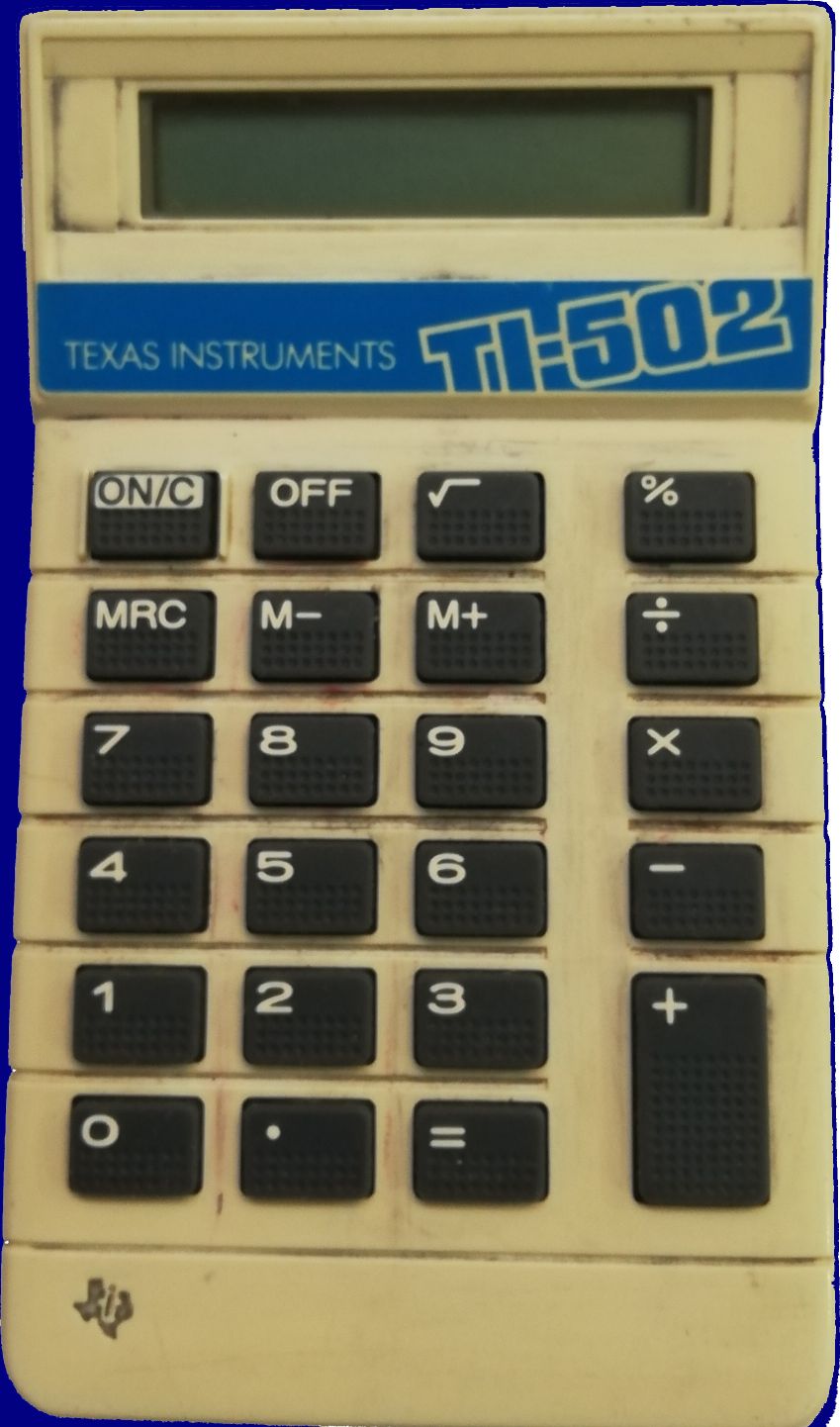 Model: TI-502 blue
Battery: LR1130
Adapter:
Year: 1988
Chip: Sharp LI3155
Info: LCD 1985 - 1990
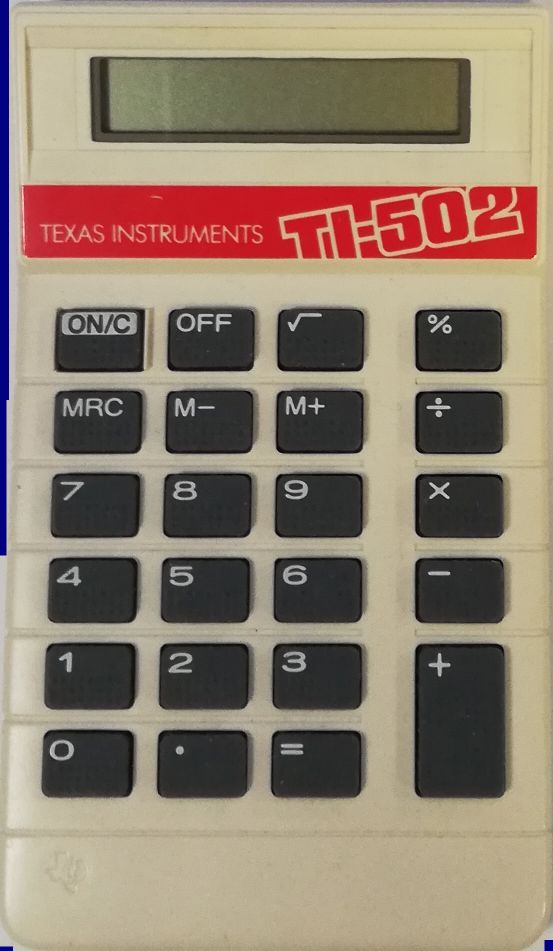 Model: TI-502 red
Battery: LR1130
Adapter:
Year: 1988
Chip: Sharp LI3155
Info: LCD 1985 - 1990
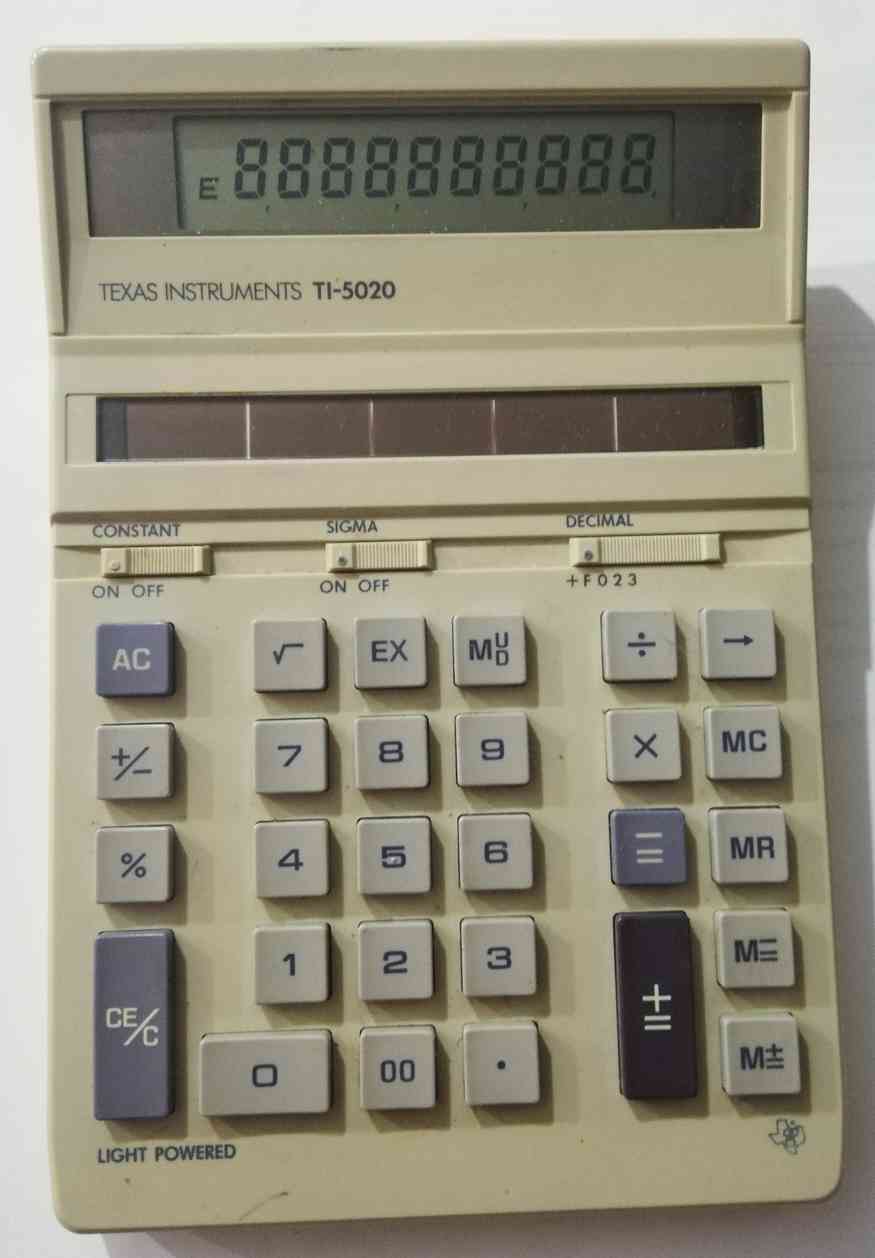 Model: TI-5020
Battery: Solar
Adapter:
Year: 1984
Chip: Toshiba T6897
Info:
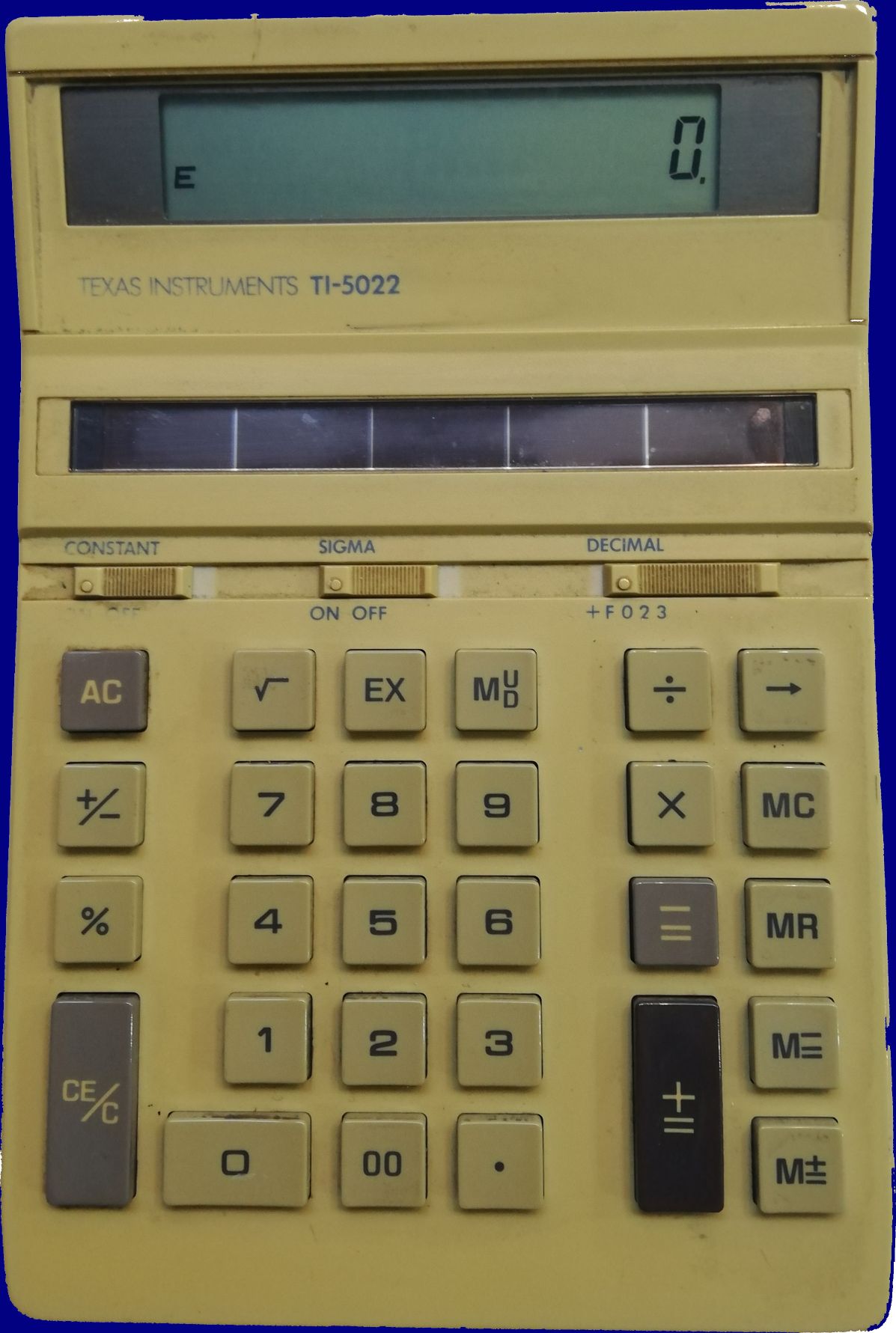 Model: TI-5022
Battery: solar
Adapter:
Year: 1983
Chip: Thoshiba T6897
Info: modern DESKTOP
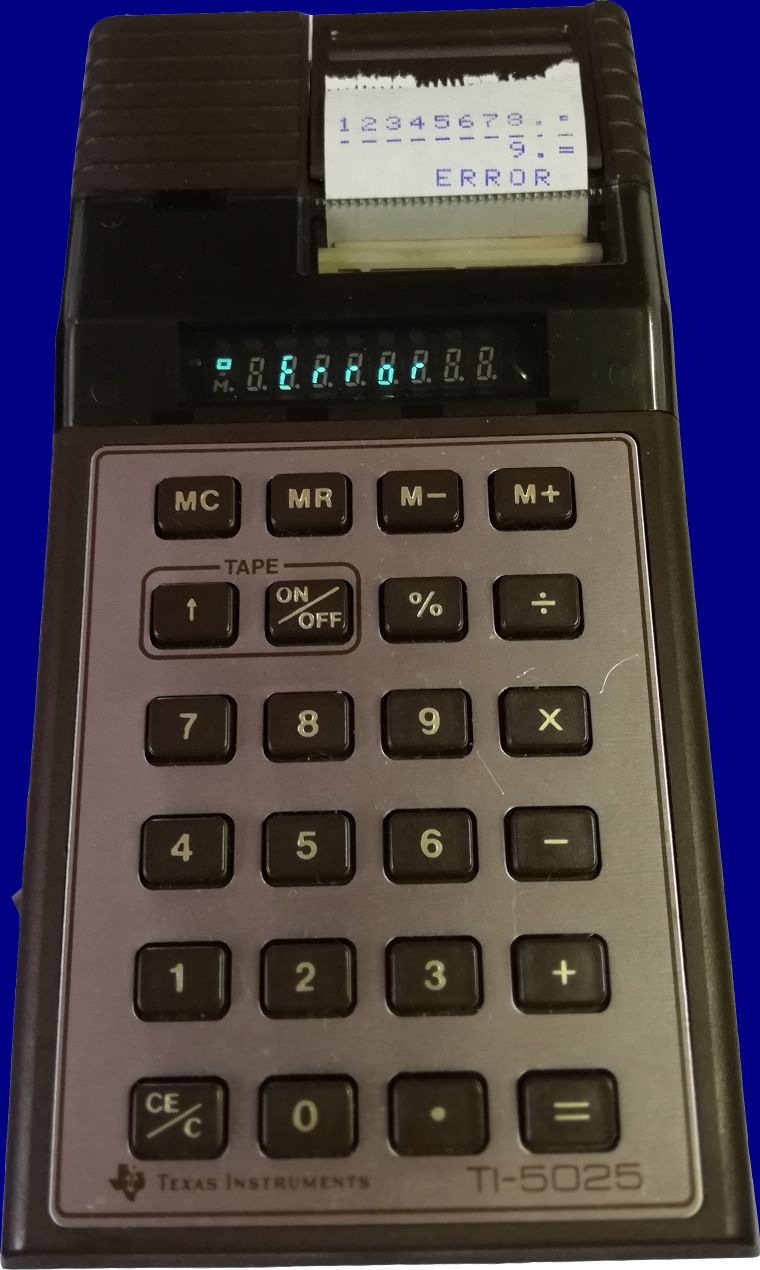 Model: TI-5025
Battery: 7 x AA ni-cd
Adapter: AC9172
Year: 1980
Chip: TMC0262
Info: first HANDHELD printing
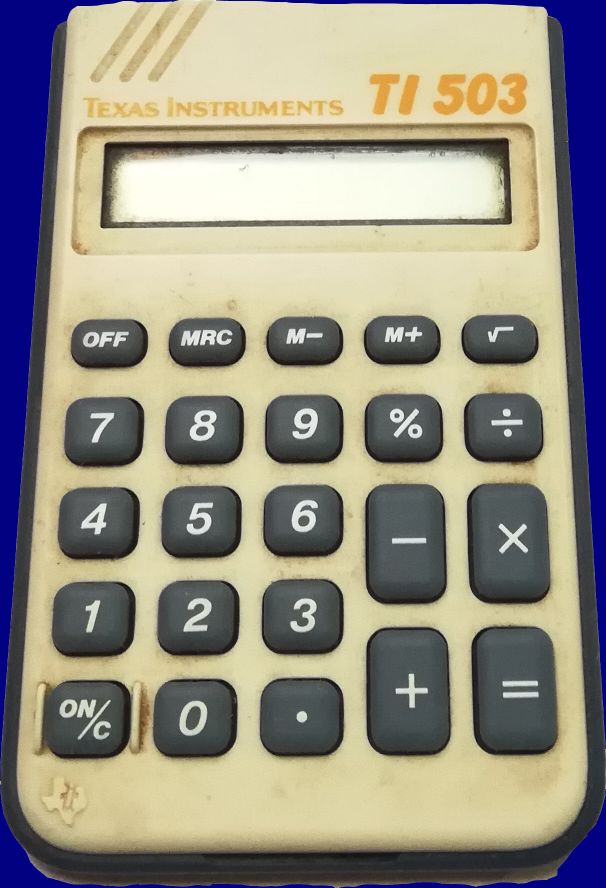 Model: TI-503
Battery: LR54
Adapter:
Year: 1991
Chip:
Info: LCD 1991 - 1999 Made in China
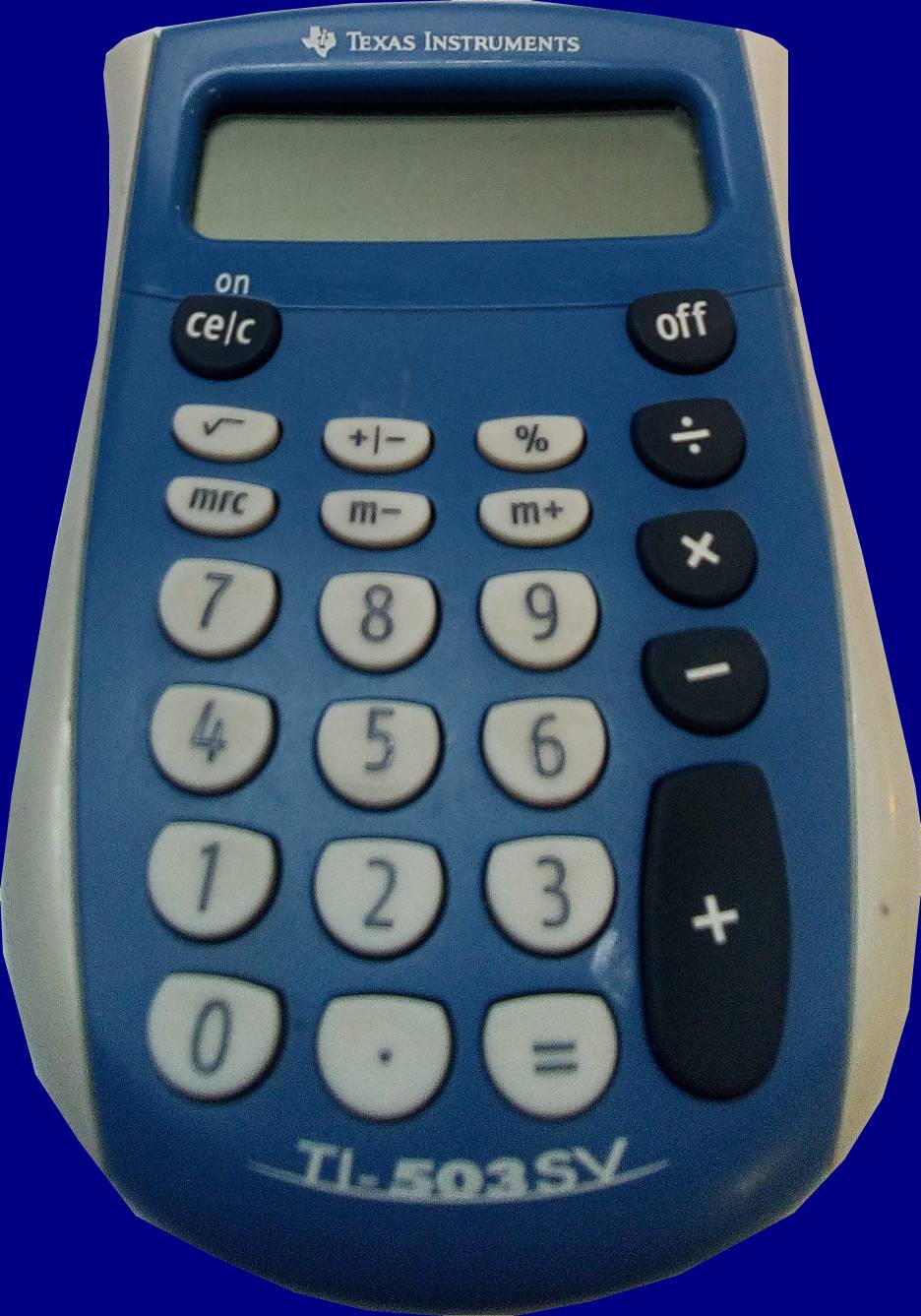 Model: TI-503 sv
Battery: solar , CR2032
Adapter:
Year: 2017
Chip:
Info: modern LCD 2000 - 2017 made in Philippines
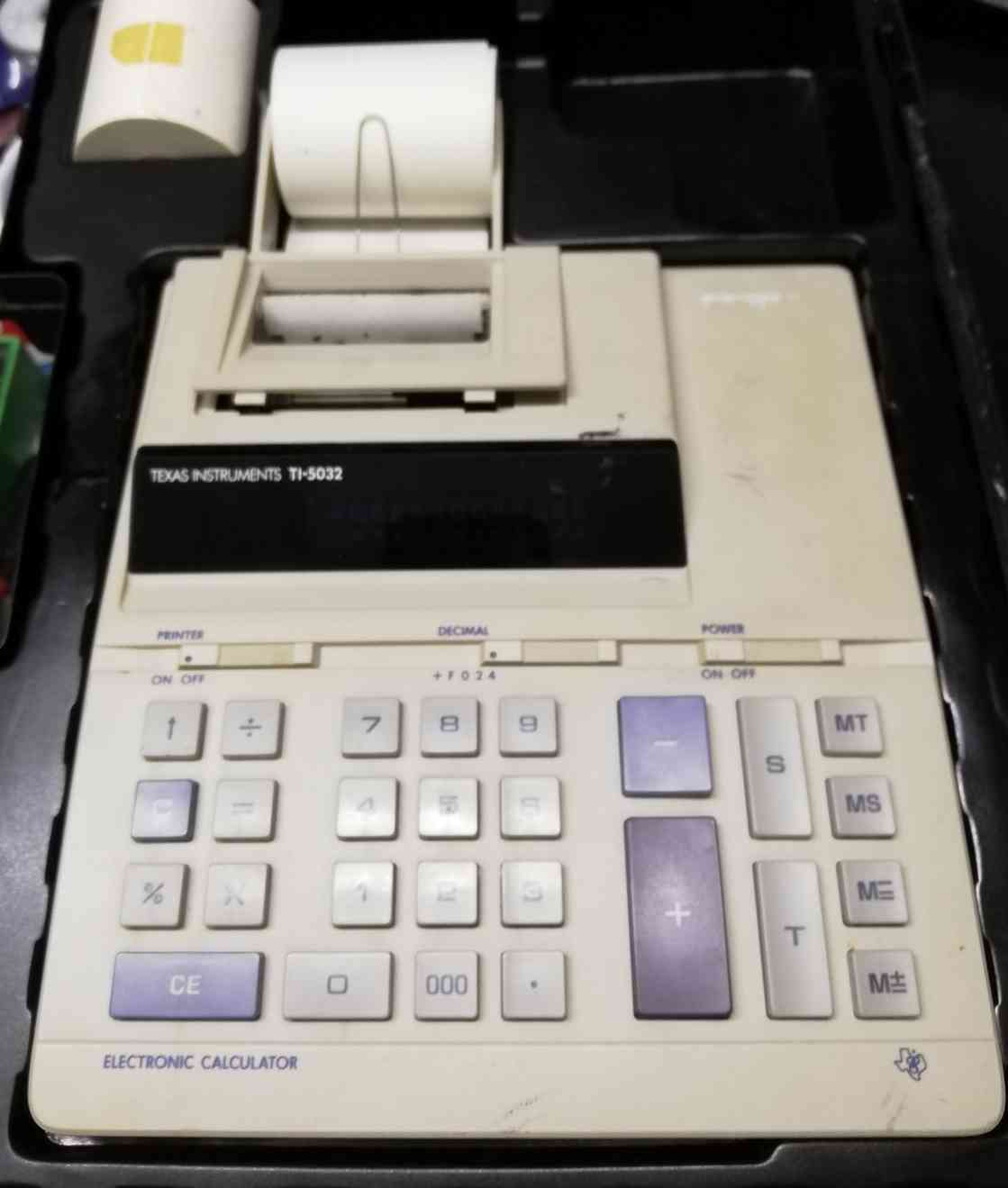 Model: TI-5032
Battery: 4 x AA
Adapter: AC9175
Year: 1983
Chip:
Manual:
Info: Donated from Maurizio Candito / The TI-5032 was the first battery operated printing desktop calculators introduced by Texas Instruments
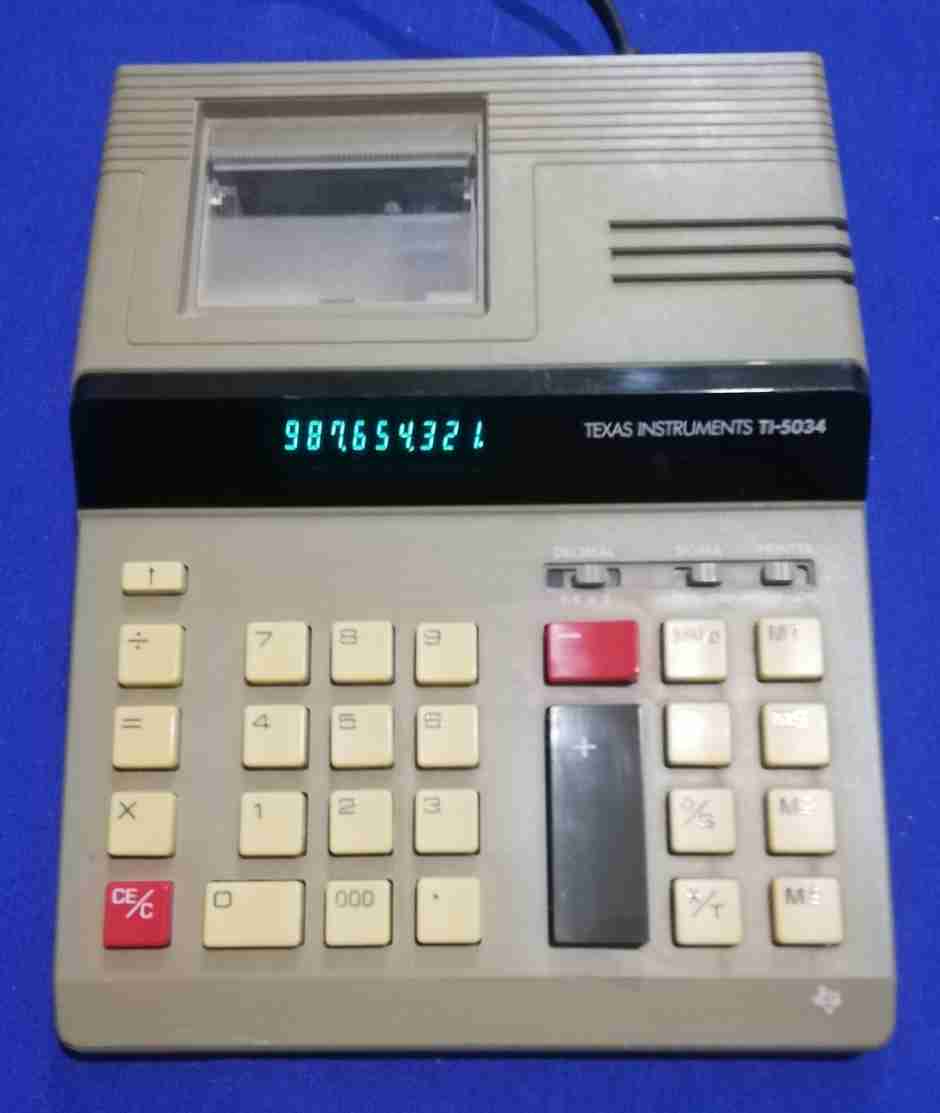 Model: TI-5034 2nd design
Battery: 220 volt
Adapter:
Year: 1990
Chip: Mitsubishi M58345AP
Info:
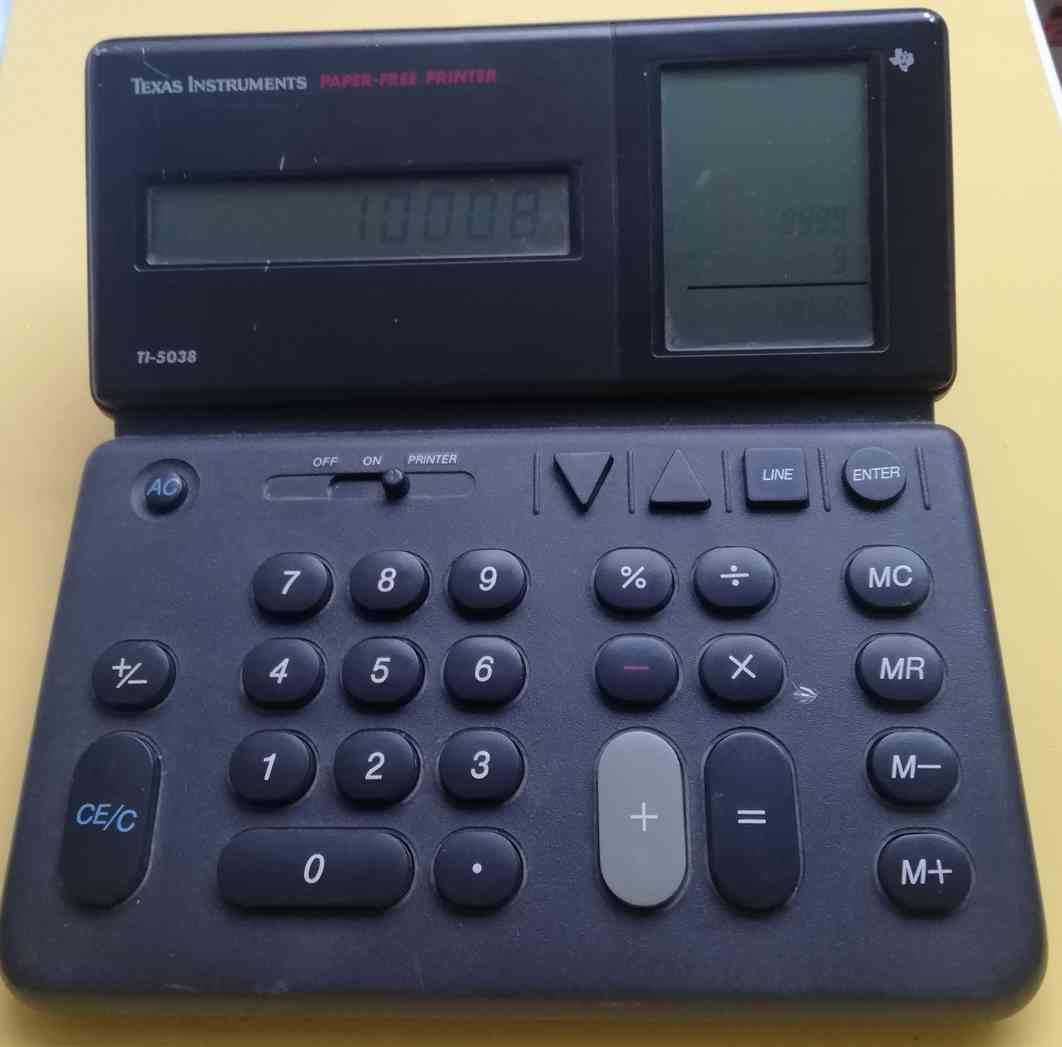 Model: TI-5038 paper free printer
Battery: 3 x AA
Adapter: AC9175
Year: 1989
Chip: Toshiba T7724, UM6116
Info: The TI-5038 continued a revolutionary concept introduced already in the year 1987: The TI-2800 Paperless Printer! The calculator works like the known printing desktops e.g. the TI-5130. All calculations are done on the main display. Instead the usual printout on a paper the results are scrolled through a secondary display with 6 lines. A maximum of 99 lines could be stored and scrolled up and down with the arrow keys.
 Model: TI-5045 SV
Battery: no
Adapter: 220 volt AC
Year: 1996 made in China
Chip: Toshiba TC83220-0027 or T7872-0016
Info: Donated by Fabio Sala
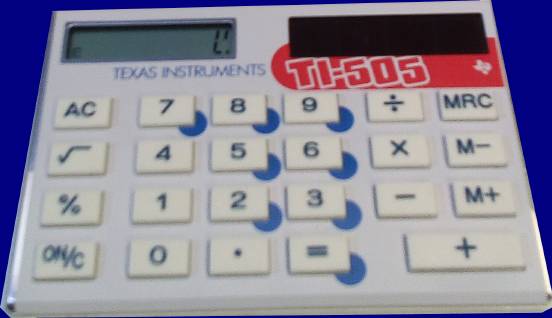 Model: TI-505
Battery: solar
Adapter:
Year: 1985
Chip:
Info: LCD 1985 - 1990
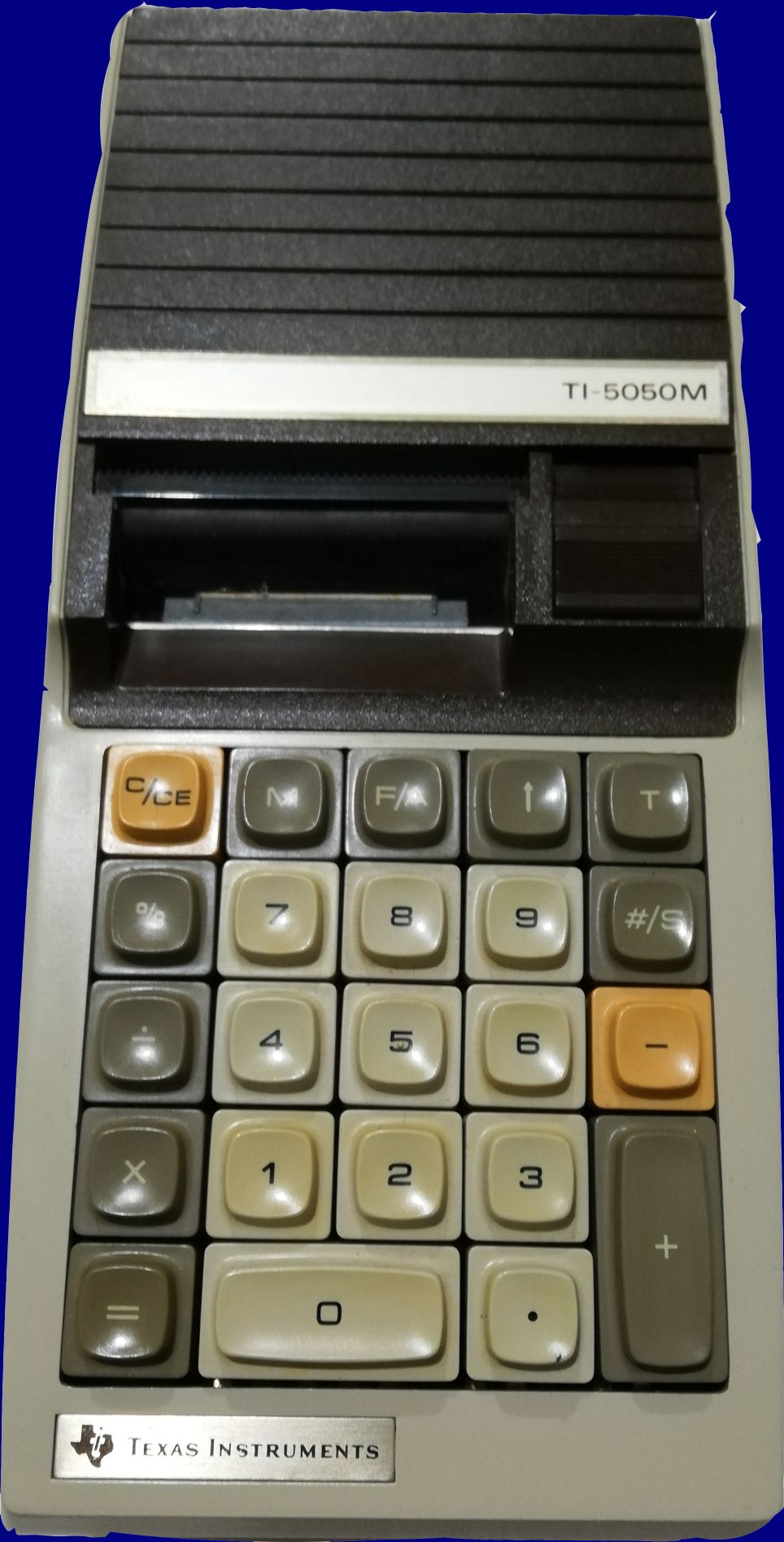 Model: TI-5050 M
Battery: 6 x AA ni-cd
Adapter: AC9171
Year: 1976
Chip: TMS1115
Info: first HANDHELD printing
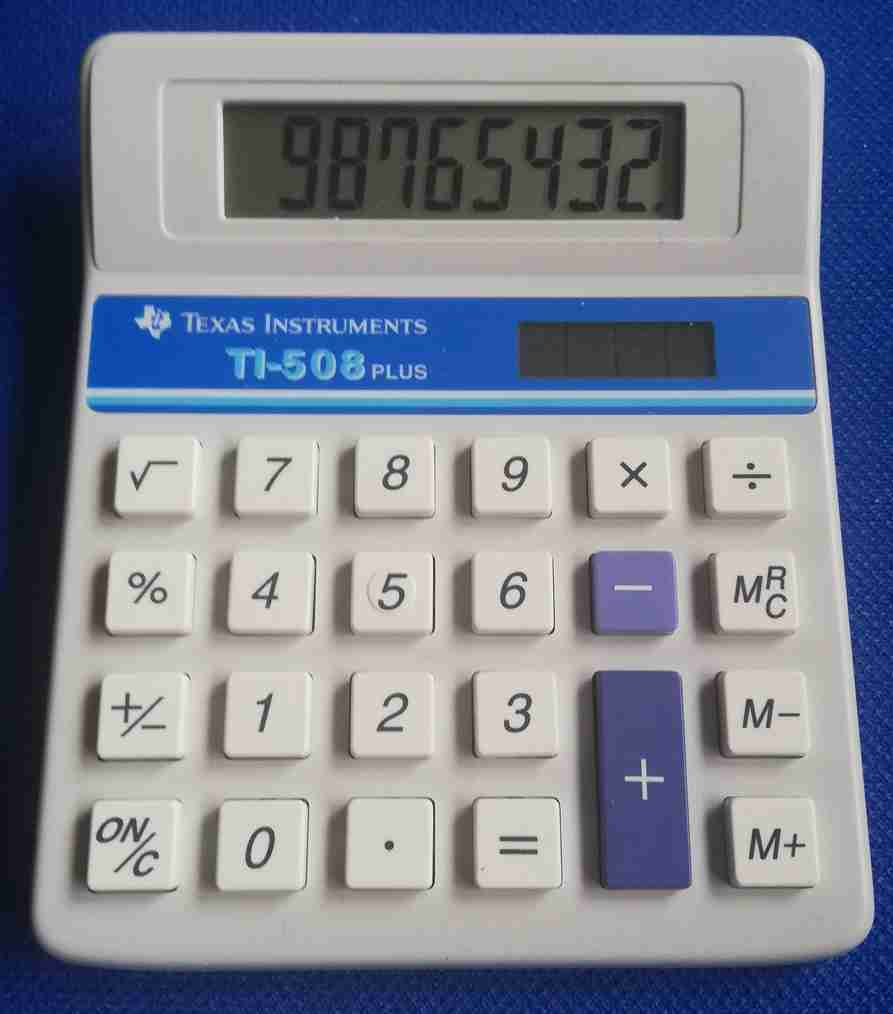 Model: TI-508 plus
Battery: solar
Adapter:
Year: 1995
Chip: Sharp LI3154
Info: made in Thailand
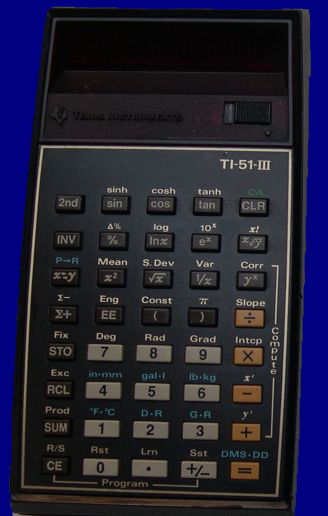 Model: TI-51 III
Battery: BP7
Adapter: AC9132
Year: 1979 Price: L.59.000 + iva 14%
Chip: TMC1502
Info:TI-51 III same as TI-55, but TI-55 was sold in the US while TI-51 III was sold in Europe. From an advertisement of the time! The most technical. Because it specializes in solving math problems (90 functions): from logarithms to trigonometry and complex statistical problems. Easy programmability (32 program steps, 10 memory registers) exponential notation. AOS (algebraic operating system). Polar/Rectangular conversions and unit conversions. It offers you the possibility to solve all your professional problems at the touch of a button.
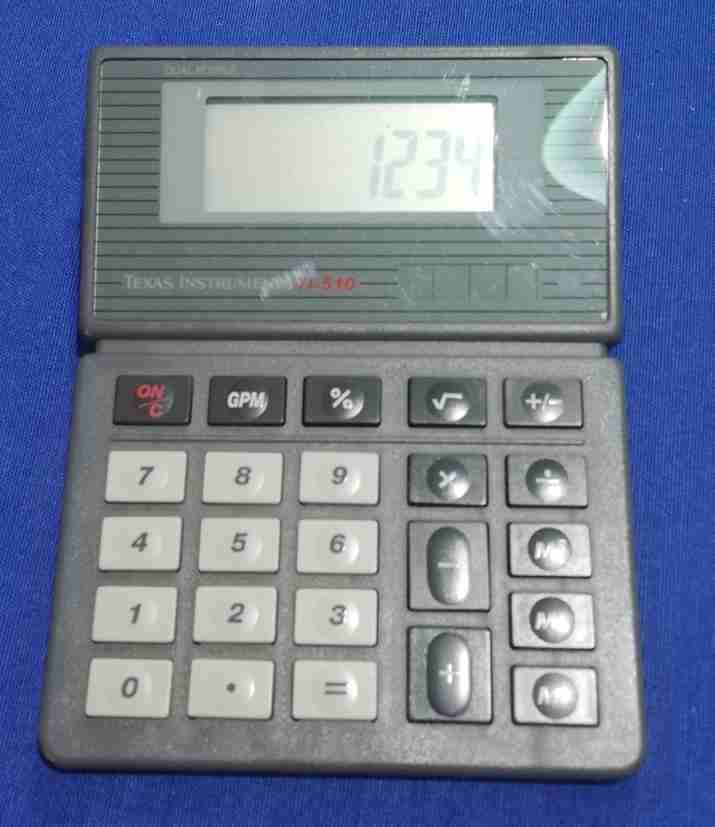 Model: TI-510
Battery: LR54 / solar
Adapter:
Year: 1980
Chip: Toshiba T9731BU
Info:
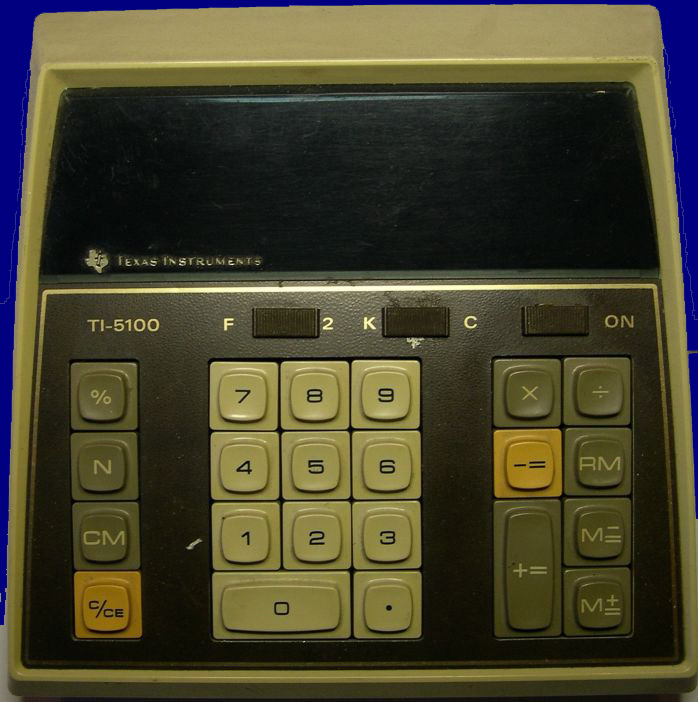 Model: TI-5100
Battery:
Adapter: AC/DC 220 volt -12 volt
Year: 1981
Chip: TMC1073
Info: DESKTOP line
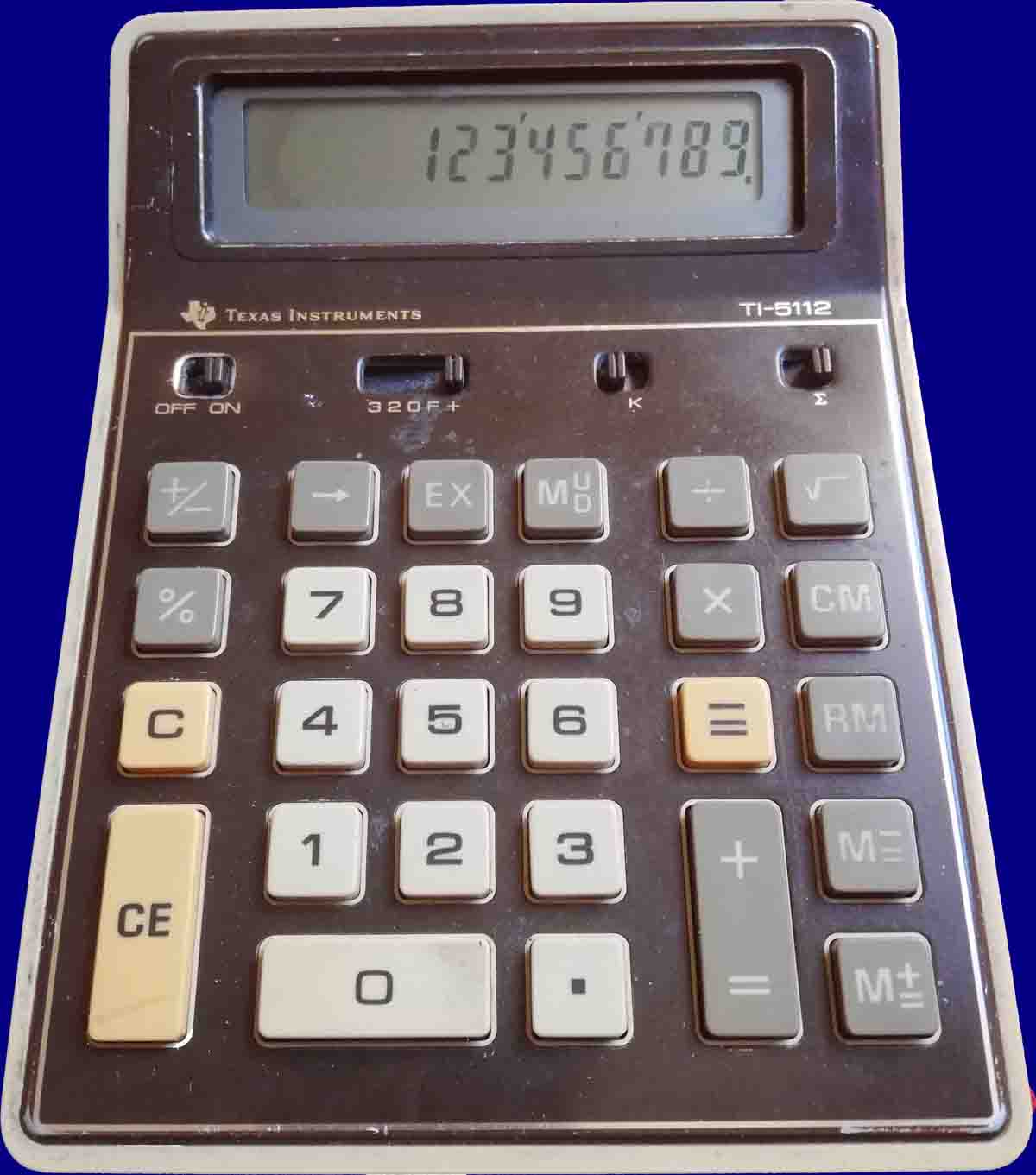 Model: TI-5112
Battery: 2 x AA
Adapter:
Year: 1988
Chip: Toshiba T6736S
Info:
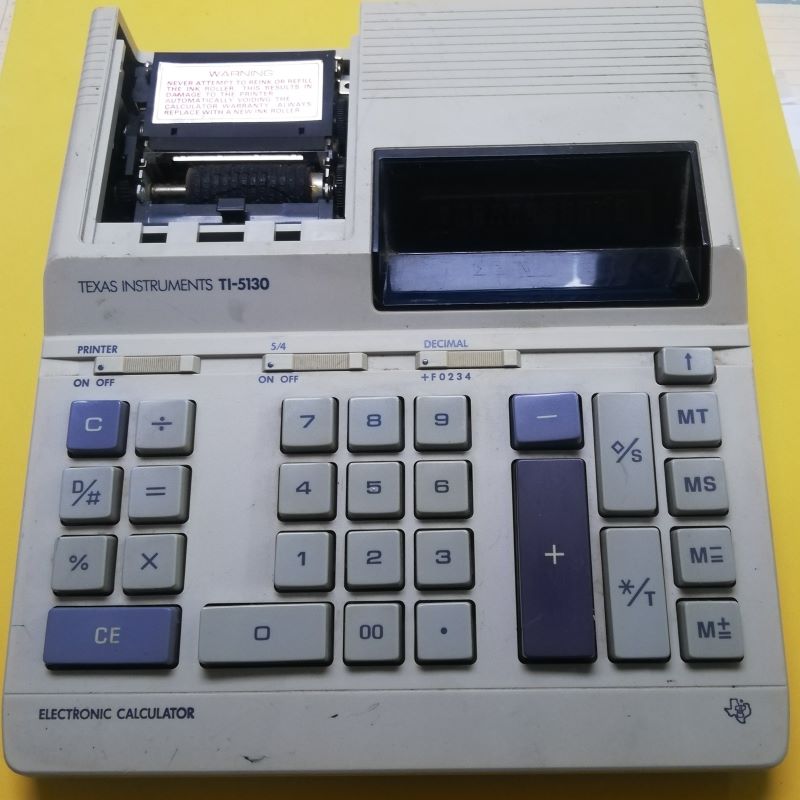 Model: TI-5130
Battery: 220 volt
Adapter: AC9900/T2
Year: 1983
Chip: NEC uPD1234G
Info: donated by the cellar clearer
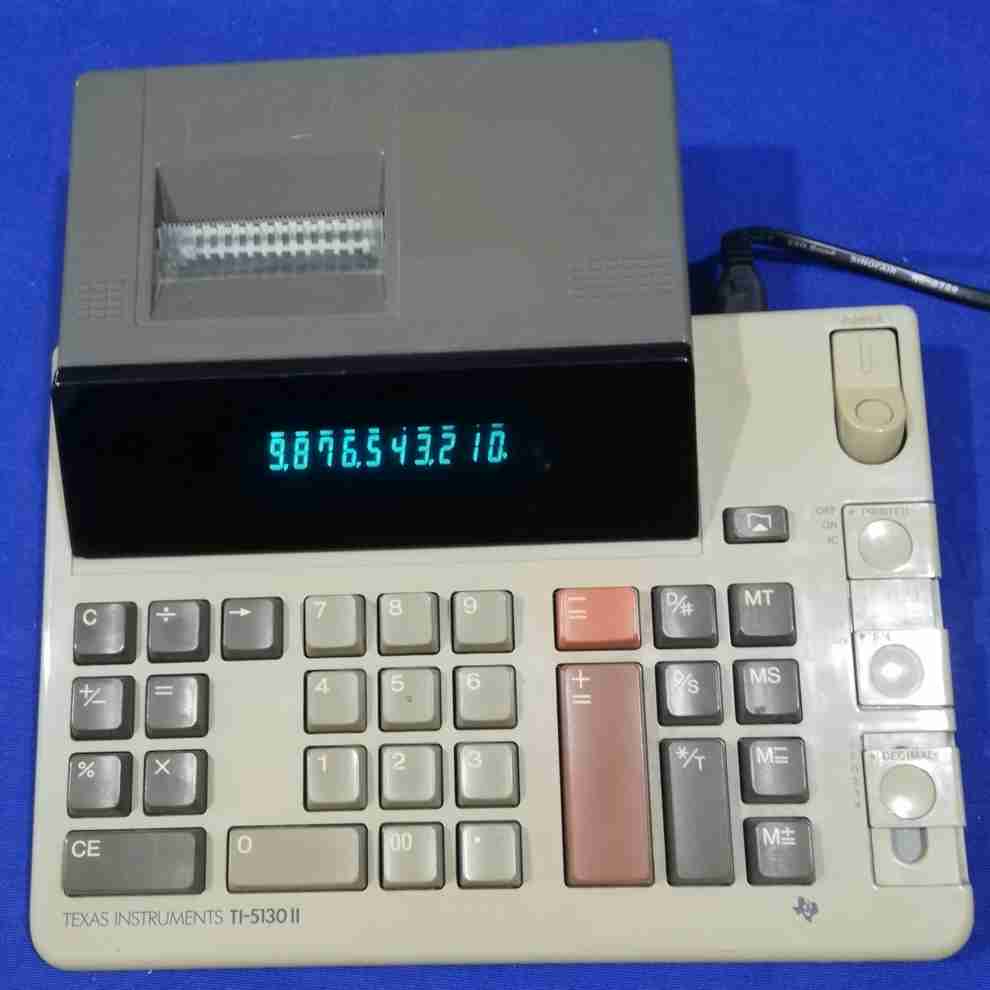 Model: TI-5130 II
Battery: 220 volt
Adapter:
Year: 1987
Chip: NEC uPD1234G
Info: made in Japan
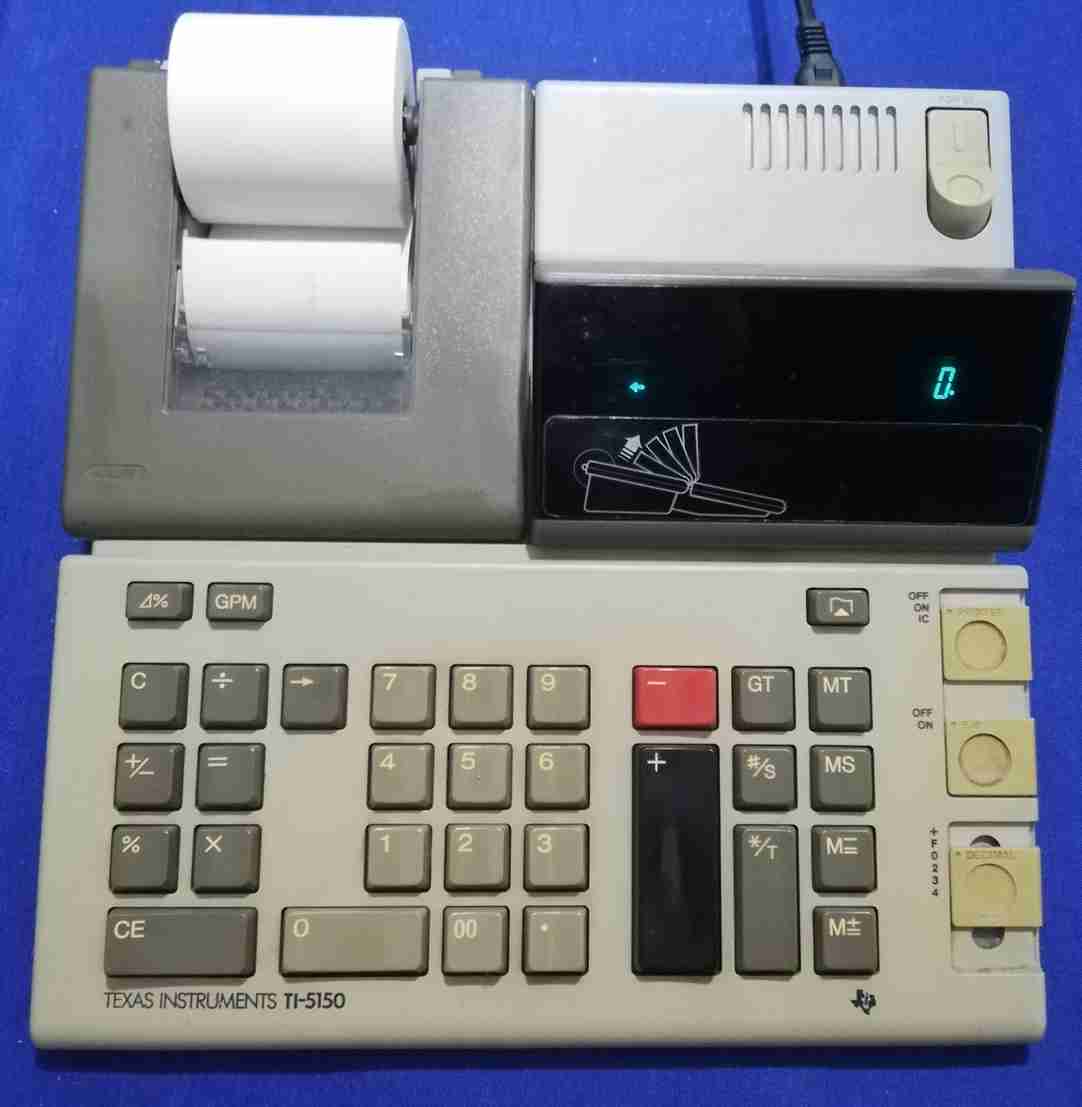 Model: TI-5150
Battery: 220 volt
Adapter:
Year: 1990
Chip:
Info:
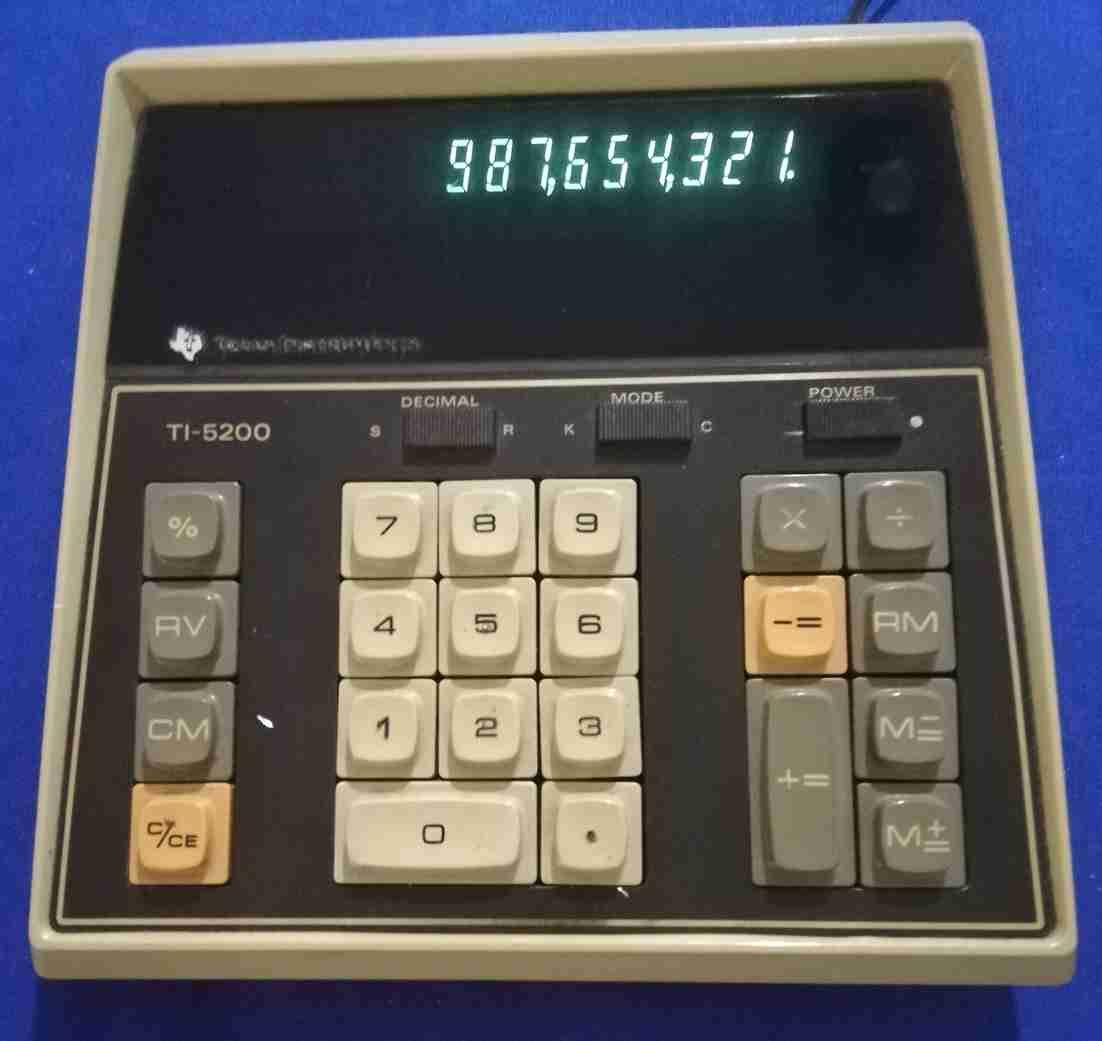 Model: TI-5200 beige
Battery:
Adapter: AC/DC 220 volt -12 volt
Year: 1978
Chip: TMC1278
Info: DESKTOP line
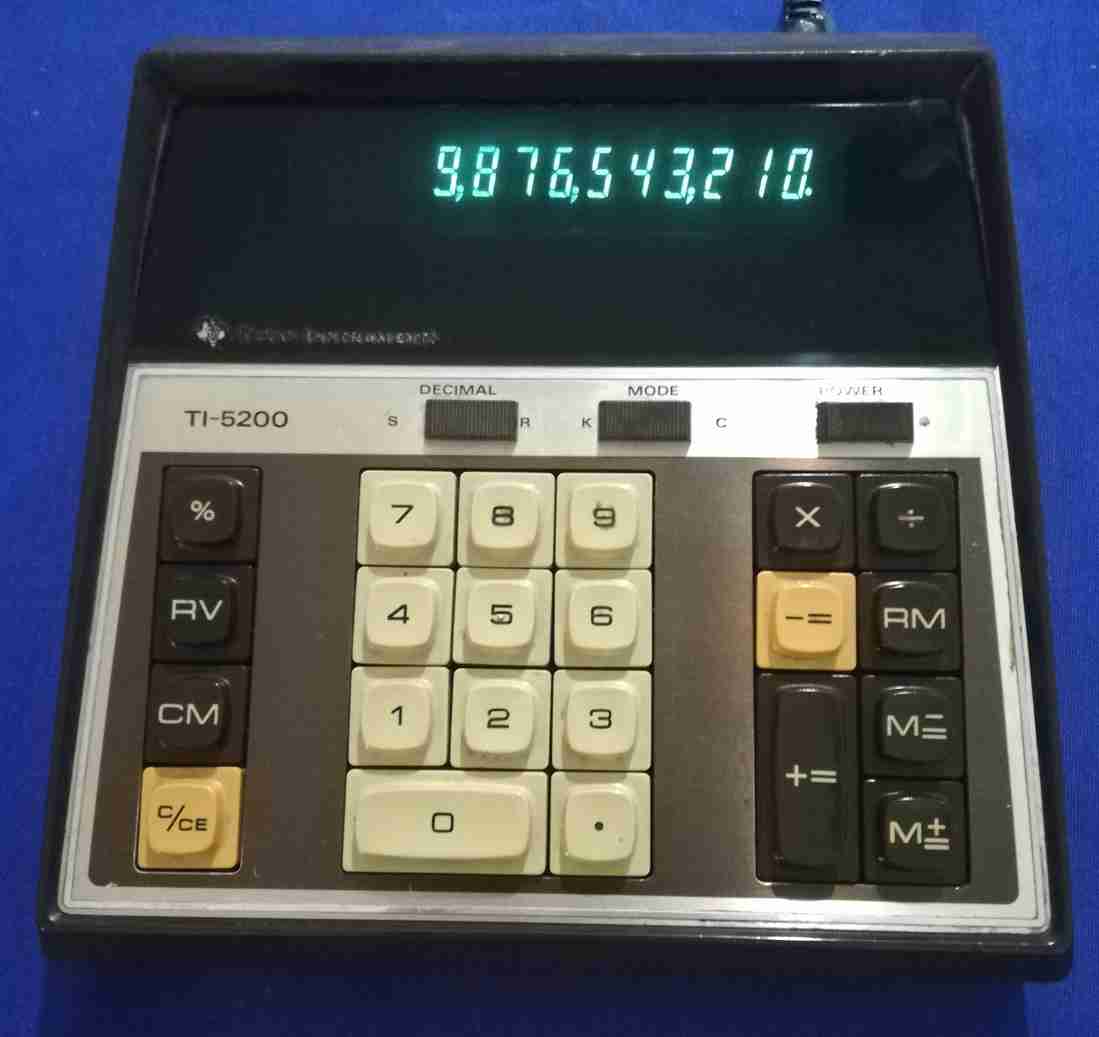 Model: TI-5200 brown
Battery:
Adapter: AC/DC 220 volt -12 volt
Year: 1978
Chip: TMC1278
Info: DESKTOP line
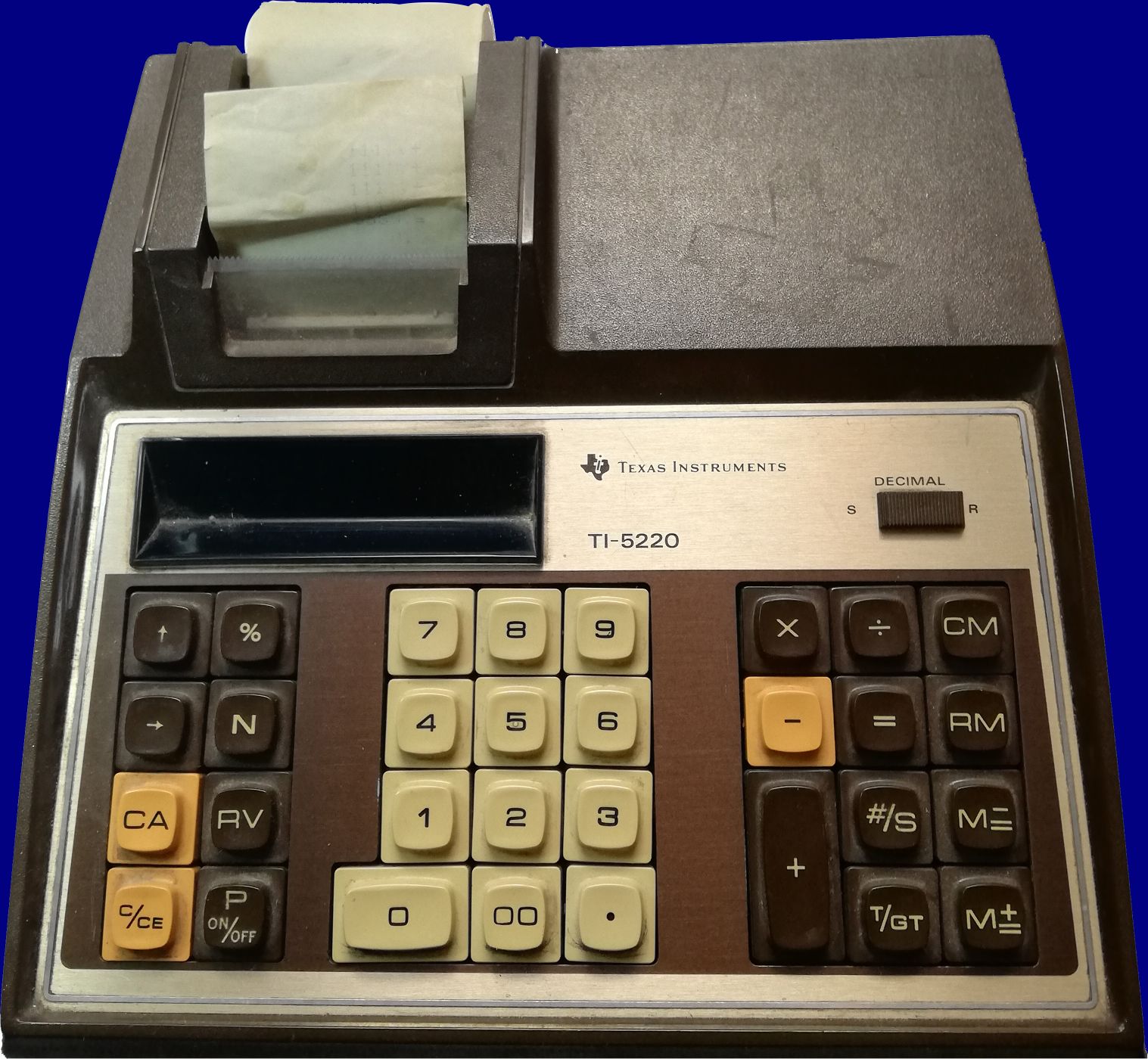 Model: TI-5220
Battery:
Adapter: 110 or 220 volt
Year: 1977
Chip: TMS1309, TMS1372
Info: DESKTOP line
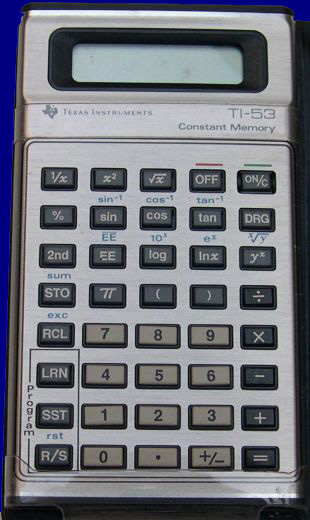 Model: TI-53
Battery: 2 x LR44
Adapter:
Year: 1982
Chip: TPO323
Info: first LCD and slimline LCD
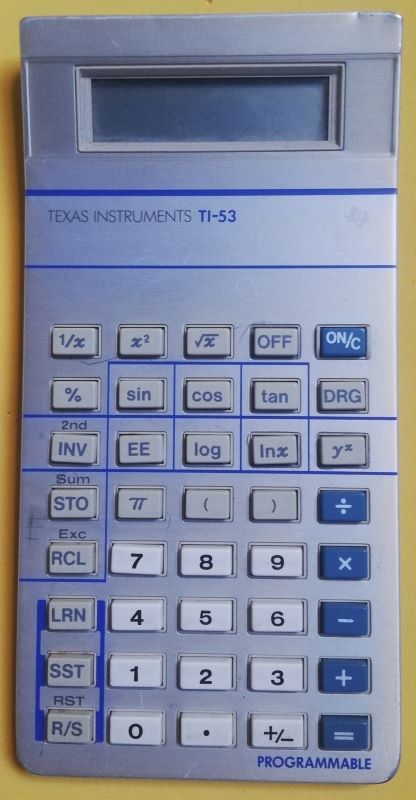 Model: TI-53 slanted
Battery: 2 x LR44
Adapter:
Year: 1985 ( RCI 17 85 )
Chip: TPO323
Info: Calculator donated by Ludovisi Giancarlo in 2023 during the 2nd edition "the story with Texas Instruments" in Rieti, (World Chili Pepper Fair).
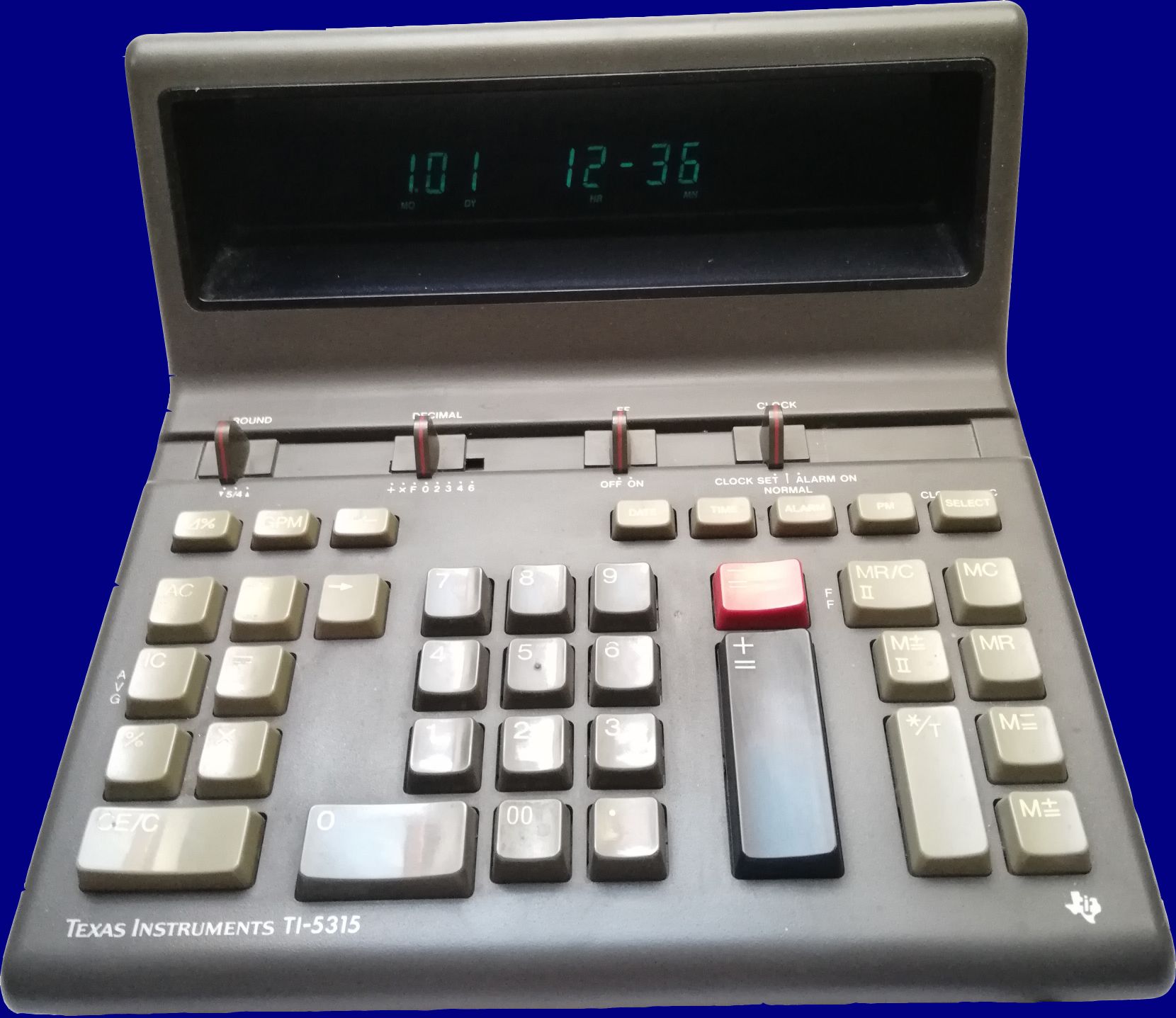 Model: TI-5315
Battery:
Adapter: AC 110 volt
Year: 1989
Chip: NEC upd7520
Info: modern DESKTOP built in clock
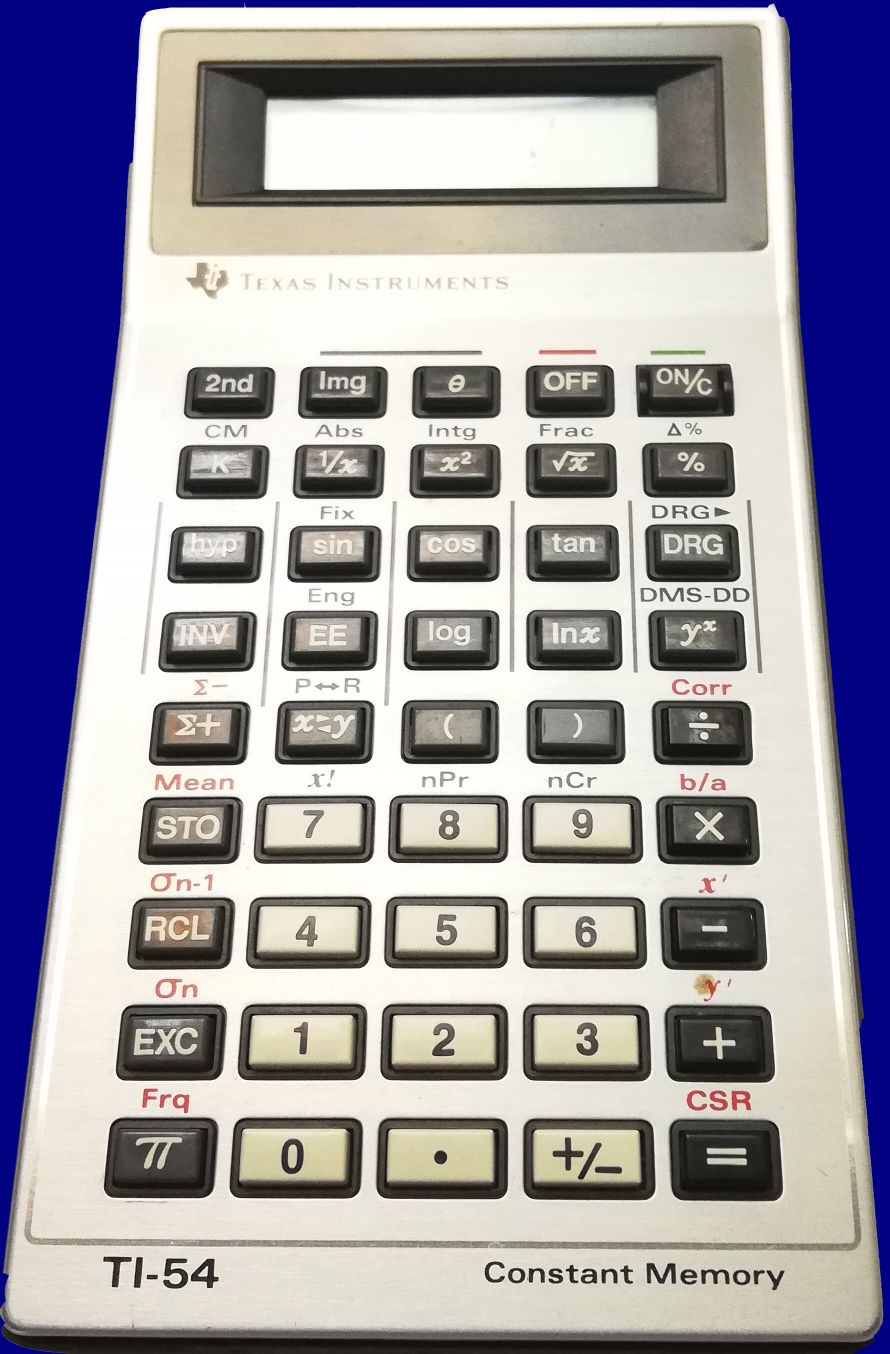 Model: TI-54
Battery: 2 x LR44
Adapter:
Year: 1982
Chip: CD4555,CD4551
Info: slanted LCD generation
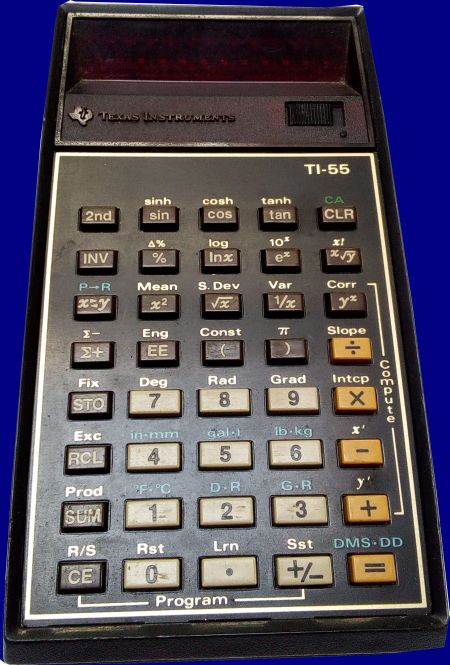 Model: TI-55
Battery: BP 7
Adapter: AC9132
Year: 1979
Chip: TMC1503
Info: TI-55 same as TI-51 III, but TI-55 was sold in the US while TI-51 III was sold in Europe.
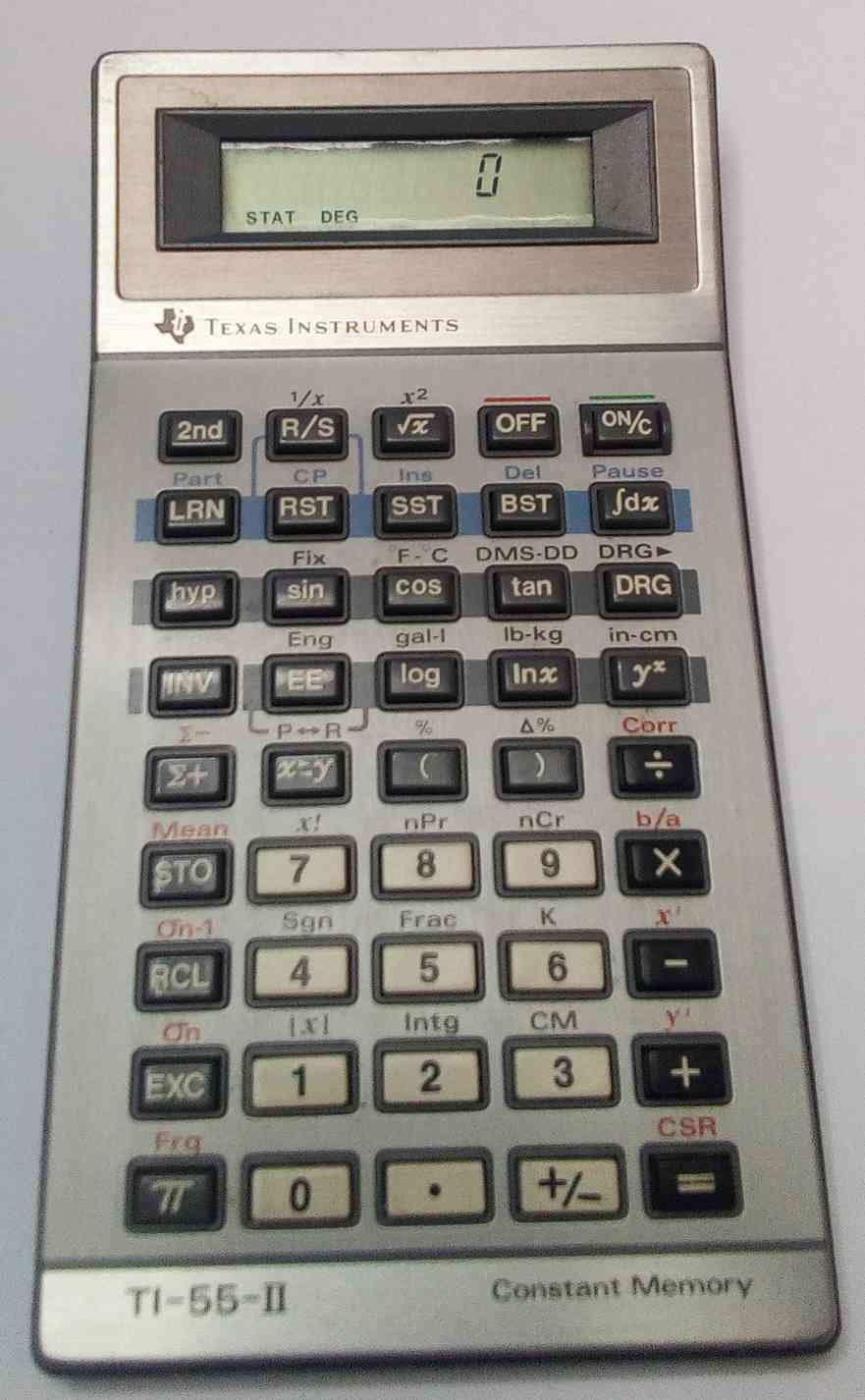 Model: TI-55 II
Battery: 2 x LR44
Adapter:
Year: 1981
Chip: CD4555,CD4556
Info: slanted LCD generation
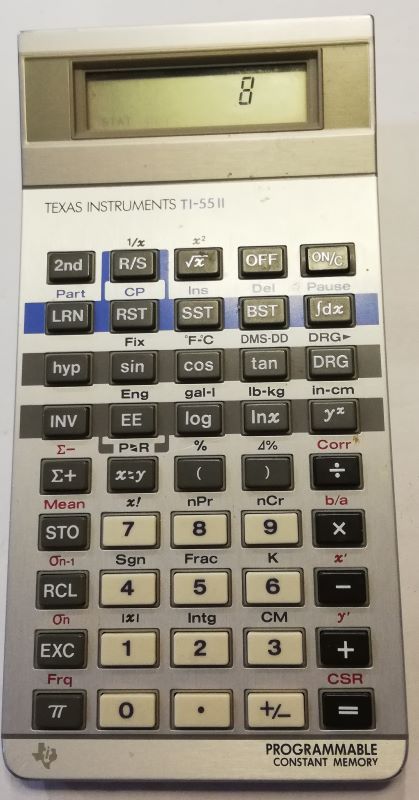 Model: TI-55 II programmable
Battery: 2 x LR44
Adapter:
Year: 1984
Chip: TP0456/CD4555, CD4556
Info: This TI-55 II could be called a rare calculator.
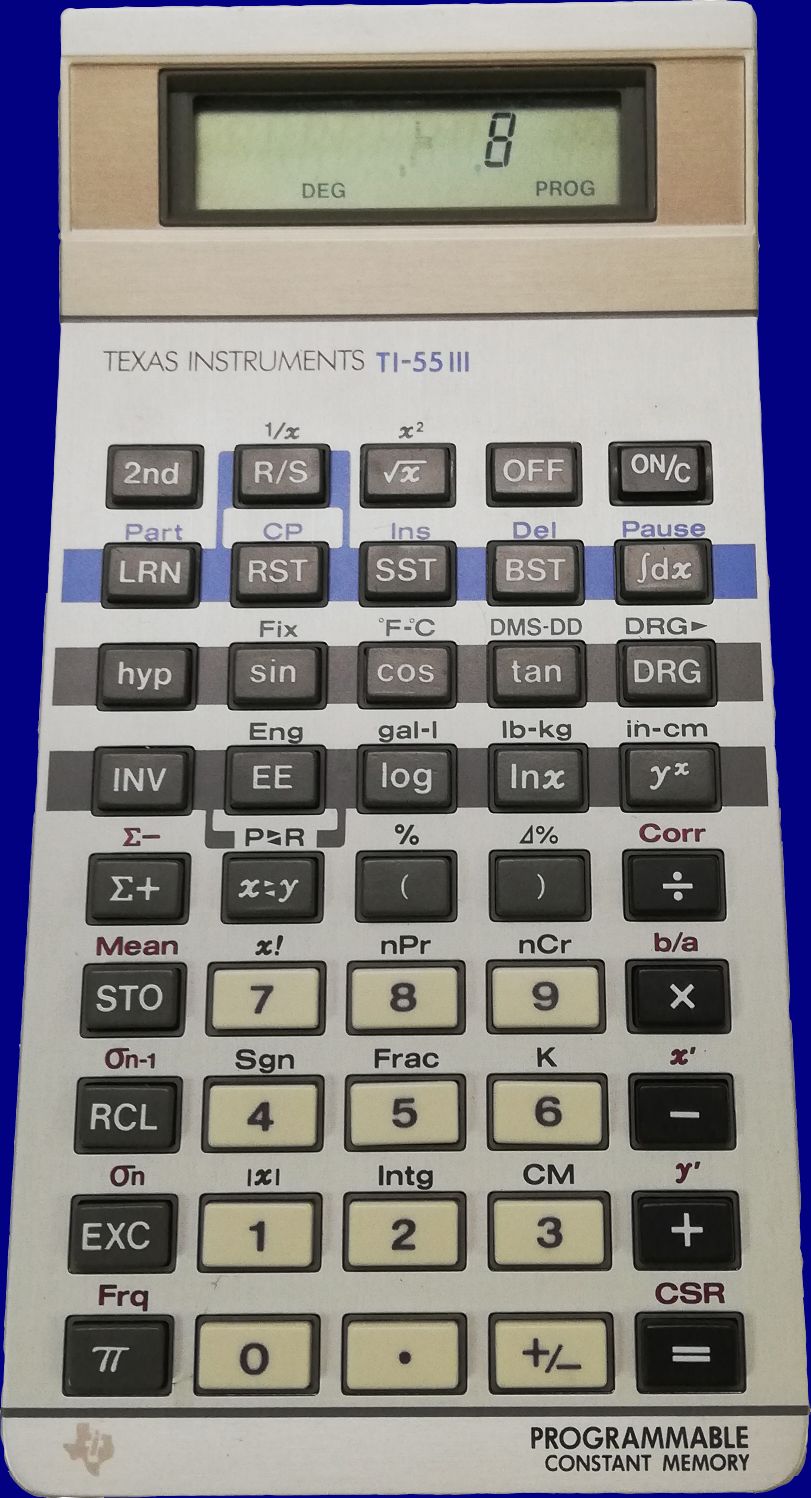 Model: TI-55 III
Battery: 2 x LR44
Adapter:
Year: 1986
Chip: CD4555,CD4556
Info: slanted LCD generation
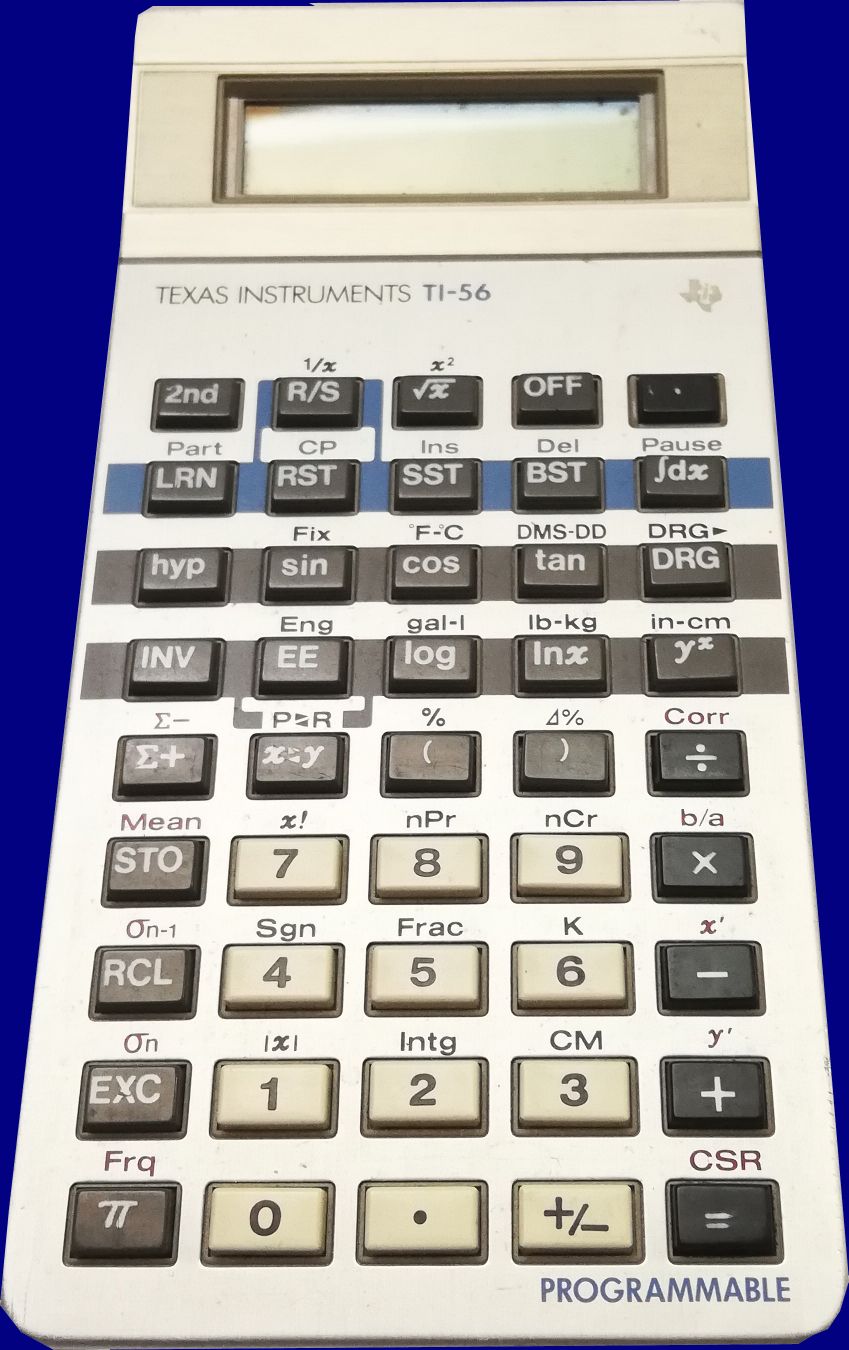 Model: TI-56
Battery: 2 x LR44
Adapter:
Year: 1985
Chip: CD4555,CD4556
Info: slanted LCD generation
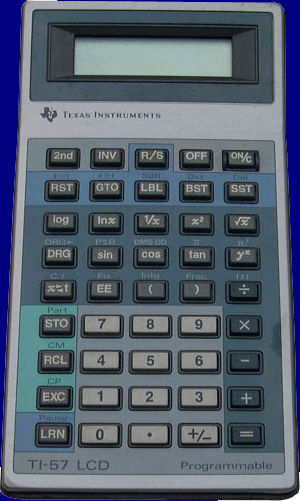 Model: TI-57 lcd
Battery: 2 x LR44
Adapter:
Year: 1984
Chip: CD4555,CD4572
Info: slanted LCD generation
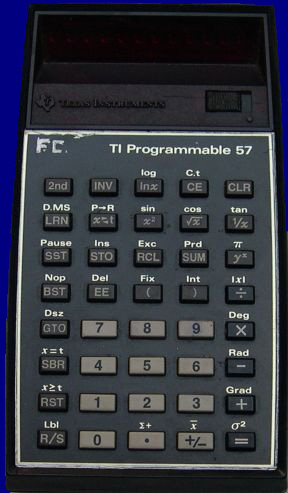 Model: TI-57 programmable
Battery: BP6 , BP7
Adapter: AC9131 , AC9132
Year: 1980 Price: L.55.000 + iva 14 %
Chip: TMC1501
Info: From an advertisement of the time! The most versatile. Because it is specialized it has 50 compact program steps. Thus it is a real programmable one which, maintaining at the same time the characteristics of a scientific one, lends itself to solving many problems with extreme flexibility. 8 addressable memories, AOS (algebraic operating system), 9 levels of parentheses, 10 labels, 2 levels of subroutines, 4 decision functions, 2 loop control functions. This is why it is the best-selling scientific-programmable in the world!
 Model: TI-57 programmabile
Battery: BP6 , BP7
Adapter: AC9131 , AC9132
Year: 1980 Price: L.55.000 + iva 14 %
Chip: TMC1501
Info: From an advertisement of the time! The most versatile. Because it is specialized it has 50 compact program steps. Thus it is a real programmable one which, maintaining at the same time the characteristics of a scientific one, lends itself to solving many problems with extreme flexibility. 8 addressable memories, AOS (algebraic operating system), 9 levels of parentheses, 10 labels, 2 levels of subroutines, 4 decision functions, 2 loop control functions. This is why it is the best-selling scientific-programmable in the world! Special version with Italian mask, probable prototype.
Property Marie Collas
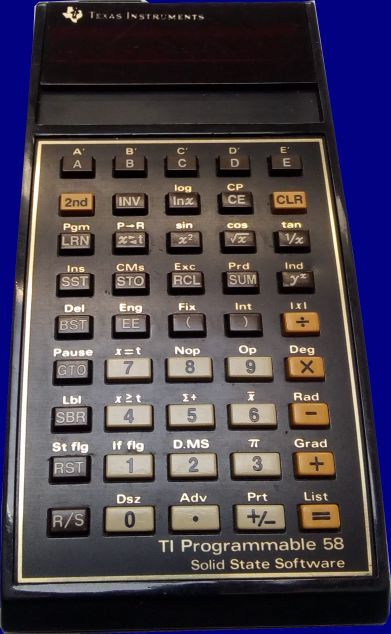 Model: TI-58
Battery: BP1 A
Adapter: AC9131 or DC9105
Year: 1977
Chip: TMC0501E TMC0582 TMC0583 TMC0571 2x TMC0598
Info: TI-58 / 59 programmable
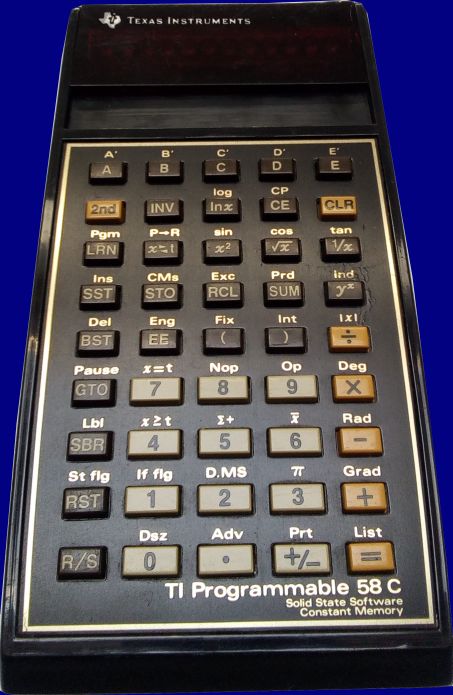 Model: TI-58 C
Battery: BP1 A
Adapter: AC9131 or DC9105
Year: 1982
Chip: TMC0501E TMC0591 CD2400 CD2401 TMC0573 TC5047
Info: TI-58 / 59 programmable
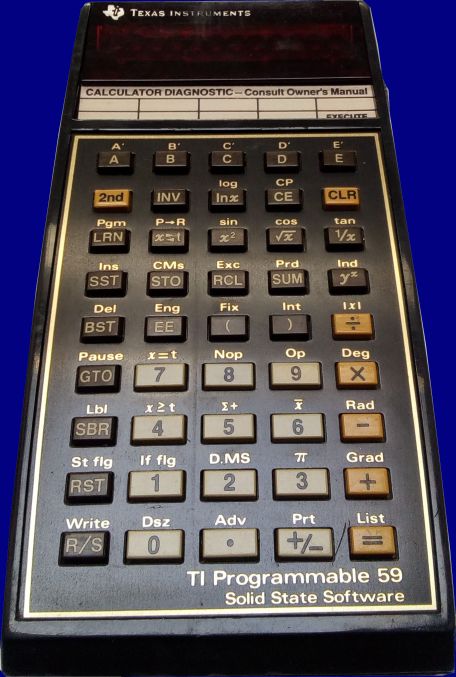 Model: TI-59
Battery: BP1 A
Adapter: AC9131 or DC9105
Year: 1980
Chip: TMC0501E TMC0582 TMC0583 TMC0571 TMC0594 4x TMC0598
Info: TI-58 / 59 programmable
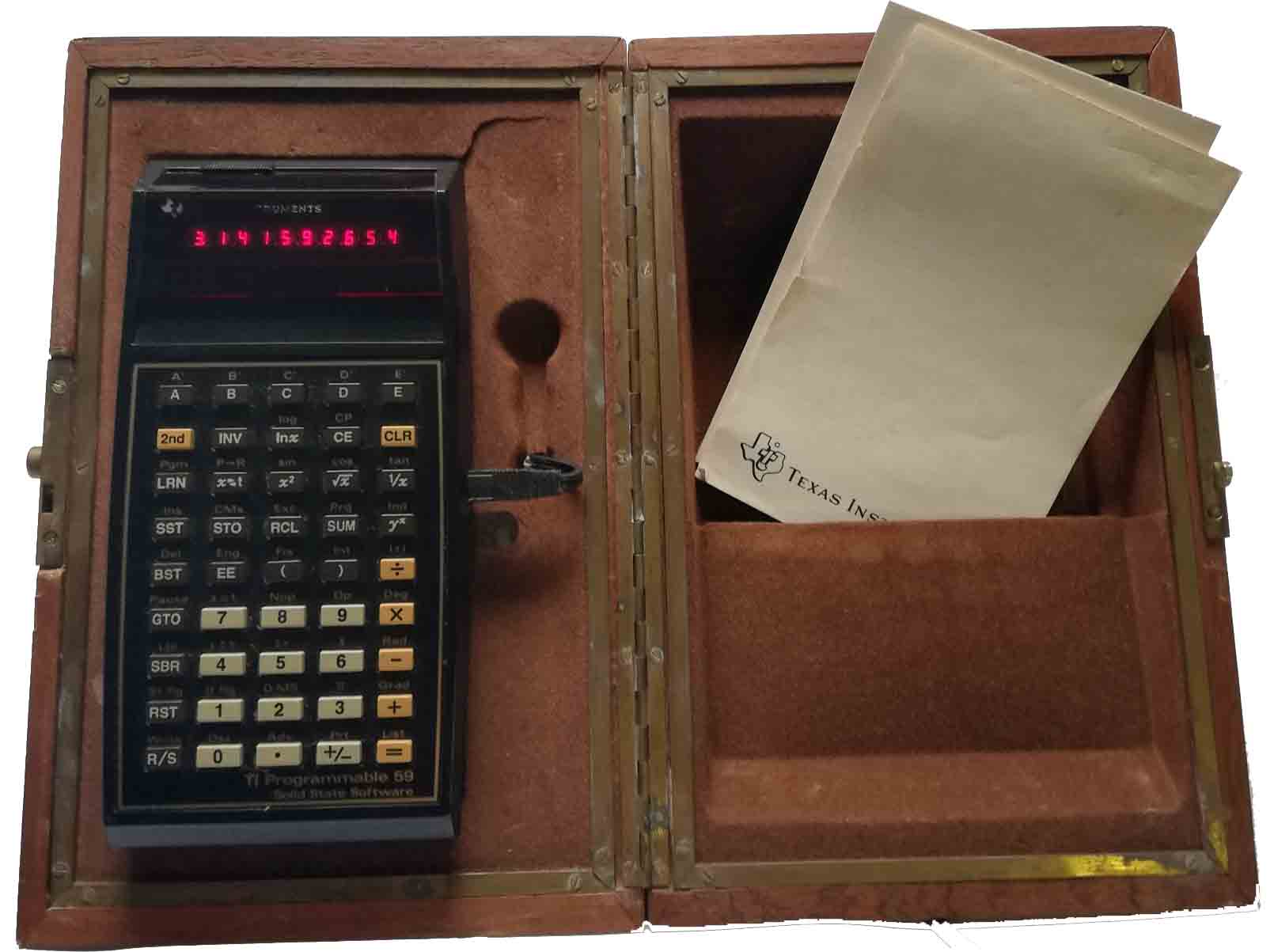
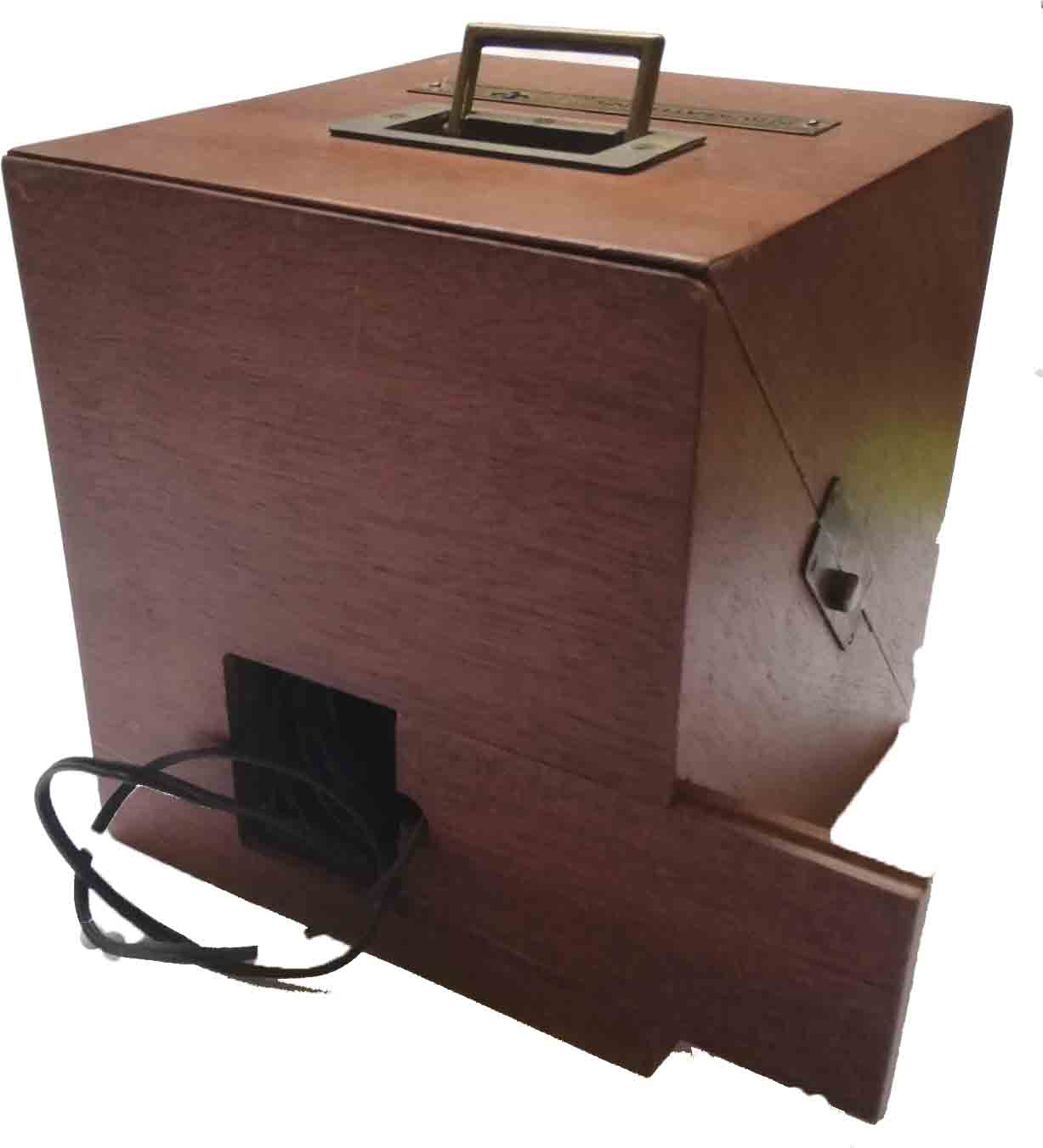
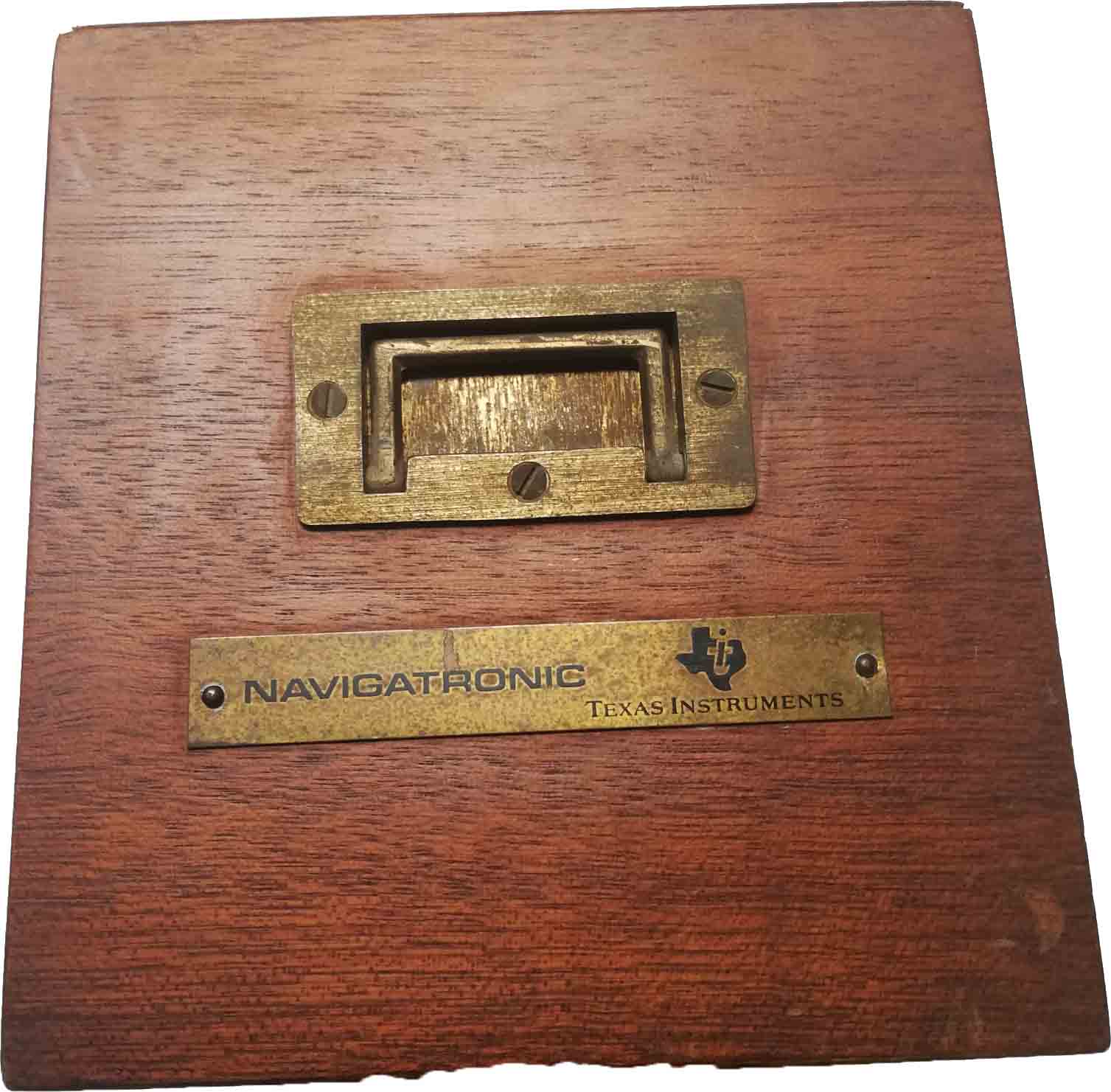 TI-58 or TI-59 calculator this rare Marine Navigation version uses a specialized module with navigation related programs. The calculator was mounted in a expensive wooden box and equipped with a DC-converter for usage on a boat.
The TI-58 and TI-59 calculators introduced a novelty, the Solid State Software Modules™ with up to 5000 program steps. On the backside of the TI-58/59 you'll note a small lid with a place for a module. The Master Library, known as "Module -1-", with 25 different programs was included with the TI-58, TI-58C, and TI-59. Twelve additional Solid State Software Modules™, known as "Module -2- to -13-" were available from Texas Instruments as Standard Modules.
| 1 | Master Libray | TMC0541 |
| 2 | Applied Statistics | TMC0542 |
| 3 | Real Estate Investment | TMC0543 |
| 4 | Surveying | TMC0544 |
| 5 | Marine Navigation | TMC0545 |
| 6 | Aviation | TMC0546 |
| 7 | Leisure Library | TMC0547 |
| 8 | Security Analysies | TMC0548 |
| 9 | Business Decision | TMC0549 |
| 10 | Math Utilities | TMC0550 |
| 11 | Electrical Engineering | TMC0551 |
| 12 | Agriculture | TMC0554 |
| 12 | Surveying ITALY | ??? |
| 13 | Structural Engineerign | TMC0553 |
| 13 | RPN Simulator | TMC0555 |
| 16 | Loran C Navigation | TMC0540 |
 Card reader with replacement of the licorice wheel... As promised the photos. I used the 7 mm external and 3 mm internal tube, in some cases I had to use the 6 mm one (SR series), since you disassemble everything, clean all the gears and then use a lithium grease (little I recommend). Since you have to disassemble everything, clean the magnetic head with isopropyl alcohol.


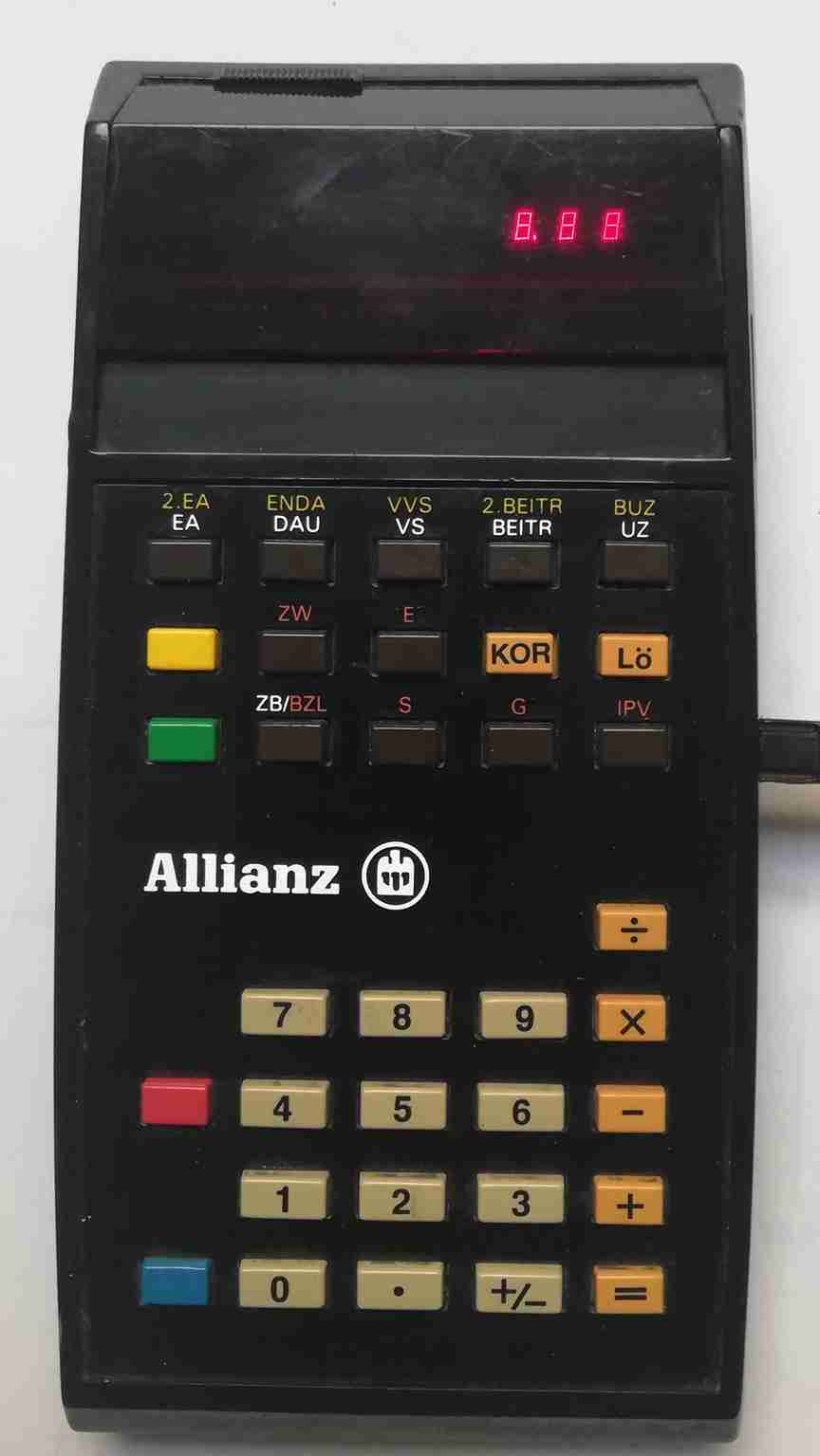 Model: TI-59 ALLIANZ
Battery: BP1 A
Adapter: AC9131 or DC9105
Year: 1979
Chip: TMC0501E TMC0591 CD2400 CD2401 TMC0573 TC5047
Info: made in Holland
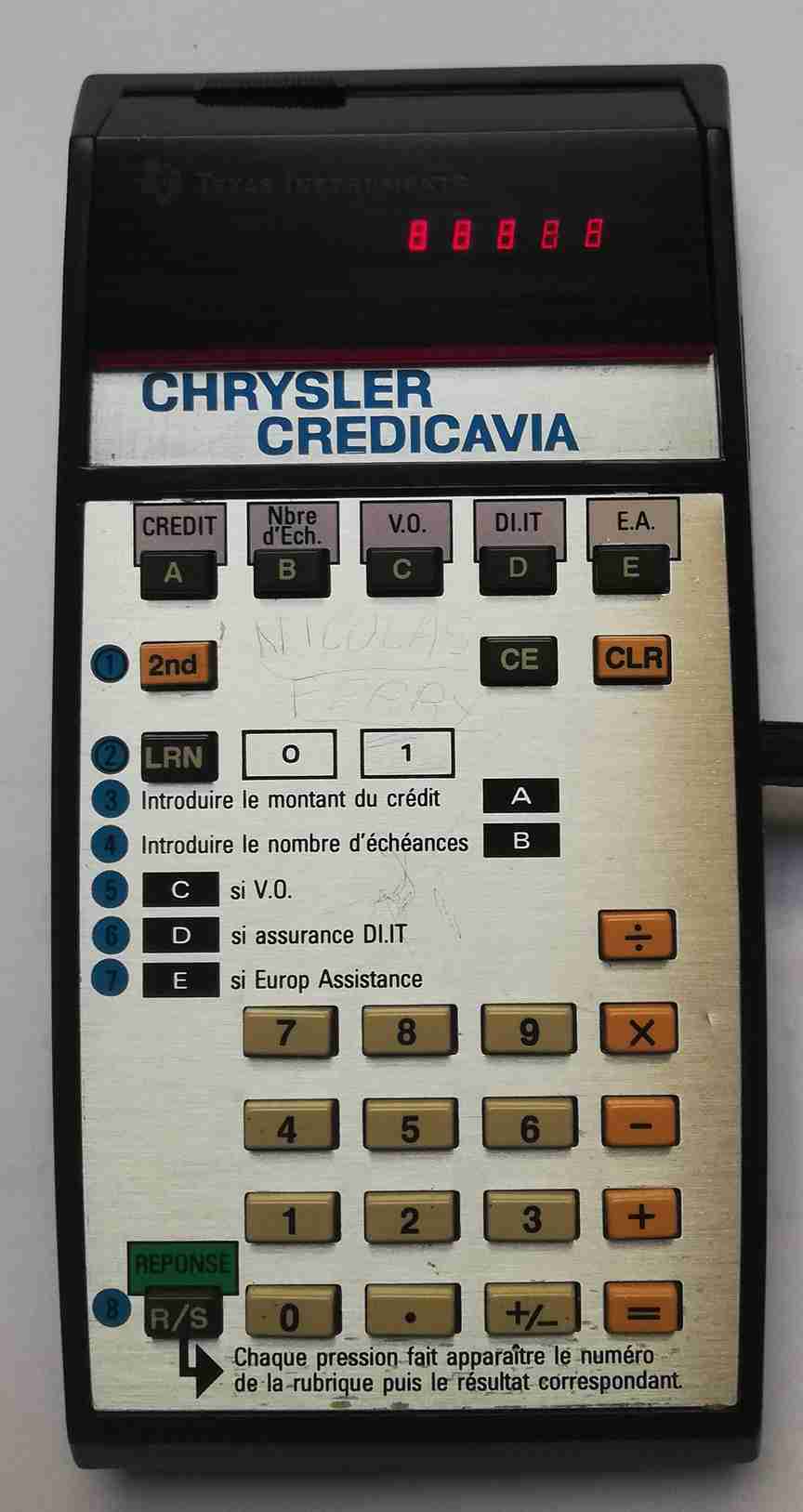 Model: TI-59 Chrysler Credicavia
Battery: BP1 A
Adapter: AC9131 or DC9105
Year: 1978
Chip: TMC0501E TMC0591 CD2400 CD2401 TMC0573 TC5047
Info: made in Holland
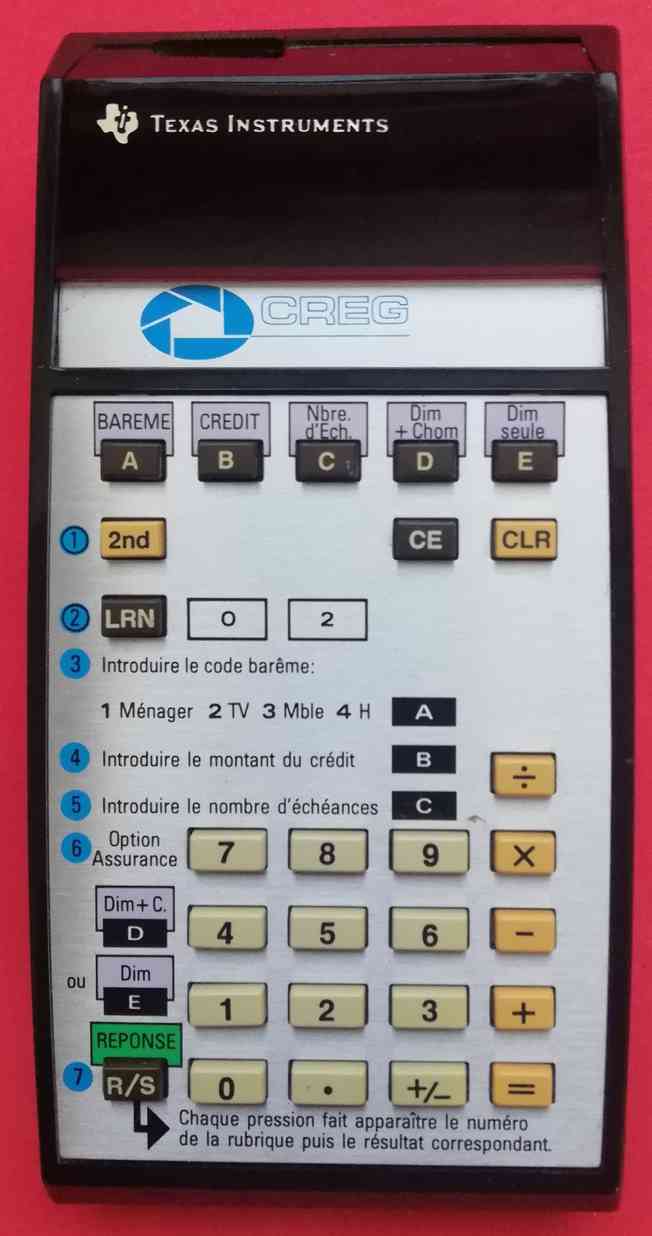 Model: TI-59 Creg insurance FR
Battery: BP1 A
Adapter: AC9131 or DC9105
Year: 1978
Chip: TMC0501E TMC0591 CD2400 CD2401 TMC0573 TC5047
Info:The innovative TI-59 was the perfect base for a lot of customized calculators. This one was used end of the 70th by insurance agents of the French CREG company.
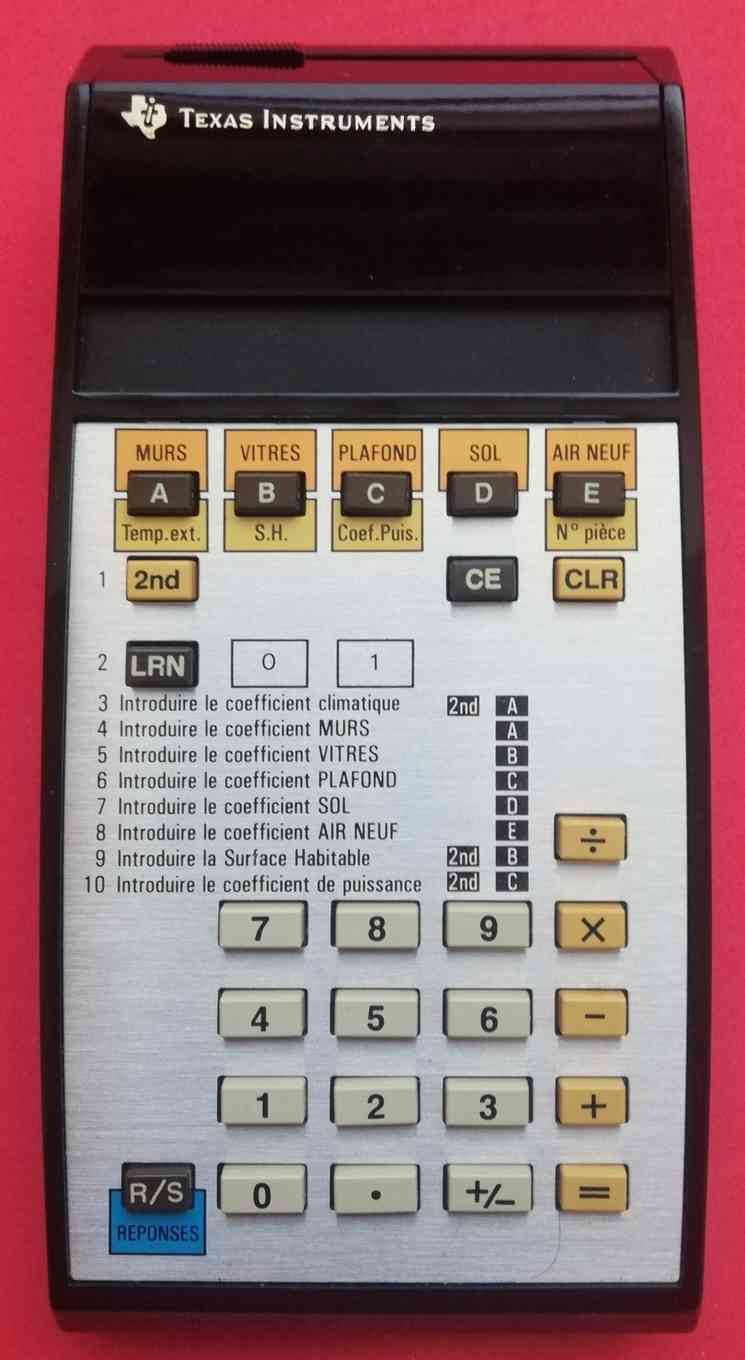 Model: TI-59 EDF FR
Battery: BP1 A
Adapter: AC9131 or DC9105
Year: 1978
Chip: TMC0501E TMC0591 CD2400 CD2401 TMC0573 TC5047
Info: The innovative TI-59 was the perfect base for a lot of customized calculators. This one was used end of the 70th by the EDF Group in France - a leading supplier of Electricity in Europe - to calculate the necessary energy to heat rooms and houses
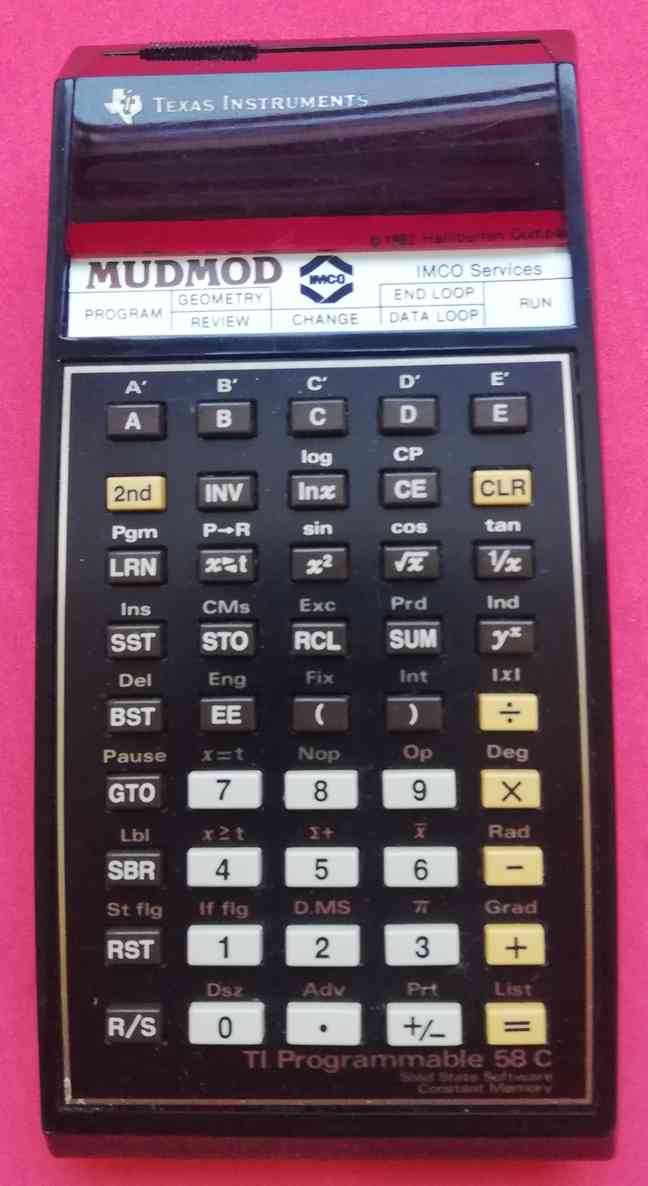 Model: TI-59 IMCO mudmod
Battery: BP1 A
Adapter: AC9131 or DC9105
Year: 1978
Chip: TMC0501E TMC0591 CD2400 CD2401 TMC0573 TC5047
Info: The IMCO "MudMod" application was developed in 1982 by IMCO Services, a division of Halliburton Co., Houston for internal use only. IMCO's first module ("DrilMod") with applications in the areas of well control, annular and bit hydraulics, directional design, d-exponents, cost/ft, and drilling mud, a total of 16 programs in all, and second module (“BossMod”) for well-control operations were sold to customers.
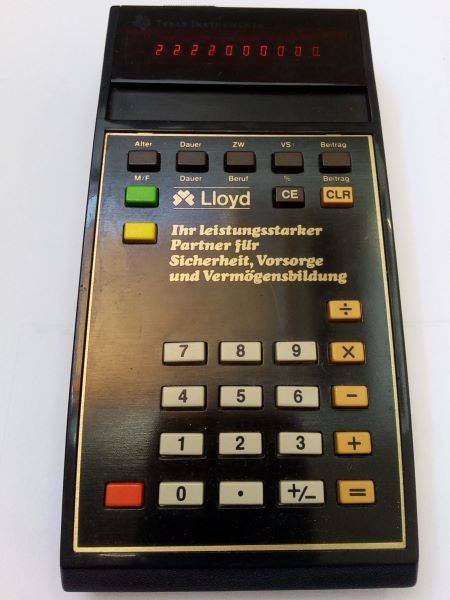 Model: TI-59 LLOYD
Battery: BP1 A
Adapter: AC9131 or DC9105
Year: 1978
Chip: TMC0501E TMC0591 CD2400 CD2401 TMC0573 TC5047
Info: TI-58 / 59 programmable
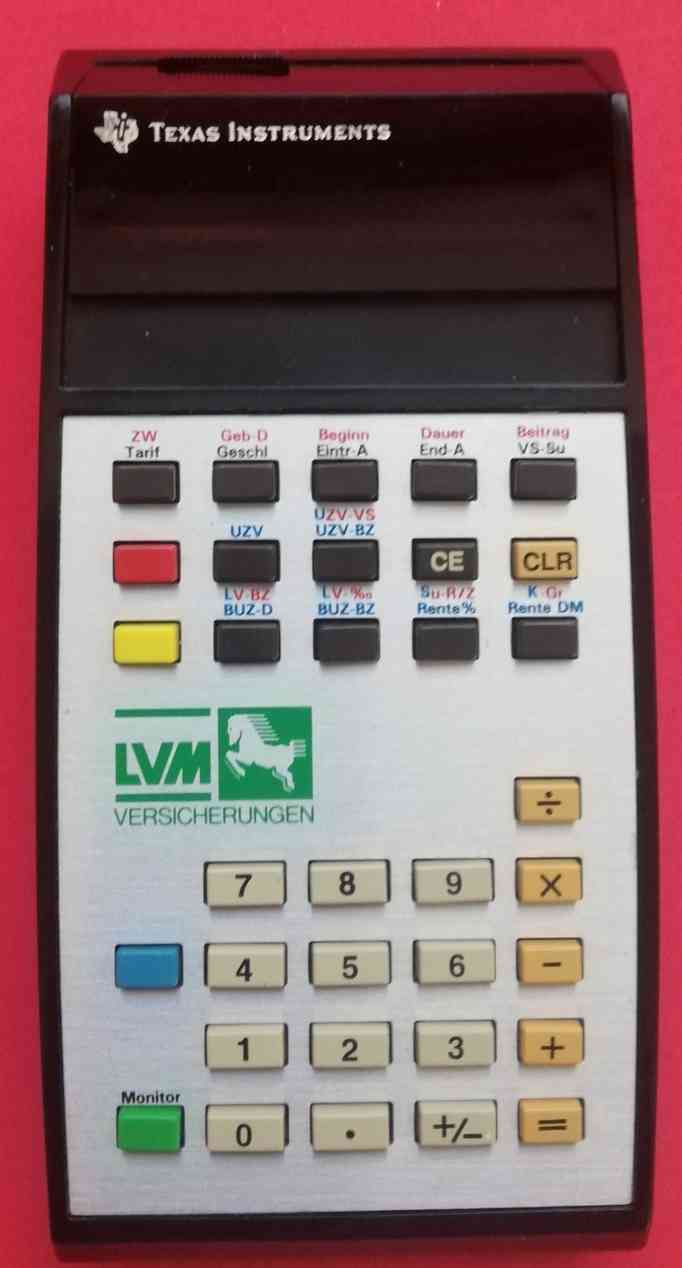 Model: TI-59 LVM insurance
Battery: BP1 A
Adapter: AC9131 or DC9105
Year: 1978
Chip: TMC0501E TMC0591 CD2400 CD2401 TMC0573 TC5047
Info: The innovative TI-59 was the perfect base for a lot of customized calculators. This one was used end of the 70th by insurance agents of the German LVM company.
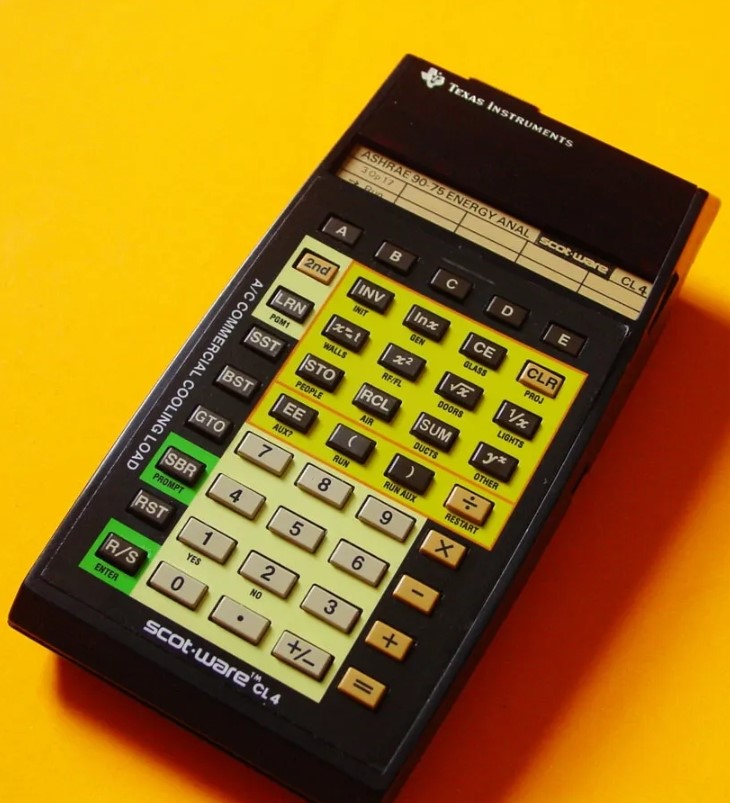 Model: TI-59 SCOT WARE CL 4
Battery: BP1 A
Adapter: AC9131 or DC9105
Year: 1978
Chip: TMC0501E TMC0591 CD2400 CD2401 TMC0573 TC5047
Info: Scot Ware by Scotch Programs Inc., headquartered in Miami, Florida, introduced already in April 1978 with the CL4 cooling load calculation an early application programmed in a customized Solid State Software Module. Purchased but never arrived!!
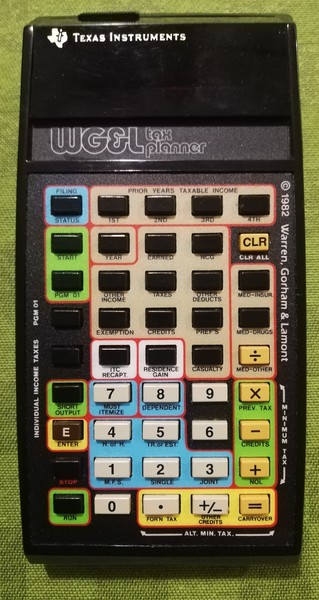 Model: TI-59 WG&L Tax Planner
Battery: BP1 A
Adapter: AC9131
Year: 1981
Chip: TMC0501E TMC0591 CD2400 CD2401 TMC0573 TC5047
Info: The tax planner application was developed in 1982 by Warren, Gorham & Lamont, Valhalla NY (WG&L) and programmed by Texas Instruments into a Solid State Software Module. Please notice the © 1983, 1984 date of the module. These modules were probably changed every year due to updates in the tax calculation process and WG&L introduced in 1985 with the incotax calculator a more flexible approach.
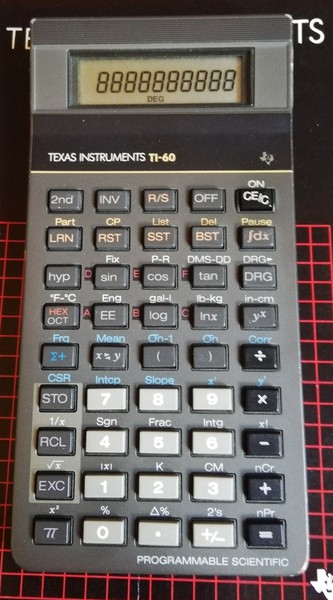 Model: TI-60
Battery: 2 x LR44
Adapter:
Year: 1987
Chip: CD4815-CD4614
Info: slanted LCD generation
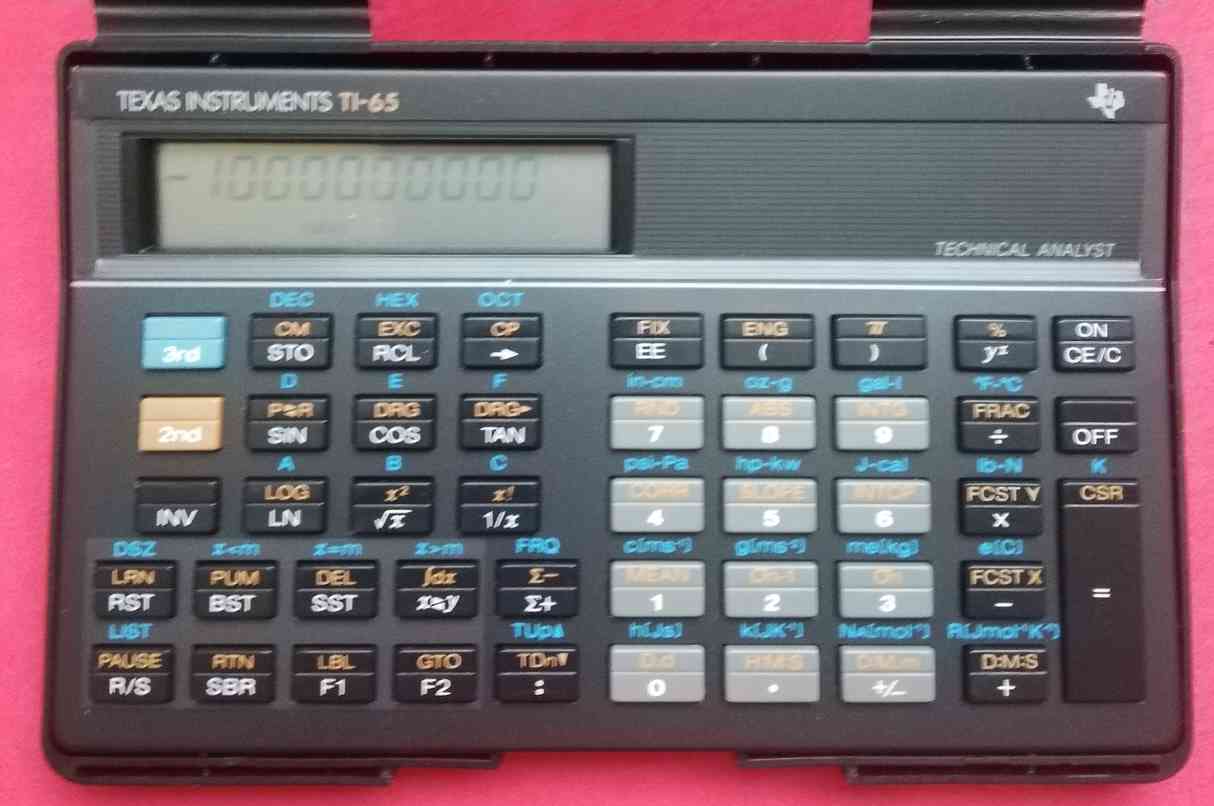 Model: TI-65
Battery: 2 x LR44
Adapter:
Year: 1988
Chip: CD4805 , CD4806
Info:The TI-65 Technical Analyst is a quite interesting calculator within the Galaxy-line.
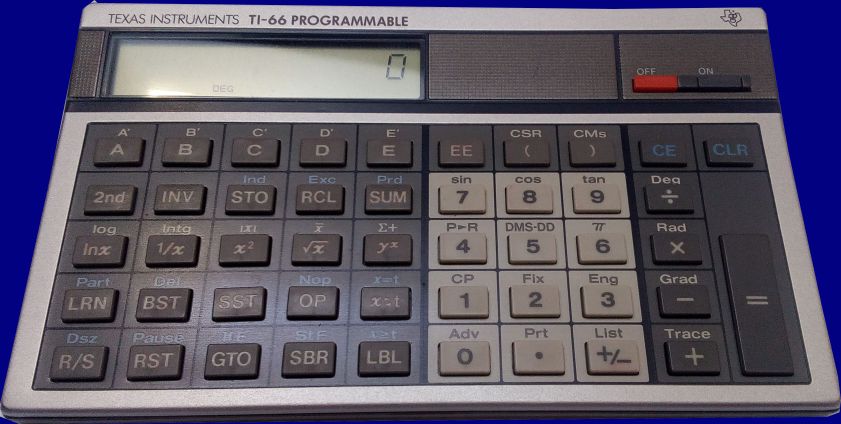 Model: TI-66
Battery: 2 x LR44
Adapter:
Year: 1984
Chip: Toshiba T6875, TC5514A
Info: GALAXY line
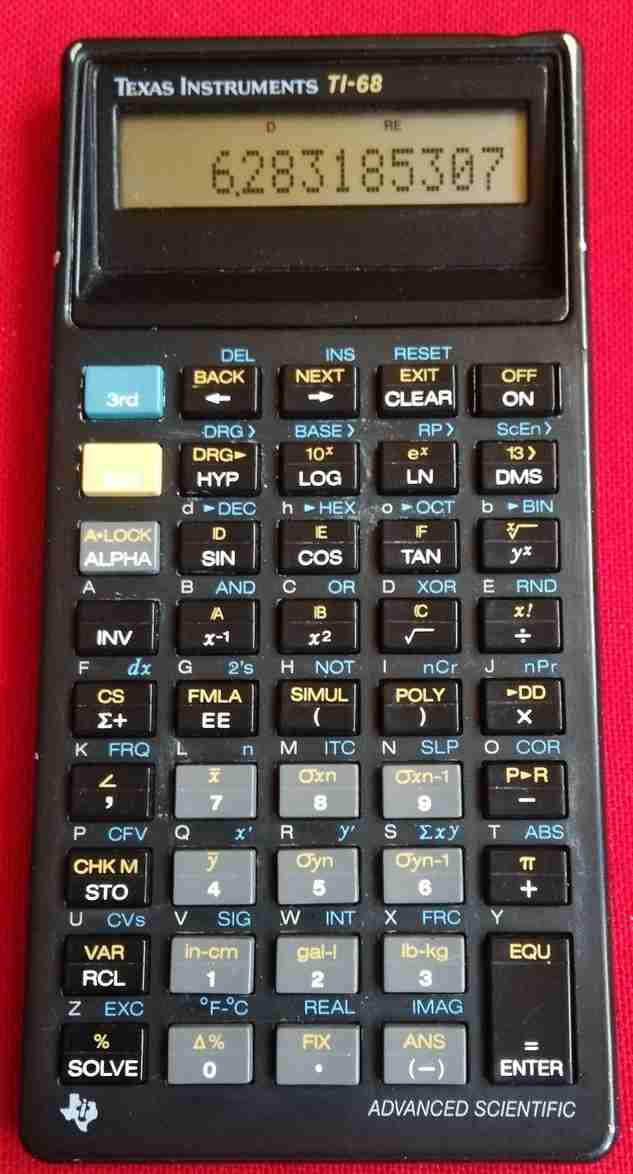 Model: TI-68
Battery: CR2032
Adapter:
Year: 1990
Chip: CPU: Toshiba T9948A
Info: Taiwan
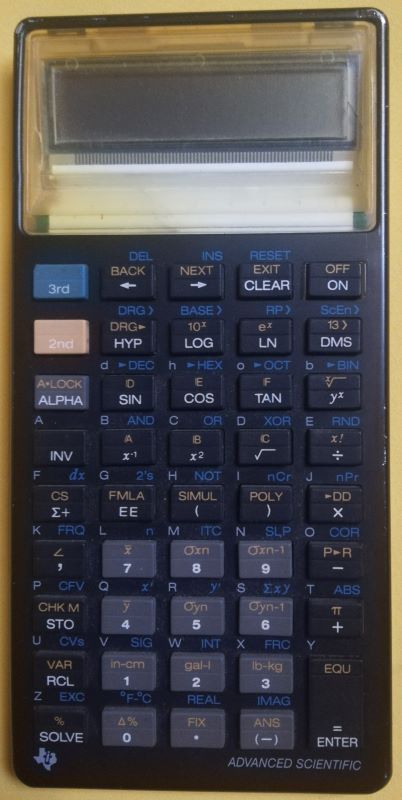
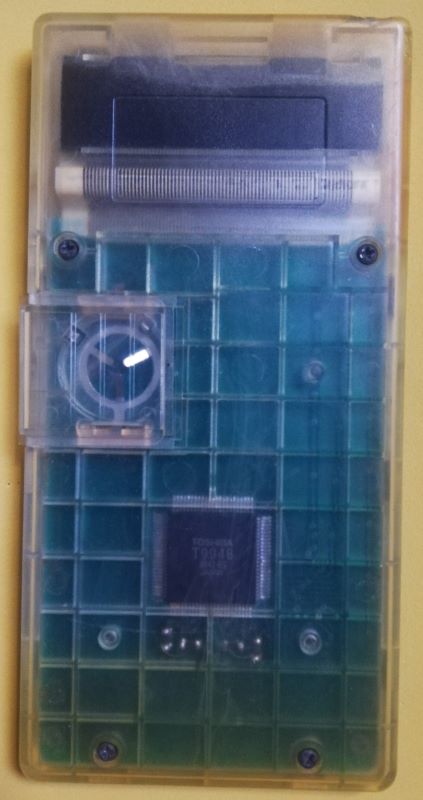 Model: TI-68 prototype
Battery: CR2032
Adapter:
Year: 1985
Chip: CPU: Toshiba T9948A
Info:Calculator donated by Massa Gennaro in 2023 during the 2nd edition "the story with Texas Instruments" in Rieti, (World Chili Pepper Fair). This was a prototype with transparent case, built in the Rieti factory.
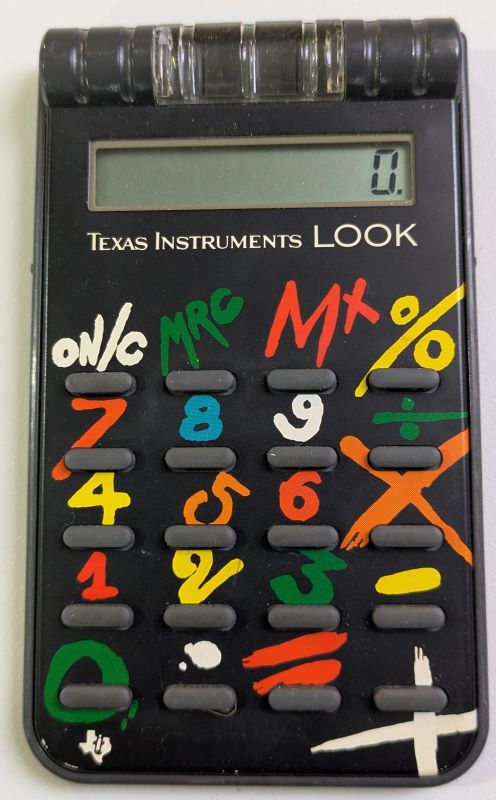 Model: TI-701 graffiti
Battery: solar
Adapter: no
Year: 1989
Chip:
Info: All models share the same design idea of a round "light tube" to collect ambient light and transport it to the high-efficiency solar cells, in the same line you can find the TI-703 blue ocean the TI-702 city night . Made in Taiwan
Special thanks go to Mrs. Pina Battinelli, who donated this calculator.
Dear Sirs, it is with great pleasure and considerable emotion that I entrust to your organization the "companion" of my initial schooling. Thank you and good luck.
Un particolare ringraziamento va alla Signora Pina Battinelli che ha donato questa calcolatrice. Scrivendo:
Gentilissimi, con grande piacere e non poca emozione affido alla vostra associazione la "compagna" del mio iniziale percosrso scolastico. Grazie e in bocca al lupo
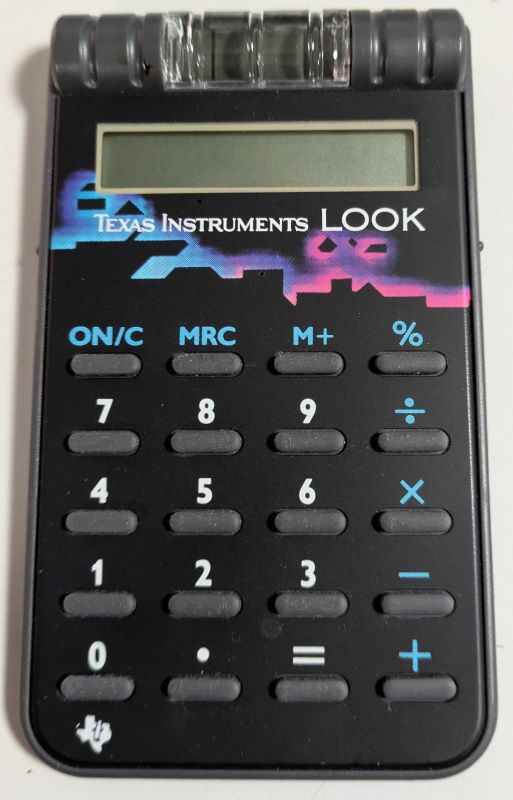 Model: TI-702 city night
Battery: solar
Adapter: no
Year: 1989
Chip:
Info:All models share the same design idea of a round "light tube" to collect ambient light and transport it to the high-efficiency solar cells, in the same line you can find the TI-701 graffiti the TI-703 blue ocean . Made in Taiwan
 Model: TI-703 blue ocean
Battery: solar
Adapter: no
Year: 1989
Chip:
Info:All models share the same design idea of a round "light tube" to collect ambient light and transport it to the high-efficiency solar cells, in the same line you can find the TI-701 graffiti the TI-702 city night . Made in Taiwan
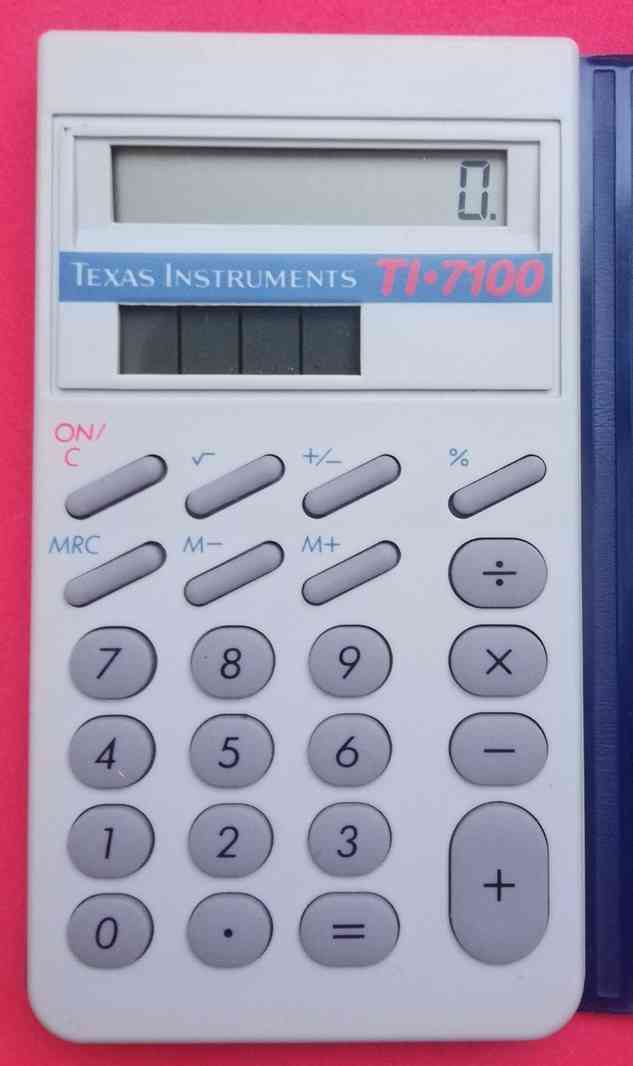 Model: TI-7100
Battery: Solar
Adapter:
Year: 1991
Chip:
Info:
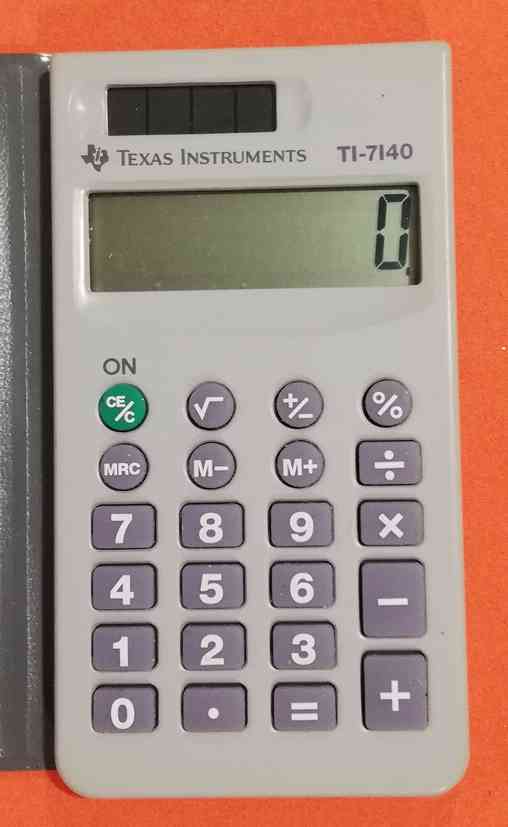 Model: TI-7140
Battery: solar
Adapter:
Year: 1994
Chip:
Info:
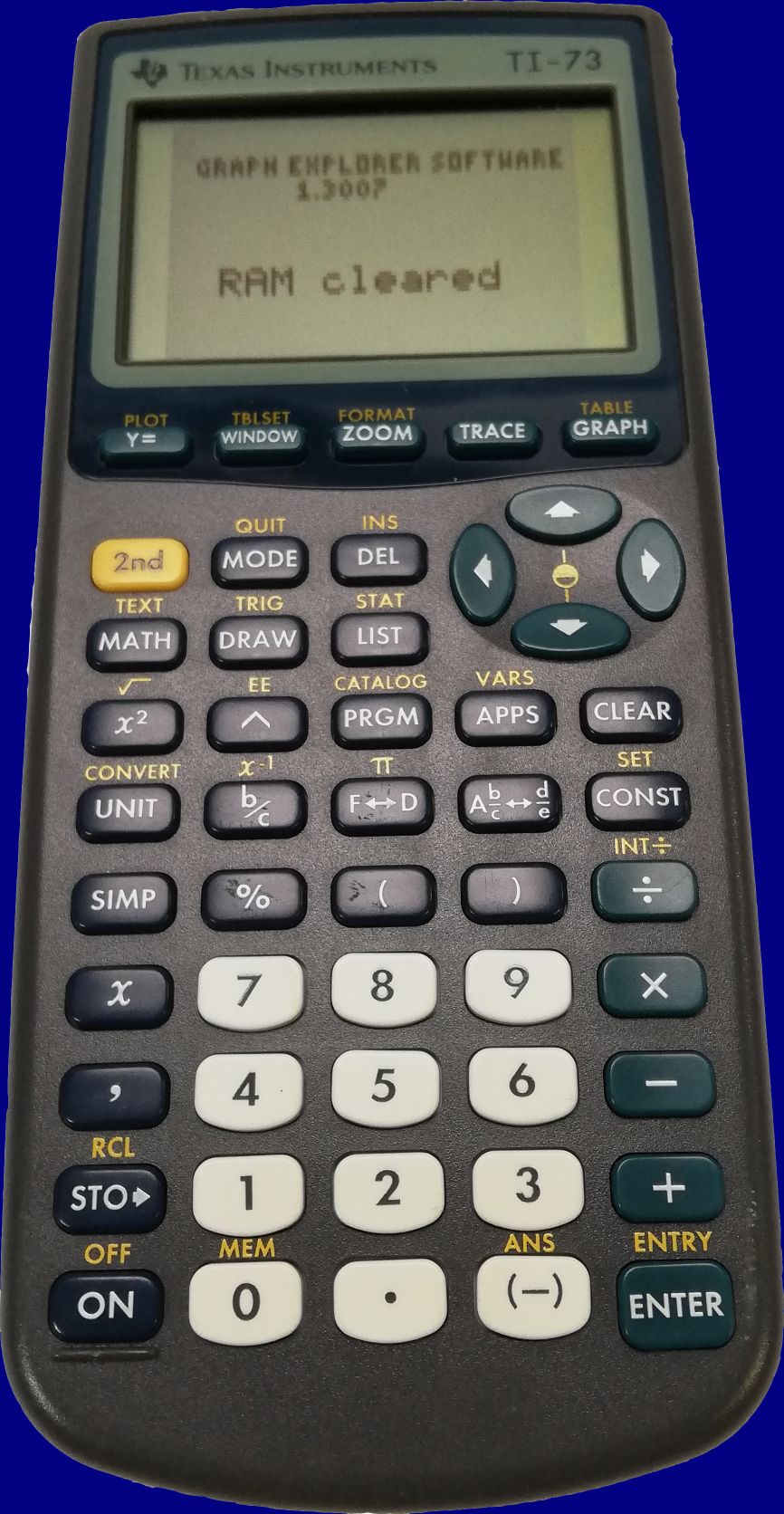 Model: TI-73
Battery: 4 AAA + CR1620
Adapter:
Year: 1999
Chip: Zilog Z84C0008
Info: GRAPHING
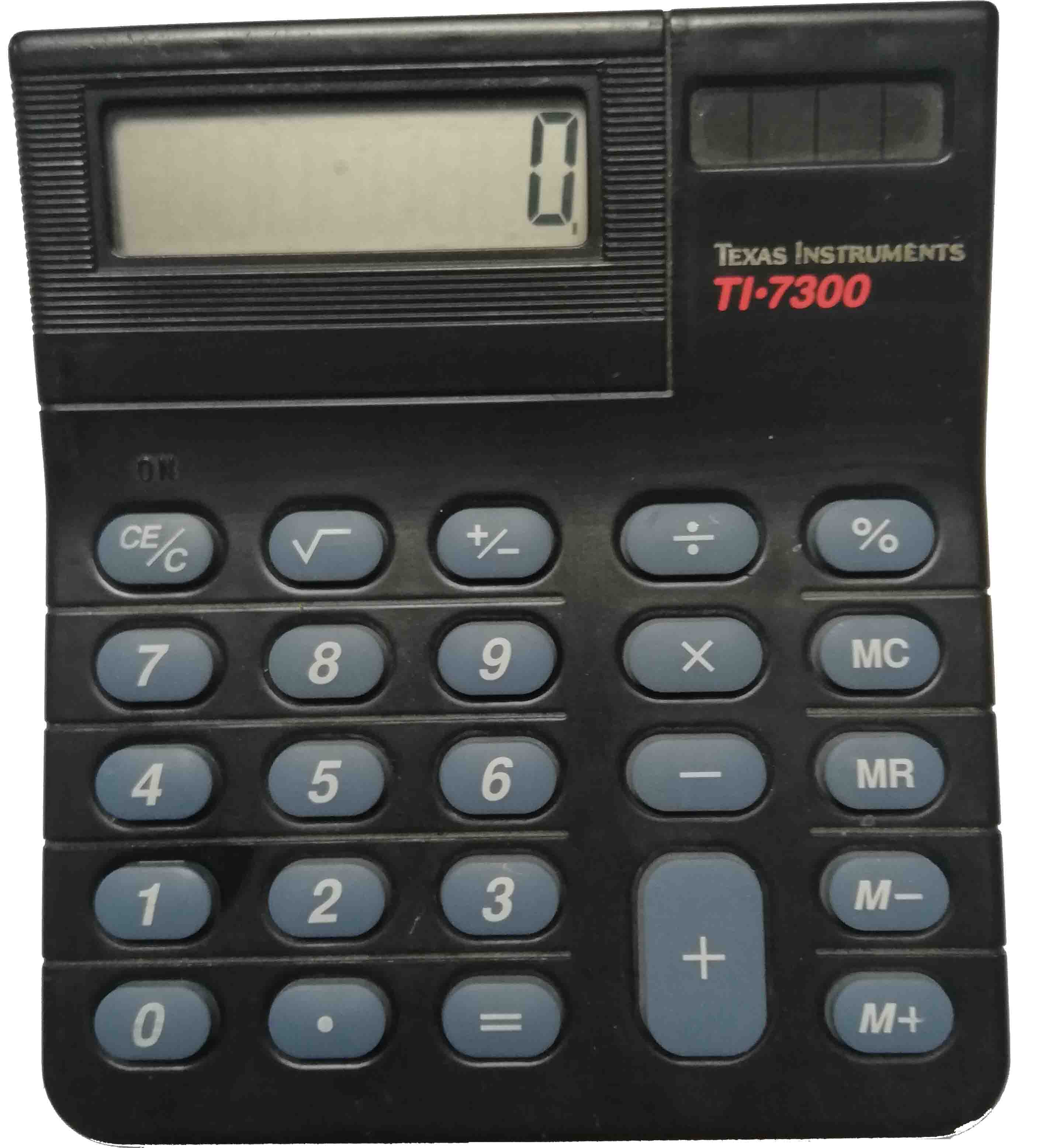 Model: TI-7300
Battery: solar
Adapter:
Year: 1989
Chip:
Info:
 Model: TI-80
Battery: 2 x CR2032
Adapter:
Year: 1996
Chip: CPU: Toshiba T6M53A ROM: LH5359©1995 RAM: SRM2264 Display: Toshiba T6B79
Info: Taiwan
 Model: TI-81
Battery: 4 AAA + CR1620
Adapter:
Year: 1991
Chip: T6A49Atoshiba
Info: GRAPHING
 Model: TI-81
Battery: 4 AAA + CR1620
Adapter:
Year: 1993
Chip: T6A43toshiba
Info: GRAPHING
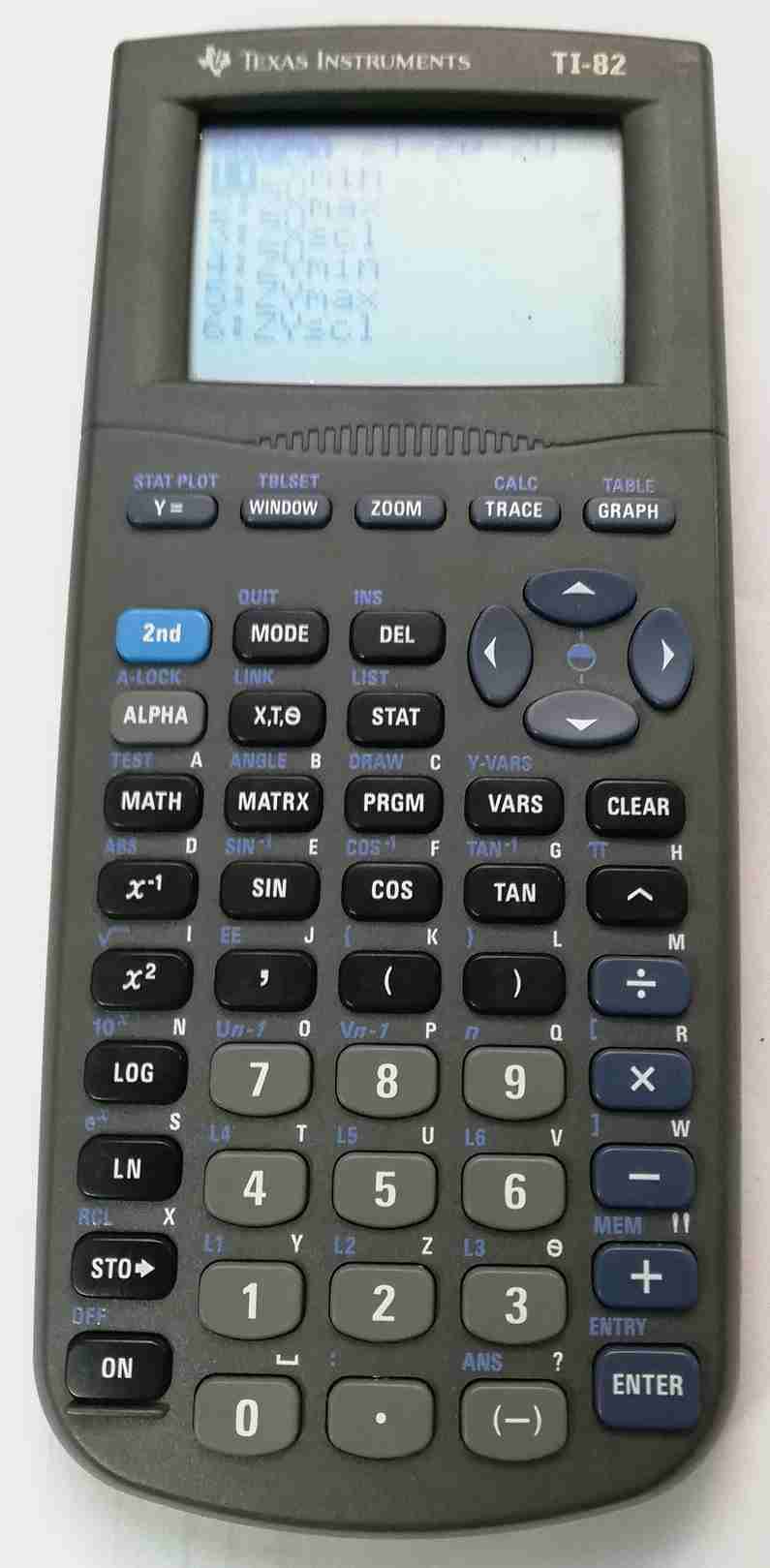
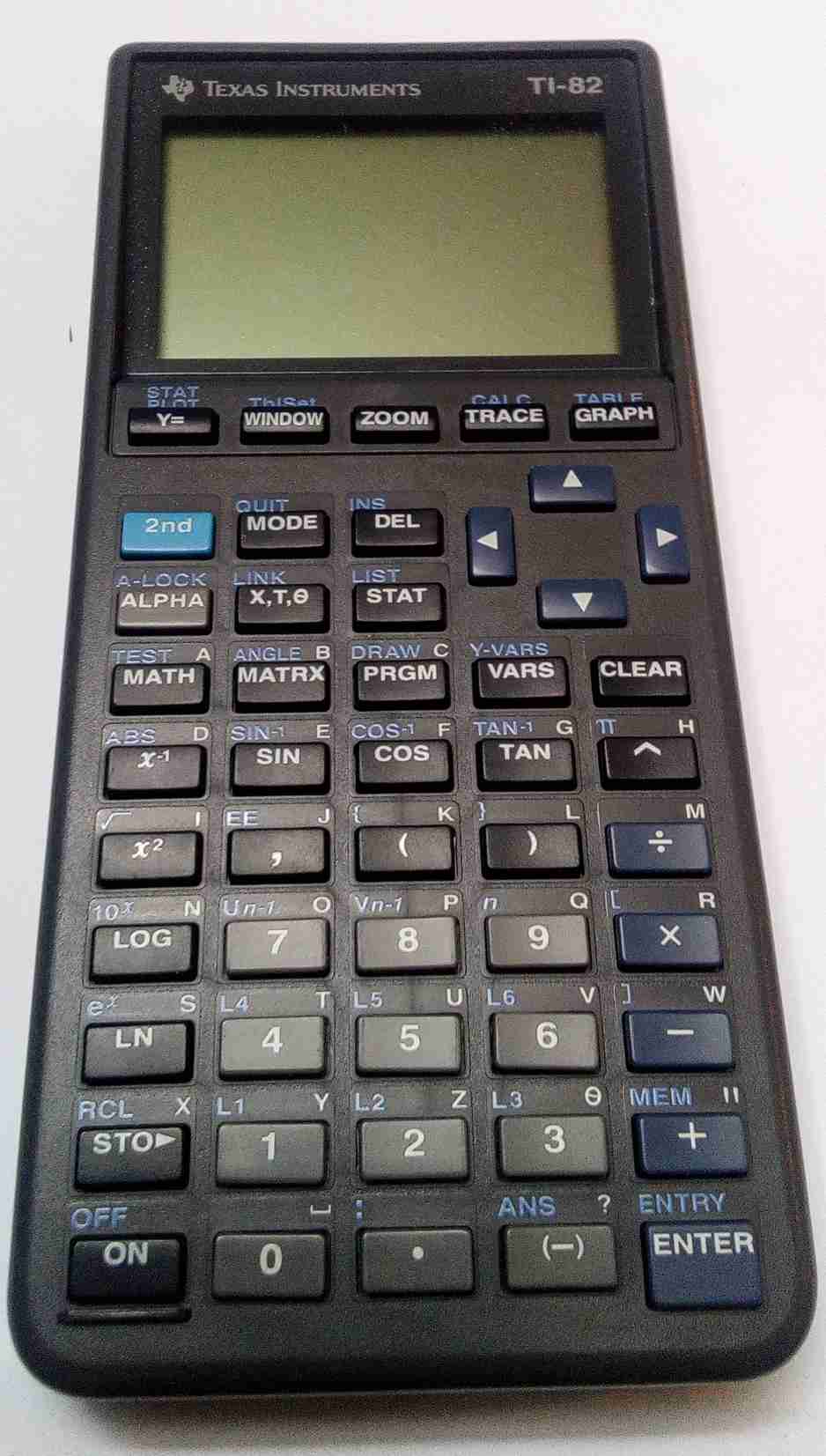 Model: TI-82 1995
Battery: 4 AAA + CR1620
Adapter:
Year: 1995
Chip: CPU: Toshiba T84C00A ASIC: Toshiba TC14L010 ROM: MX J9533©1995 RAM: SRM20256 Display: Toshiba T6A04
Info: GRAPHING
 Model: TI-82 parcus
Battery: 4 AAA + CR1620
Adapter:
Year: 1994
Chip: TCPU: Toshiba T6C79 ROM: TA1782©2000 RAM: HY62WT081 Display: Toshiba T6A04A84C00
Info:
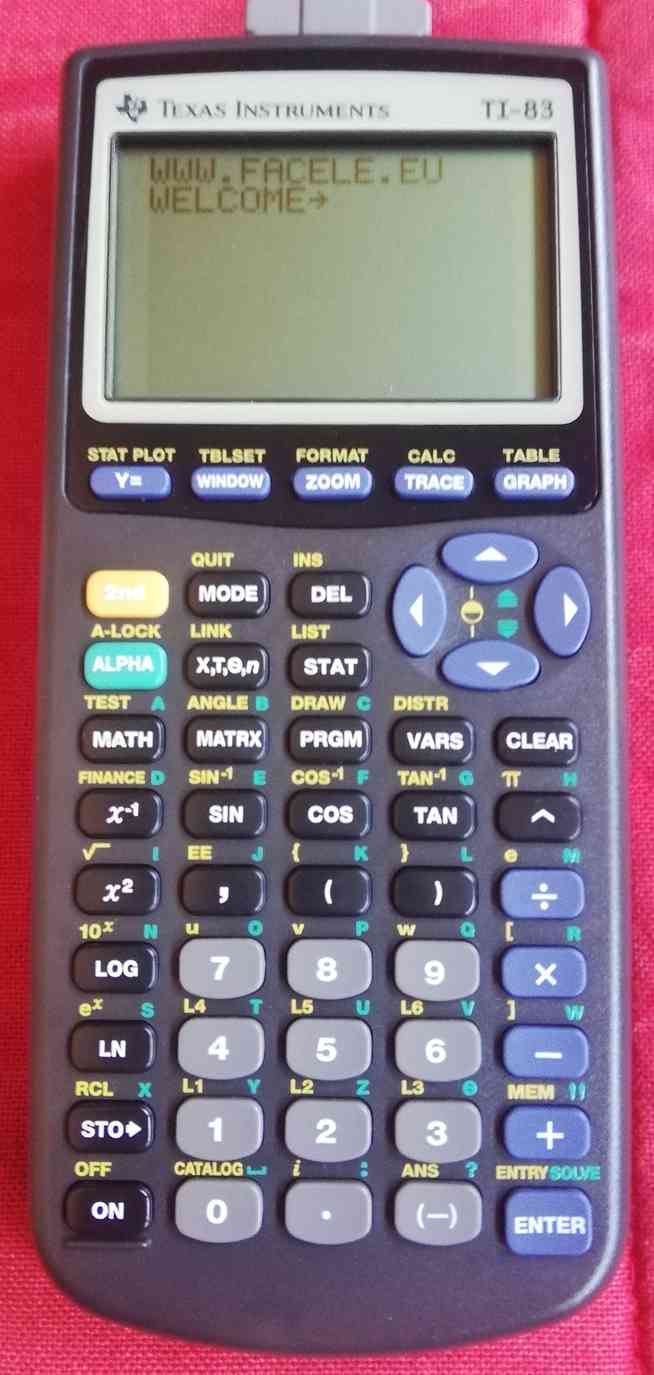 Model: TI-83
Battery: 4 AAA + CR1620
Adapter:
Year: 1996
Chip: T6C79 toshiba
Info:From a users point of view the TI-83 is compatible with the TI-82 but added some financial functions and the "official" support of assembly programming. A smart decision, the TI-83 developed itself as a popular programming platform and prepared the tremendous success of the TI-83 Plus.
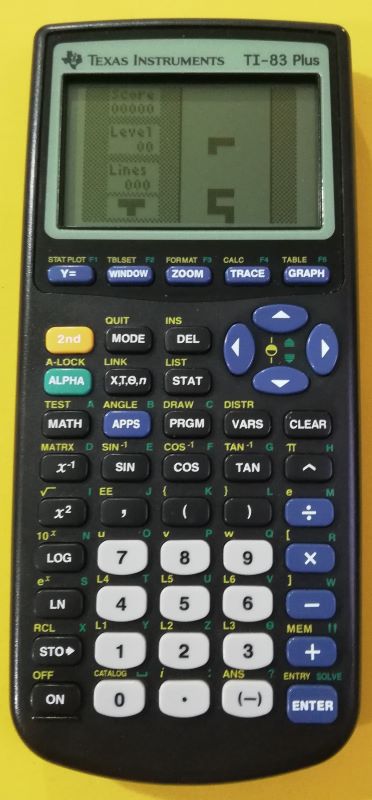 Model: TI-83 plus
Battery: 4 AAA + CR1620
Adapter:
Year: 1999
Chip: CPU: Zilog Z84C0008 ASIC: TI REF 9815455 Flash: AM29F400 RAM: SRM2B256 Display: Toshiba T6A04
Info:The TI-83 Plus added Flash technology to the TI-83 Graphing calculator. This technology gives you the flexibility to add calculator software applications and additional functionality beyond math and science, providing long-term value.
 Model: TI-84 plus
Battery: 4*AAA + SR44
Adapter:
Year: 2004
Chip: ASIC: TI REF 83PLUSB/TA2 or TI REF 84PLUSB/TA3 Flash: 29LV800 Display: Toshiba T6K04
Info:The TI-84 Plus doubles the capacity of the Flash ROM of the original TI-83 Plus to 480k Bytes. Other enhancements include a high contrast LCD, an integrated USB port for computer connectivity, an internal clock, and an available kickstand. The clock speed of the Z80 compatible microprocessor raised to 15 MHz compared to the 6 MHz of the earlier TI-83 products
 Model: TI-85
Battery: 4 AAA + CR1620
Adapter:
Year: 1992
Chip: T6A43 toshiba
Info: GRAPHING
 Model: TI-86
Battery: 4 AAA + CR1620
Adapter:
Year: 2000
Chip: T6A43 toshiba
Info: GRAPHING
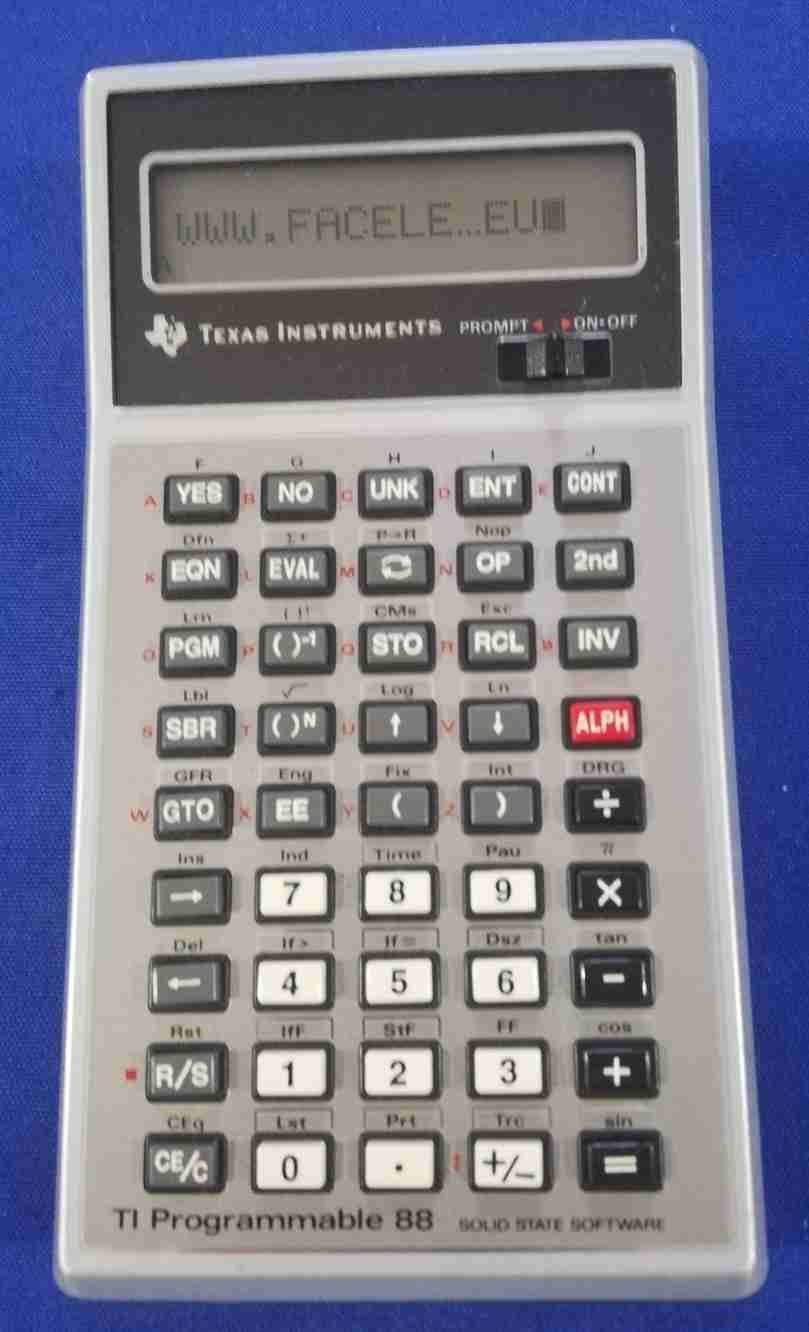 Model: TI-88 (PVT4)
Battery: BP88 (1*AA-NiCd)
Adapter: AC9133
Year: 1982
Chip: TP0485 (CD2901), TP0485 (CD2902), 2*TP0530, 2*TP0531, TP0532 (CD5402), SN77203
Info: We wrote May 1982 when Texas Instruments printed the sales brochures of the TI-88 on glossy paper. The brochures promised the introduction of the TI-58C/TI-59 successor for Forth Quarter 1982 in a package matching the TI-55-II line - before we got word of the TI-66. Today we know more: The development of the TI-88 was finalized, the manuals printed, the first pre-production calculators worked perfectly and Texas Instruments canceled the whole project! Maybe one of the reasons was the introduction of the powerful Hewlett-Packard HP-41C calculator or the innovative Sharp PC-1211 Pocket Computer. Or the underestimated complexity of the TI-88 design. Or electrostatic discharge (ESD) issues of the Module contacts. Or the internal competition with the CC 40 Compact Computer. Or the keyboard problems encountered with the TI-55-II family of calculators. Or the decision of a Manager of TI's Consumer Electronic group to quit the calculator business...
Learn more about the demanding "Project X" initiated already in Summer 1977 and leading not only to the (failed) TI Programmable 88, but the TI-66 PROGRAMMABLE, failed TI-76 PROGRAMMABLE, Compact Computer CC 40, (failed Compact Computer CC 70) and last but not least the successful TI-74 BASICALC and TI-95 PROCALC.
with permission of the author DATAMATH.org
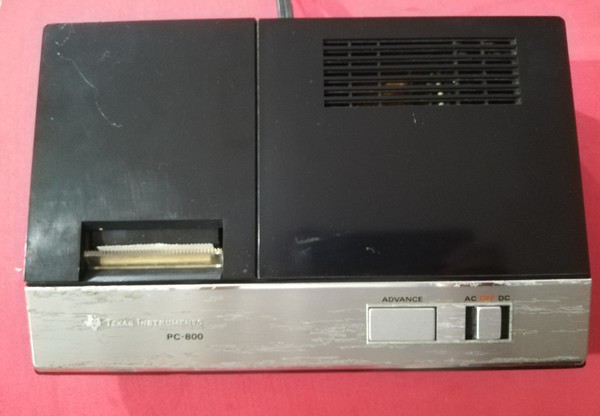 The PC-800 Printer is a dot-matrix thermal printer designed for use with the TI-88 Programmable. It connects to the TI-88 through a 2-pin Peripheral I/O connector. A second Peripheral I/O connector on the back of the PC-800 allows to connect another device like the CA-800 Cassette Interface to the TI-88.
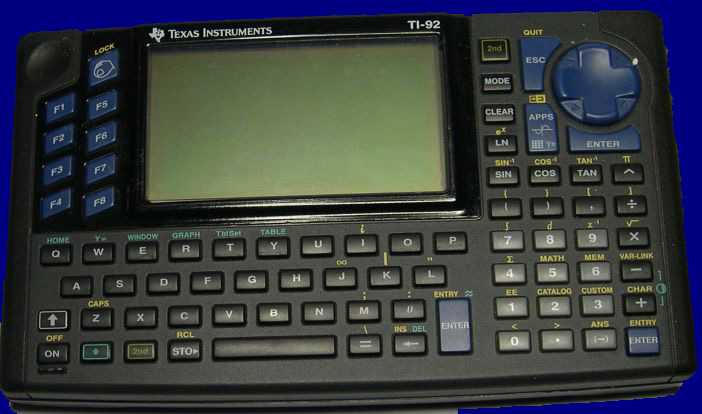 Model: TI-92
Battery: 4 x LR43 + CR2032
Adapter:
Year: 1996
Chip: SC414181
Info: first SYMBOLIC
 Model: TI-Nspire cas touchpad
Battery: 4 x AAA
Adapter: USB
Year: 2010
Chip: CPU: TI-NS2007C-0 (L9B0713) SDRAM: MT48H16M16 Flash: SEC K9F5608 Display: Novatek NT7702H, 2*xxx
Info: Texas Instruments announced on March 8, 2010 the new TI-Nspire CAS Touchpad and TI-Nspire Touchpad graphing calculators. In the United States the new calculator was listed on the TI website as a complement to the TI-Nspire CAS with Clickpad while in some other countries, e.g. Germany, the calculator was introduced as successor to the previous model. The new Operating System 2.0 and some internal labels on the PCBs (printed circuit boards) of the calculator suggest indeed the switch to a "TI-Nspire 2".
 Model: TI-Nspire CX
Battery: 3.7 L1230SP Li-Ion
Adapter: AC9211U
Year: 2011
Chip: CPU: ET-NS2010B-0 (T6UJ1XBG-0002) ,SDRAM and Flash MCP: Samsung K511F12ACA
Info: Texas Instruments introduced at the 2011 T3 International Conference held on February 25-27 in San Antonio, TX with the TI-Nspire CX and TI-Nspire CX CAS their first graphing calculators with full color, backlit displays.
 Model: TI-Nspire CX II
Battery: 3.7 L1200SPA Li-Ion
Adapter:
Year: 2019
Chip: CPU: ET-NS2018-000 (S6M98) SDRAM Micron MT46H32M Flash-ROM: Micron MT29F1G01
Info:Texas Instruments introduced at the 2011 T3 International Conference held on February 25-27 in San Antonio, TX with the TI-Nspire CX and TI-Nspire CX CAS their first graphing calculators with full color, backlit displays.
 Model: View Screen TI-80 /81 /82 /83
Battery: power from calculator
Adapter:
Year: 2004
Chip: Toshiba T6A04A
Info:The TI ViewScreen panel connects with a cable to the Texas Instruments Graphing calculators. Placing the panel on the overhead projector enlarges the image of the handheld screen so that each student can follow along.
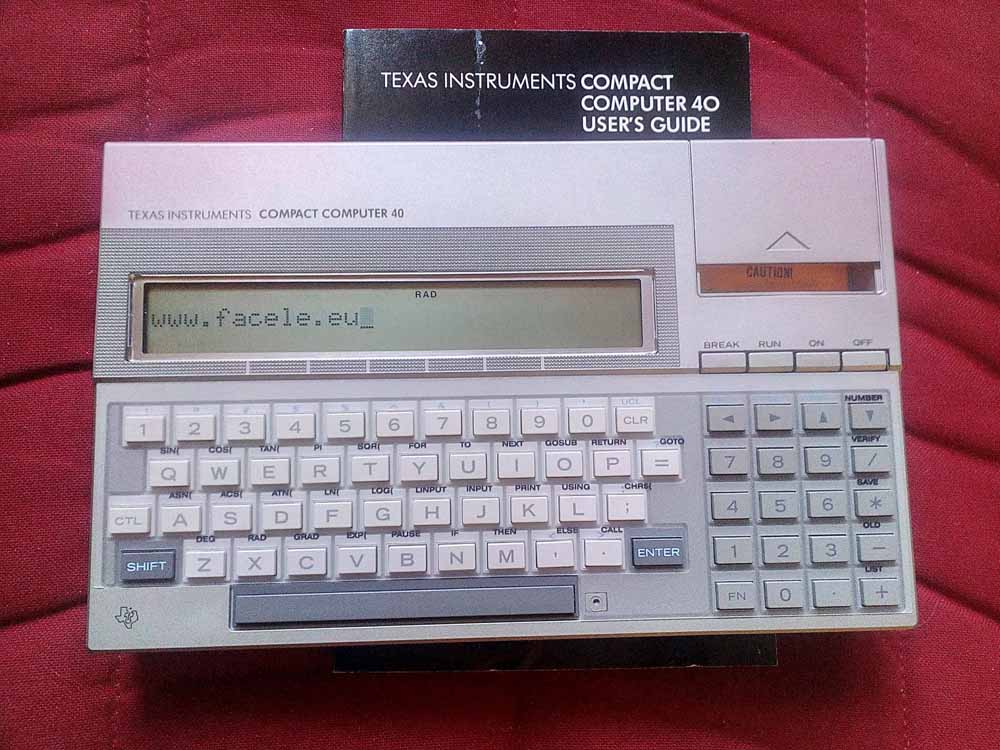 Compact Computer 40 or CC-40 is a battery-powered laptop that was developed by Texas Instruments and released in March 1983. Priced at $ 249, it weighs 600 grams and can be powered by four AA batteries or an adapter CA. It was designed as a portable business computer and uses TI's TMS70C20 CPU, an 8-bit microprocessor running at 2.5 MHz.
The CC-40 has 6 kilobytes of random access memory (expandable to 18 KB), 34 KB of read-only memory, and a 31-character LCD display. It is capable of running for 200 hours on one set of batteries and the memory is not cleared by turning off the unit, so a non-powered unit can retain data for several months.
The CC-40 has a single Hexbus port for connecting peripherals. The following Hexbus peripherals have been released: 80 column printer, printer / plotter, RS232 and modem. A "wafertape" digital drive (a licensed version of the Exatron Stringy Floppy) [1] pictured on the computer box was released as a prototype only, reportedly because it proved too unreliable. The inability to store the data has permanently damaged the sales of the CC-40.
The software was only available on cartridge or by typing programs into its built-in BASIC interpreter. The BASIC interpreter is similar but not identical to the TI-99 / 4A.
My modules are: module statistic / mathematics /advance electrical engineering / finance only manual
BASIC quick reference card with permission www.datamath.org
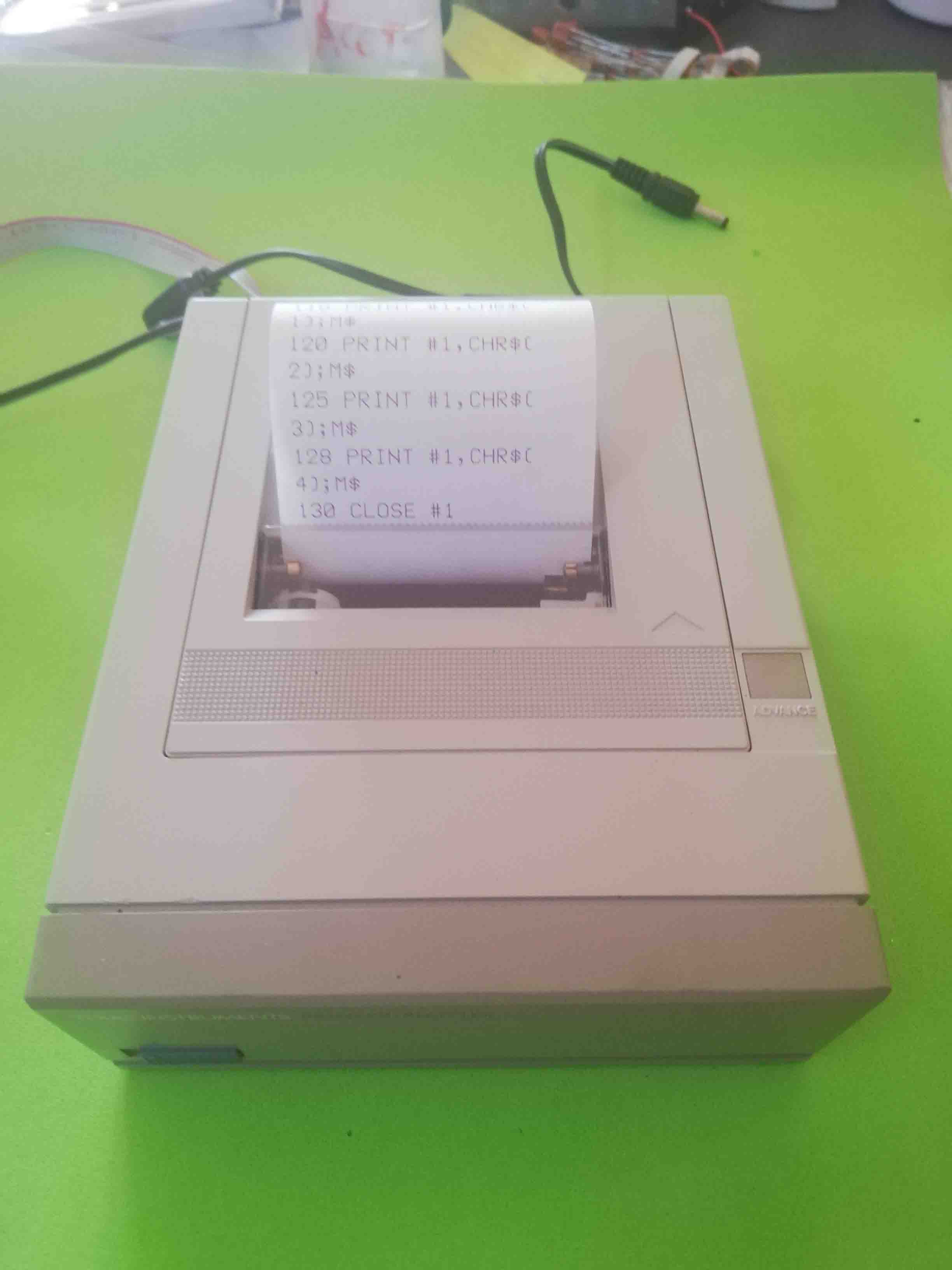
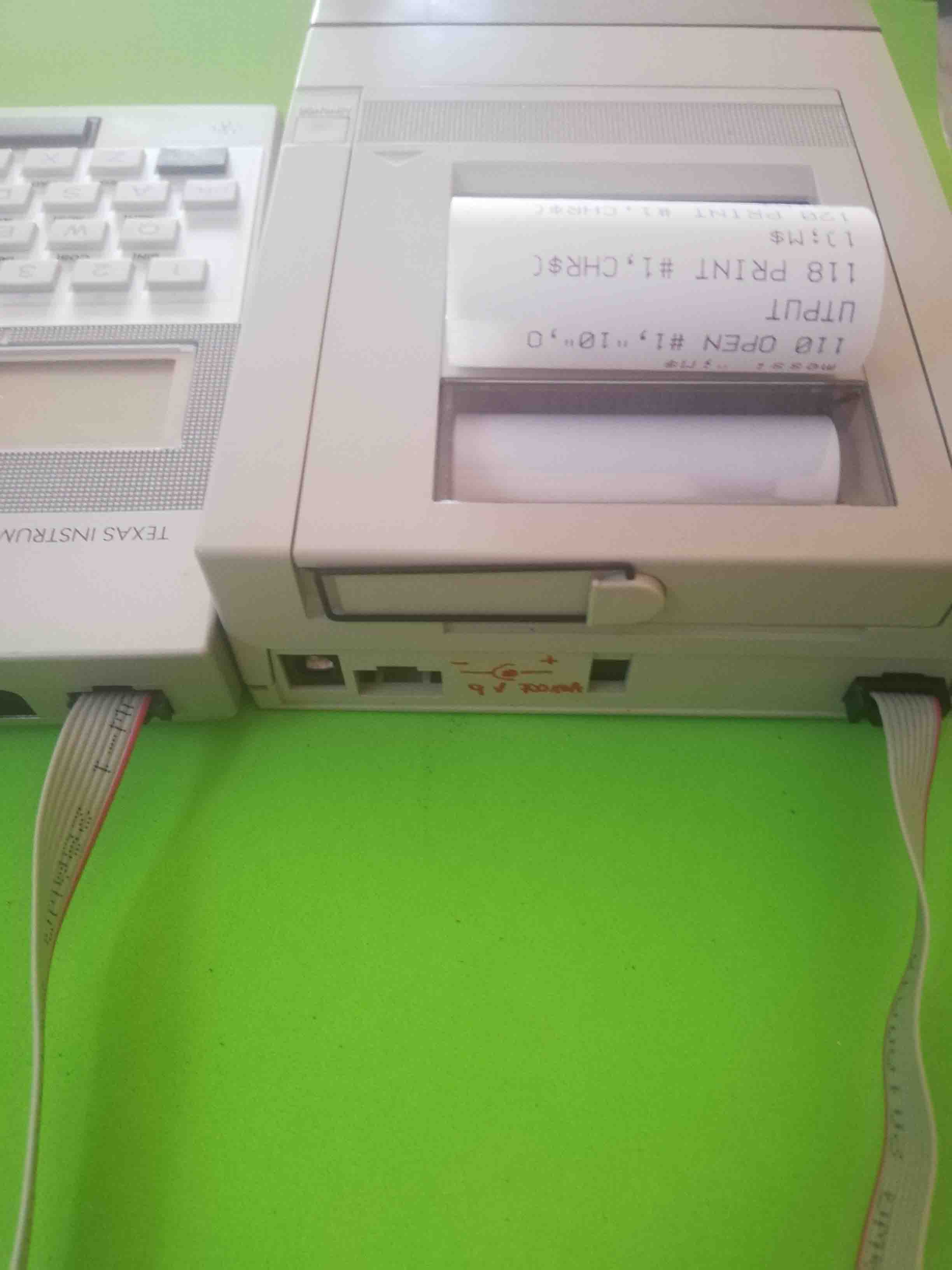
HX-1000 A beautiful 1983 plotter for the Texas Instruments Compact Computer 40 (CC-40). The HX-1000 plotter connects to the CC-40 via Hexbus cable (8 pin to pin) and features a passthrough for additional Hexbus devices. The HX-1000 uses an ALPS DPG1302 print head assembly. The HX-1000 uses four colored nibs (black, green, red and blue) and 55mm paper as in many calculators. Many other brands of plotters use the same mechanism called ALPS DPG1302 such as: Commodore 1520 Tandy CGP-115 Sharp CE-150 Atari 1020 Mattel Aquarius 4615.
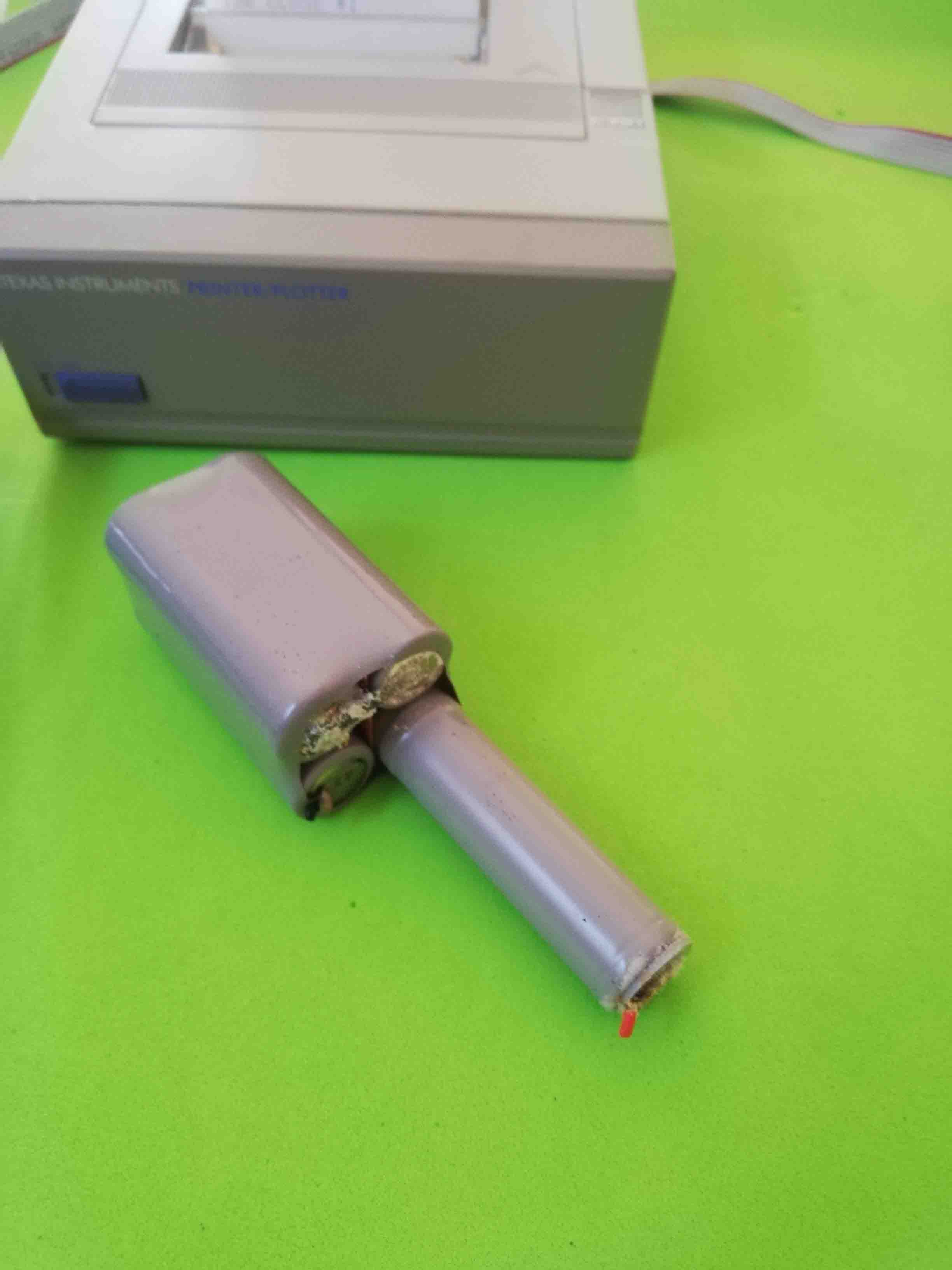 Pay particular attention to the batteries, because they must be removed, otherwise you risk destroying the pcb of the plotter, as happened to mine, I had to sweat to get it started again.
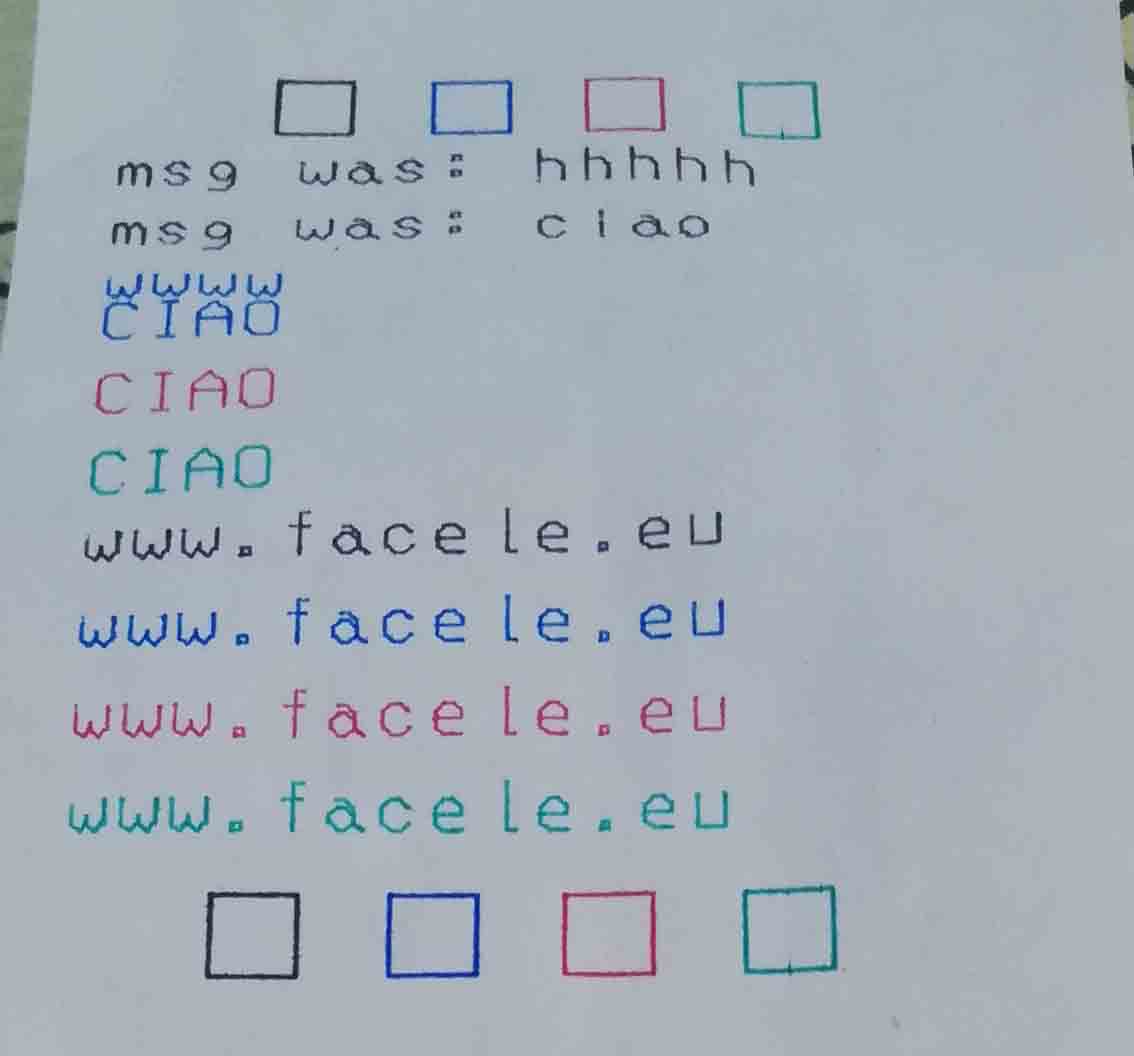 If you want to test, enter the following instructions!
100 LINPUT " Enter Message: ";M$
110 OPEN #1,"10",OUTPUT ' 10 address HX-1000
120 PRINT #1,CHR$(1);M$ ' PEN 1
130 PRINT #1,CHR$(2);M$ ' PEN 2
140 PRINT #1,CHR$(3);M$ ' PEN 3
150 PRINT #1,CHR$(4);M$ ' PEN 4
160 CLOSE #1
if you want to list the program, insert : LIST "10"
where 10 is the address of the HX-1000, you can change the address between 10 and 11 by changing the hardaware switch under the paper roll!
USERS MANUAL with permission www.datamath.org
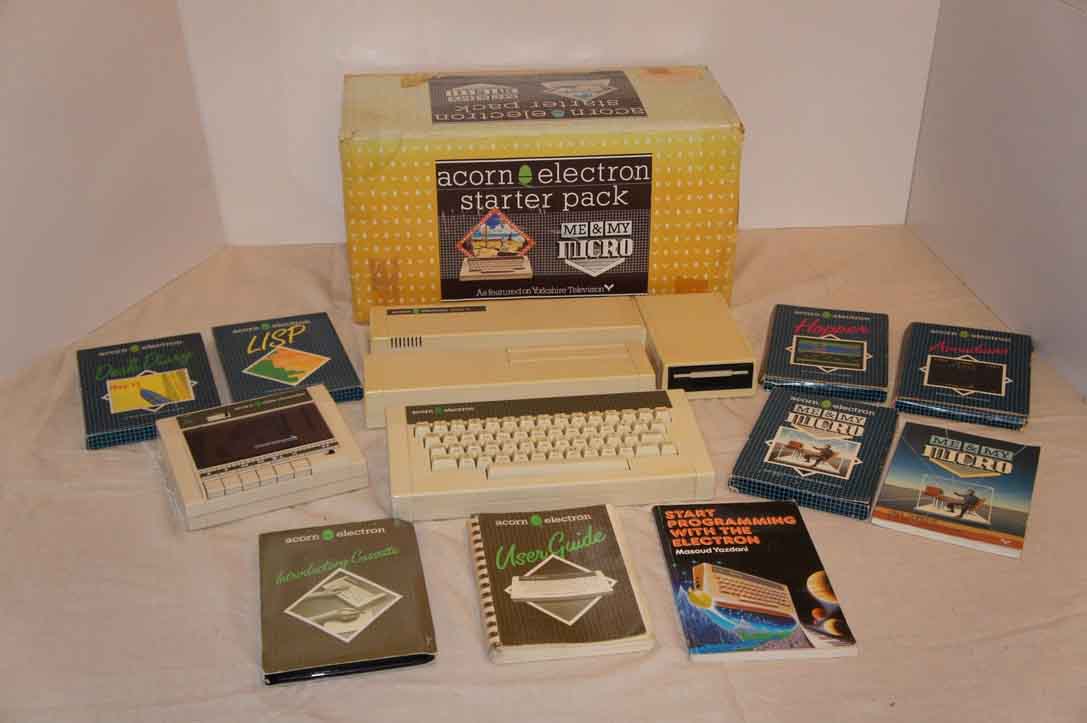 The Acorn Electron is a budget version of the BBC Micro educational/home computer introduced by Acorn Computers
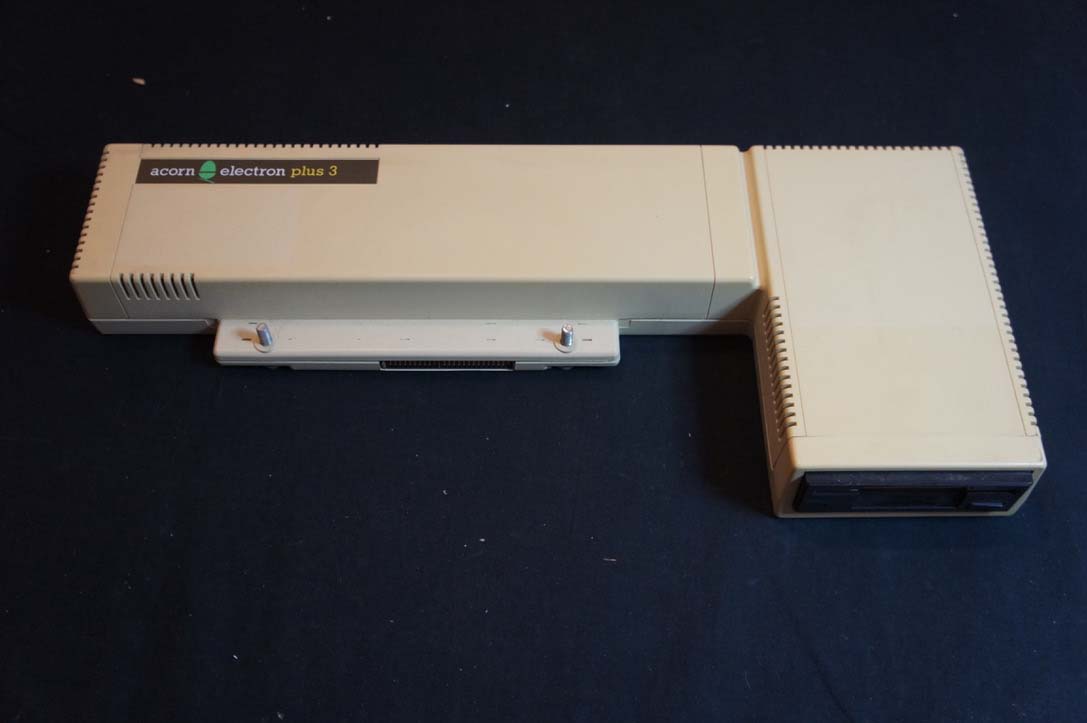 Ltd on 25 August 1983. It has 32 kilobytes of RAM, and its ROM includes BBC BASIC v2 along with its operating system.
The Electron was able to save and load programs onto audio cassette via a supplied converter cable that connected it to any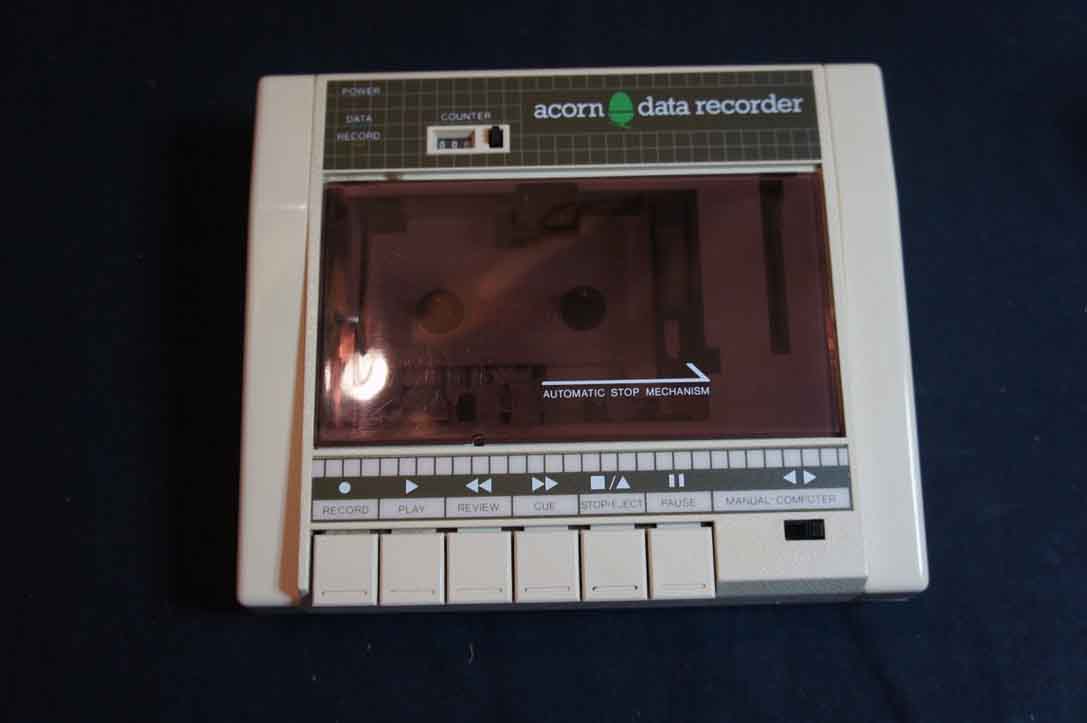 standard tape recorder that had the correct sockets. It was capable of basic graphics, and could display onto either a television set, a colour (RGB) monitor or a "green screen" monitor.
For a short period, the Electron was reportedly the best selling micro in the United Kingdom, with an estimated 200,000 to 250,000 machines sold over its entire commercial lifespan.
Model: Acorn
Adapter: External PSU, 19V AC
Year: 1983
Keyboard: 56-key cwitch keyboard
Cpu: Synertek SY6502A clocked at 2 MHz when accessing ROM and 1 MHz when accessing RAM Speed: 2 mhz CO-processor: x Ram: 432K RAM 32K ROM Sound: 1 channel of sound, 7 octaves; built-in speaker. Software emulation of noise channel supported
Display: RF modulator, composite video, RGB monitor output, 160×256 (4 or 16 colours), 320×256 (2 or 4 colours), 640×256 (2 colours), 320×200 (2 colours – spaced display with two blank horizontal lines following every 8 pixel lines), 640×200 (2 colours – spaced display)
Size - Weight: 58 mm x 343 mm x 160 mm
I/O ports: Expansion port, tape recorder connector (1200 baud CUTS variation on the Kansas City standard for data encoding, via a 7-pin circular DIN connector), aerial TV connector (RF modulator), composite video and RGB monitor output
Media: Cassetta, floppy disk (opzionale), cartuccia ROM (opzionale) OS: Acorn MOS V.1.0
Peripherals: x
Price: 133 £ (1983)
 The BBC Microcomputer System, or BBC Micro, is a series of microcomputers designed and built by Acorn Computers Limited in the 1980s for the Computer Literacy Project of the BBC. The machine was the focus of a number of educational BBC TV programmes on computer literacy, starting with The Computer Programme in 1982, followed by Making the Most of the Micro, Computers in Control in 1983, and finally Micro Live in 1985.

Model: BBC micro
Adapter: Internal PSU, 220 VAC
Year: 1981-1994
Keyboard: Keyboard, twin analogue joysticks with fire buttons, lightpen
Cpu: Synertek SY6502A clocked at 2 MHz when accessing ROM and 1 MHz when accessing RAM Speed: 2 mhz CO-processor: x Ram: 16–32 KiB (Model A/B)64–128 KiB (Model B+) 128 KiB (Master) Plus 32–128 KB ROM, expandable to 272 KiB Sound: Texas Instruments SN76489, 4 channels, monoTMS5220 speech synthesiser with phrase ROM (optional) Display: PAL/NTSC, UHF/composite/TTL RGB
Size - Weight: x
I/O ports: Printer parallel, RS-423 serial, user parallel, Econet (optional), 1 MHz bus, Tube second processor interface
Media: cassette tape, floppy disk (optional) – 5+1⁄4-inch or (later) 3+1⁄2-inch, hard disk also known as 'Winchester' (rare), Laserdisc (BBC Domesday Project)OS: Acorn MOS V.1.0
Peripherals: x
Price: 235 £ (1981)
.jpg)
The Amiga 1200, or A1200 (code-named "Channel Z"), is a personal computer in the Amiga computer family released by Commodore International, aimed at the home computer market. It was launched on October 21, 1992, at a base price of £399 in the United Kingdom (equivalent to £1,040 in 2023) and $599 in the United States (equivalent to $1,340 in 2024). The A1200 was launched a few months after the Amiga 600, using a similar slimline design that replaced the earlier Amiga 500 Plus and Amiga 500. Whereas the A600 used the 16-bit Motorola 68000 of earlier Amigas, the A1200 was built around the 32-bit Motorola 68EC020. Physically, the A1200 is an all-in-one design incorporating the CPU, keyboard, and disk drives (including the option of an internal 2.5" hard disk drive) in one physical unit. The A1200's hardware architecture was later used as the basis for Commodore's Amiga CD32 game console in 1993.
.jpg)
.jpg)
.jpg)
.jpg)
Wikipedia Commodore Amiga 1200
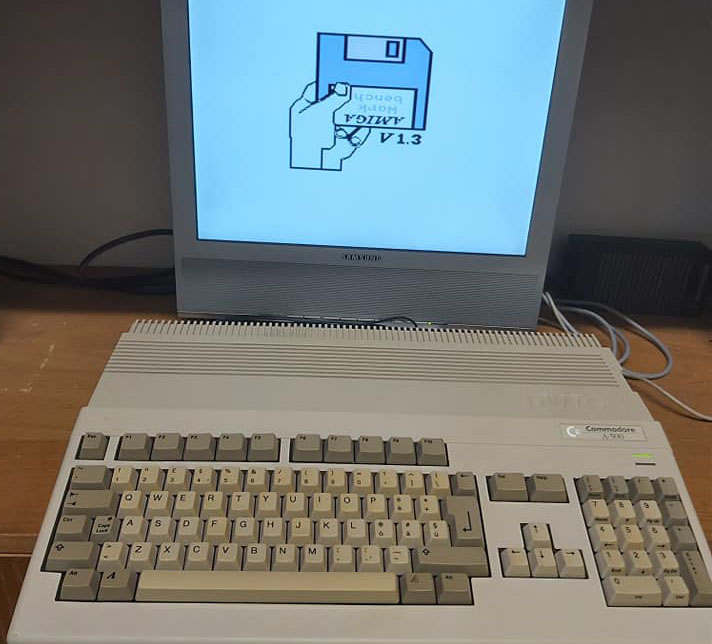
The Amiga 500, also known as the A500, is the first low-end version of the Amiga home computer. It contains the same Motorola 68000 as the Amiga 1000, as well as the same graphics and sound coprocessors, but is in a smaller case similar to that of the Commodore 128.
Commodore announced the Amiga 500 at the January 1987 winter Consumer Electronics Show – at the same time as the high-end Amiga 2000. It was initially available in the Netherlands in April 1987, then the rest of Europe in May. In North America and the UK it was released in October 1987 with a US$699/£499 list price. It competed directly against models in the Atari ST line.
The Amiga 500 was sold in the same retail outlets as the Commodore 64, as opposed to the computer store-only Amiga 1000. It proved to be Commodore's best-selling model, particularly in Europe. Although popular with hobbyists, arguably its most widespread use was as a gaming machine, where its graphics and sound were of significant benefit.
Amiga 500
.jpg)
.jpg)
.jpg)
.jpg)
.jpg)
.jpg)
This set consisting of an Amiga 500 and an original monitor from the 80s was donated by Federica Grillo!

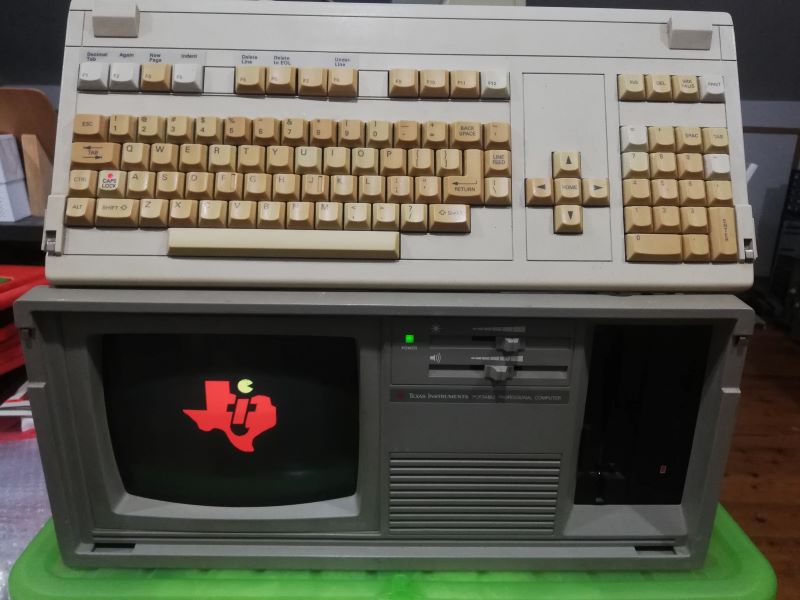
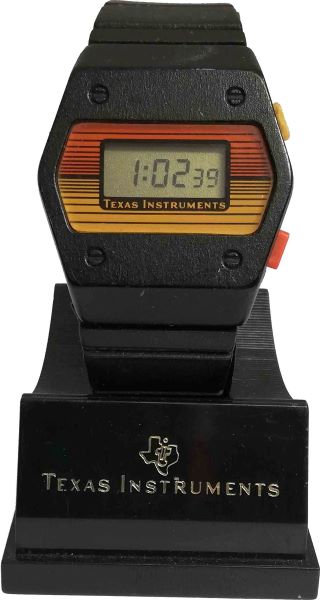

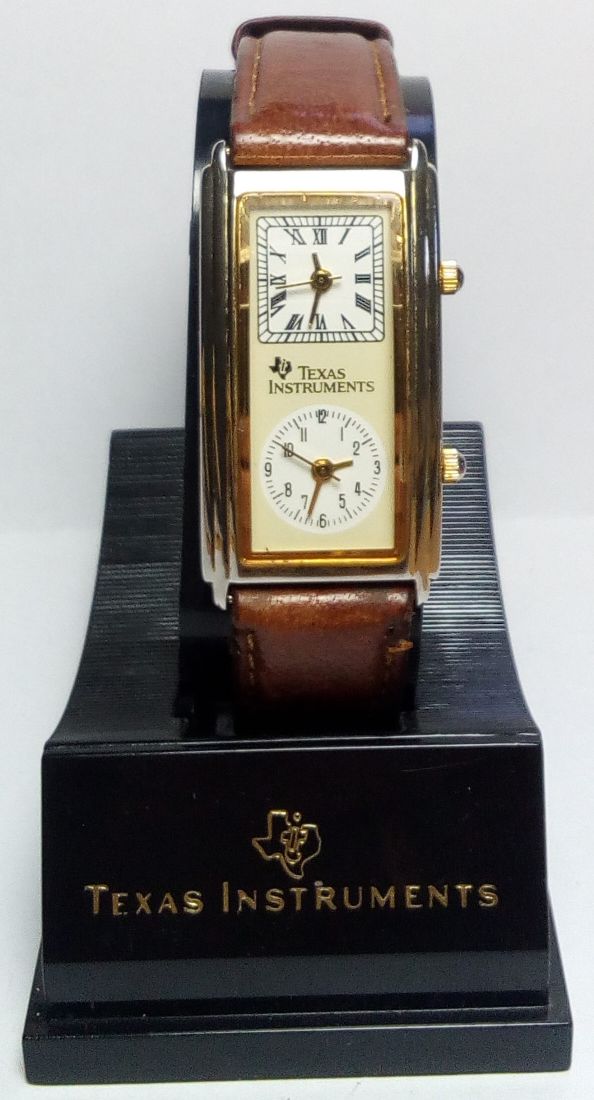
.jpg "Core Module Watch")

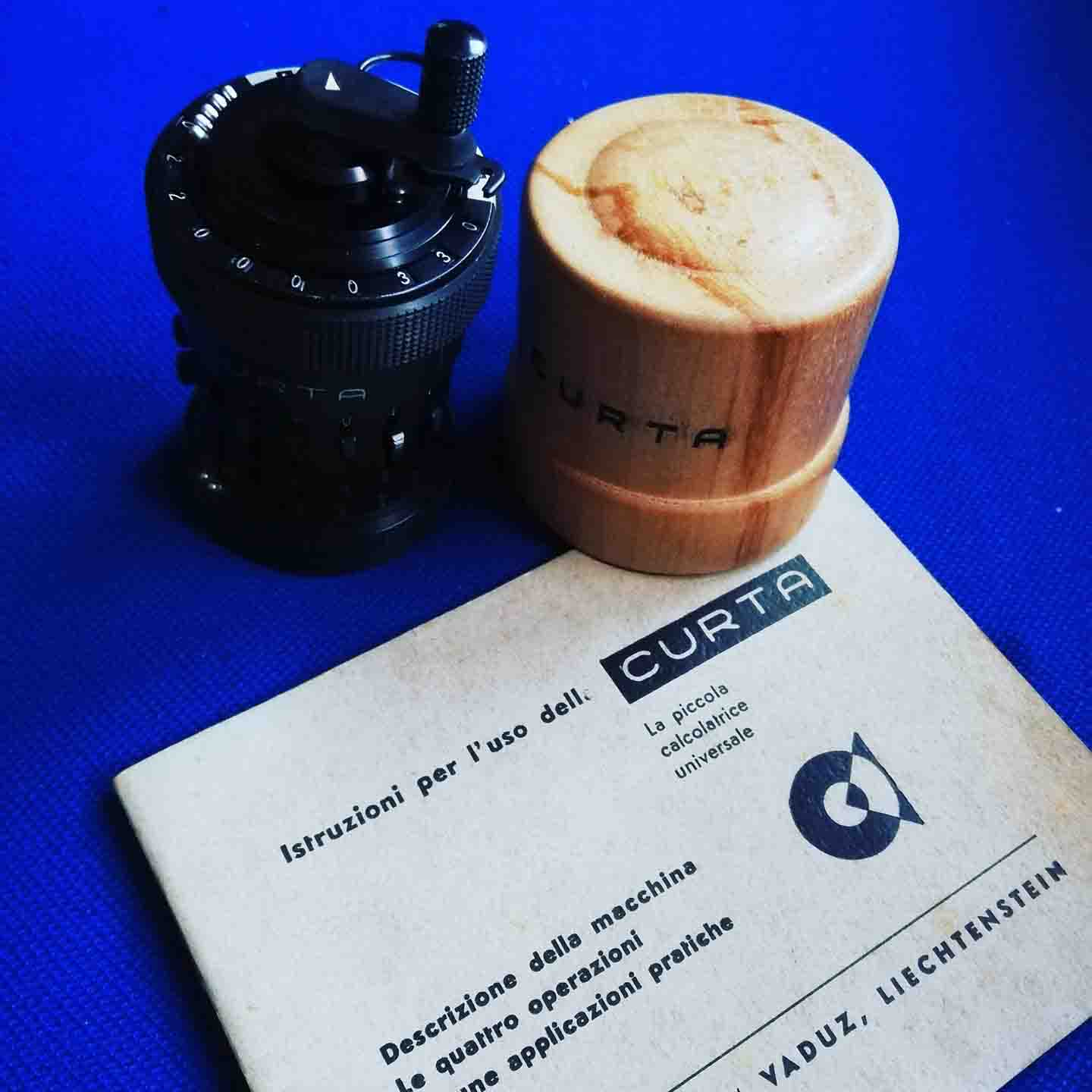
.jpg "Calculator Fuller")

.jpg "Olivetti Valentine")
.jpg "Console / Games")
.jpg "Battle Star Galactica")
.jpg "APPLE")


.png)